





The atmosphere inside Montreal’s Bell Centre has always possessed a secular, almost spiritual reverence, a place where the ghosts of hockey’s past seem to hover just above the pristine sheet of ice. This sacred ice was where Claude Lemieux began his journey into professional sports history, making it profoundly poetic that one of his final public appearances occurred on this very stage ahead of Game 3 of the Eastern Conference Final. Stepping out under the rafters, Lemieux carried the ceremonial torch, a flame representing the passing of passion and duty from one generation of Montreal Canadiens to the next, while the crowd roared in recognition of a man who had given his blood, sweat, and youth to their beloved franchise. Yet, only days after basking in the warmth of that hometown ovation, the hockey world was thrown into sudden mourning by the devastating news of his passing at the age of 60. The shocking loss of a figure so vibrant, so stubborn, and seemingly so invincible served as a stark reminder of the fragile mortality of our sporting heroes, leaving fans, former teammates, and even old rivals to grapple with the departure of a legendary warrior who left everything he had on the ice.
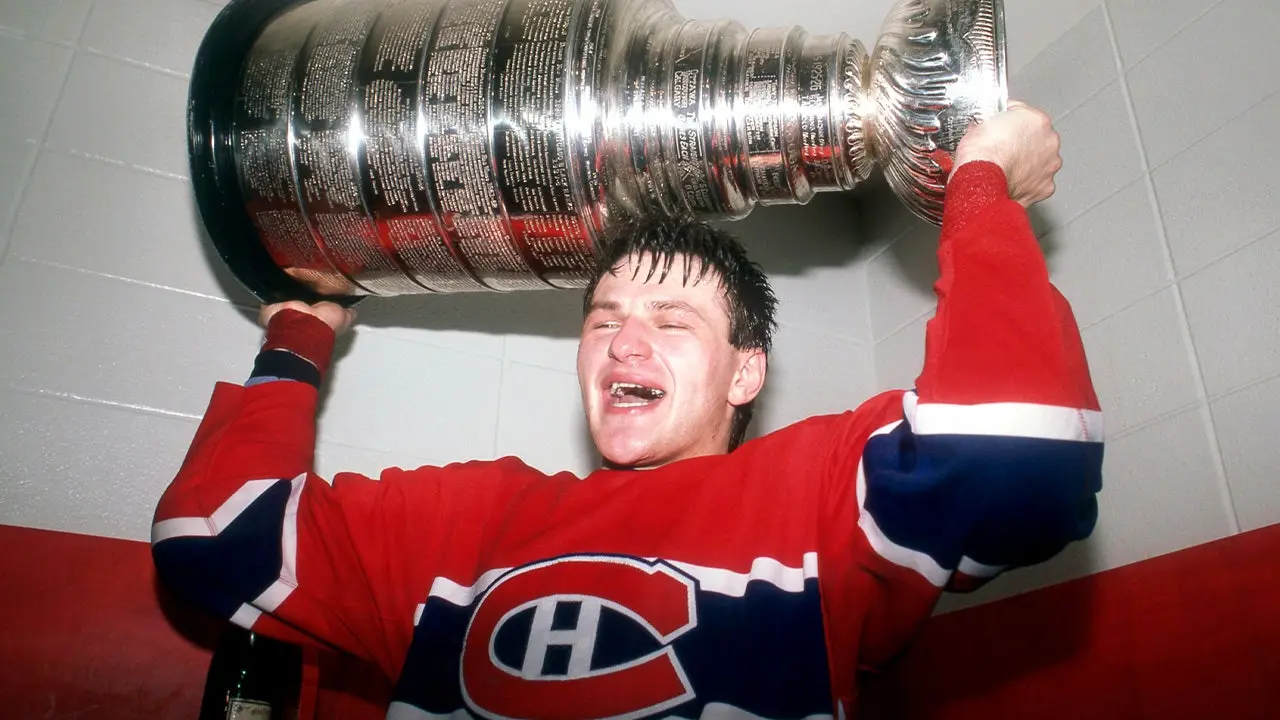
To understand Claude Lemieux is to understand the complex psychology of the hockey “pest,” a highly specialized, deeply polarizing role that Lemieux elevated to a masterclass of psychological and physical warfare. To his opponents and their fans, he was an absolute nightmare, an instigator who knew precisely how to get under the skin of the league’s most composed players, disrupting their rhythm and driving them to the brink of madness. Yet, to those who wore the same crest on their chests, Lemieux was an indispensable brother-in-arms, a clutch performer whose energy kept his team alive when all hope seemed lost. He broke into the NHL with the Montreal Canadiens, quickly proving that he was far more than an agitator; he possessed the raw skill and instincts of a natural goal-scorer, a talent he put on full display during Montreal’s historic 1986 Stanley Cup run. Over the course of his career, Lemieux would go on to win four Stanley Cups, cementing his legacy not as a mere distraction on the ice, but as a championship cornerstone who understood the precise alchemy required to win when the stakes were at their absolute highest.
The peak of Lemieux’s legendary status materialized in the mid-1990s, an era when his playoff performance transformed him from a feared competitor into an postseason myth. In 1995, he led the New Jersey Devils to a Stanley Cup championship, capturing the prestigious Conn Smythe Trophy as the playoffs’ most valuable player by scoring crucial, game-defining goals with an uncanny sense of timing. The following season, in an administrative twist that would alter the landscape of the NHL, he found himself traded to the Colorado Avalanche, where he immediately helped guide the franchise to its first-ever Stanley Cup in 1996. By doing so, Lemieux achieved a rare, historic milestone, becoming only the tenth player in the long history of the NHL to win back-to-back Stanley Cups with two completely different franchises. This period also cemented his central role in the infamous, blood-soaked rivalry between the Colorado Avalanche and the Detroit Red Wings, a feud that defined late-90s hockey and showcased Lemieux as a man who welcomed the heat of the fire, never backing down from the physical and emotional toll of championship-level hockey.
As the years rolled on and the physical wear and tear of his aggressive playing style accumulated, Lemieux’s journey became one of remarkable grit and longevity, spanning 1,215 regular-season games across multiple franchises including Montreal, New Jersey, Colorado, Phoenix, Dallas, and San Jose. When he initially walked away from the sport in 2003, many assumed his chapter had closed, but Lemieux possessed a restless competitive hunger that refused to be easily quieted. In 2009, at the age of 43, when most players of his generation had long settled into quiet retirement, he embarked on an improbable and physically grueling comeback with the San Jose Sharks, defying age and standard hockey wisdom to prove he still belonged on the ice. This late-career crusade was not about chasing statistics or money; it was a deeply human pursuit, an athletic love affair with a game that he simply could not leave behind until he had extracted every single drop of competitive joy from his aging body.
After finally hanging up his skates for good, Lemieux transitioned into the business side of the sport, channeling his vast knowledge of the game’s internal dynamics into a career as a player agent. In a beautiful twist of competitive irony, the man who had spent decades terrorizing goaltenders became a trusted ally, protector, and representative to one of the league’s elite netminders, Carolina Hurricanes goaltender Frederik Andersen. This professional relationship set the stage for a cinematic moment during his final appearance at the Bell Centre, where Lemieux stood as the symbol of Montreal’s historic legacy, while his client, Andersen, sat at the opposite end of the ice defending the Hurricanes’ net. This intersection highlighted the quiet evolution of Lemieux’s life, demonstrating how the fierce, combative villain of the 1990s had grown into a respected mentor, statesman, and guardian for the modern generation of hockey players, bridging the gap between his era of raw physical hockey and the highly strategic, business-oriented today.
Ultimately, the tragedy of Claude Lemieux’s passing is felt not just in the records he left behind, but in the living legacy that carries his name forward into the future of the sport. The Lemieux hockey DNA runs deep, exemplified by his brother Jocelyn, who carved out a respectable career playing in nearly 600 NHL games, and his son Brendan, who has carried the family’s signature gritty playing style through more than 300 NHL contests of his own before taking his talents to Switzerland’s historic HC Davos. Beyond the box scores, the Stanley Cup rings, and the highlight reels of old rivalries, Claude Lemieux was a husband, a father, a teammate, and a friend whose larger-than-life personality filled every room he entered. As the hockey community comes together to mourn his untimely departure, they remember a man who lived his life with an uncompromising intensity, a player who taught us that greatness often requires us to embraces our flaws, push boundaries, and play with a heart so big that even the coldest sheet of ice could never hope to freeze it.