


The Unfinished Business in Pittsburgh: A Story of Legacy, Money, and the Gridiron
The sweltering heat of a Pittsburgh summer hung over the UPMC Rooney Sports Complex like a thick, anxious blanket. The air, typically filled with the sharp cracks of shoulder pads and the guttural calls of practice, was instead charged with a different kind of energy—a tense, bewildered silence that followed the news of a contract dispute. With the season opener against the Atlanta Falcons less than three weeks away, the Steelers’ most promising defensive cornerstone, cornerback Joey Porter Jr., was not on the field. He was on the physically unable to perform (PUP) list, a designation officially attributed to a back issue that flared up during a routine mobility test. But as head coach Mike McCarthy stood before a bank of microphones, his weathered face betraying a mix of pragmatism and deep-seated concern, the truth was as clear as the Ohio River on a cloudy day. This wasn’t about a dodgy spine. This was about leverage, pride, and the brutal, unromantic business that has always coexisted with the poetry of football. McCarthy, who had only recently taken the reins in the Steel City, expressed his genuine desire to get his star defender back on the grass, but he also knew the distant horizon of a new contract was a mountain that couldn’t be scaled with a simple play call. “I want the chance to work with Joey, to dial up schemes with him in coverage,” McCarthy stated, his voice carrying a hint of a coach who knows his game plan is incomplete without his chief weapon. “When that chance arrives,” he paused, scanning the room, “is anyone’s guess—myself and the front office included.” The impasse was real, a wall of fiscal figures and perceived value standing between an organization and its prodigal son.
McCarthy, a veteran of the NFL’s long, often acrimonious offseasons, has seen this dance a thousand times. He understands the delicate ecosystem of a locker room where contracts are the dividing line between men who feel honored and those who feel disrespected. The official diagnosis of a back issue was a convenient shield, a medical smokescreen that allowed both sides to save face while the real negotiation happened in private suites and phone calls. But McCarthy was not naive. He recognized Porter’s holdout—or rather, his “hold-in,” a modern tactic where the player reports but participates only in individual drills, refusing the risk of full 11-on-11 contact—as a calculated message. “I learned this early in my career as a head coach,” McCarthy reflected, his eyes looking past the reporters to the empty practice field where Porter should have been intercepting passes. “You have to separate the business side of this league from the football side. Sometimes that separation is easier than others. Right now, it’s particularly difficult.” The weight of his words hung in the humid air. He was not just a strategist missing a cornerback; he was a leader trying to mend a fractured relationship between a player who wants to be paid like a top-tier star and a franchise that prides itself on financial discipline. The “back issue” was, in reality, the pressure of an expiring rookie contract, the fear of a career-altering injury before securing long-term wealth, and the gnawing anxiety of watching his peers cash in while he waited in limbo. For McCarthy, the challenge wasn’t just defensive alignment; it was managing the fragile ego of a young man fighting for his legacy, all while trying to install a new defensive system with a coaching staff that was themselves only learning how to work together.
To understand the magnitude of this standoff, one must look at Porter’s roots, which run deeper than the foundation of Acrisure Stadium. Joey Porter Jr. is not just another talented defensive back; he is the son of Joey Porter Sr., a legendary Steelers linebacker whose ferocious play and larger-than-life personality are part of the franchise’s folklore. Growing up in Pittsburgh, Porter Jr. walked the same hallways, heard the same cheers, and felt the same expectations as his father. He was the hometown kid who never let his heritage become a burden, but instead used it as fuel to forge his own path. After being drafted in the second round of 2023 with the 32nd overall pick, he was a tantalizing prospect—long, physical, and boasting the rare ability to erase an opponent’s top receiver from the game. In his third season, that potential exploded into tangible production. He finished with three interceptions, broke up 14 passes, and terrorized quarterbacks across the league. He was no longer a prospect; he was a cornerstone, a shadow that haunted wide receivers’ dreams. Yet, his contract did not reflect that ascension. He was entering the final season of his four-year rookie deal, still earning a fraction of what his impact was worth. The market had exploded around him. Seattle’s Devon Witherspoon had just signed a massive extension, and New England’s Christian Gonzalez had been given a lucrative offer, setting the bar for the league’s top young corners. Joey Porter Jr. looked at those numbers, looked at his own tape, and knew he belonged in that conversation. He was coming off his best year, his confidence soaring, and he had told reporters in June that he believed he was one of the top players at his position, deserving of a payment that reflected that elite status. Although he might not have reached the astronomical figures of the absolute top of the market yet, he believed he was standing on the precipice. For a player with his pedigree, the silence from the front office was a slight he could not ignore.
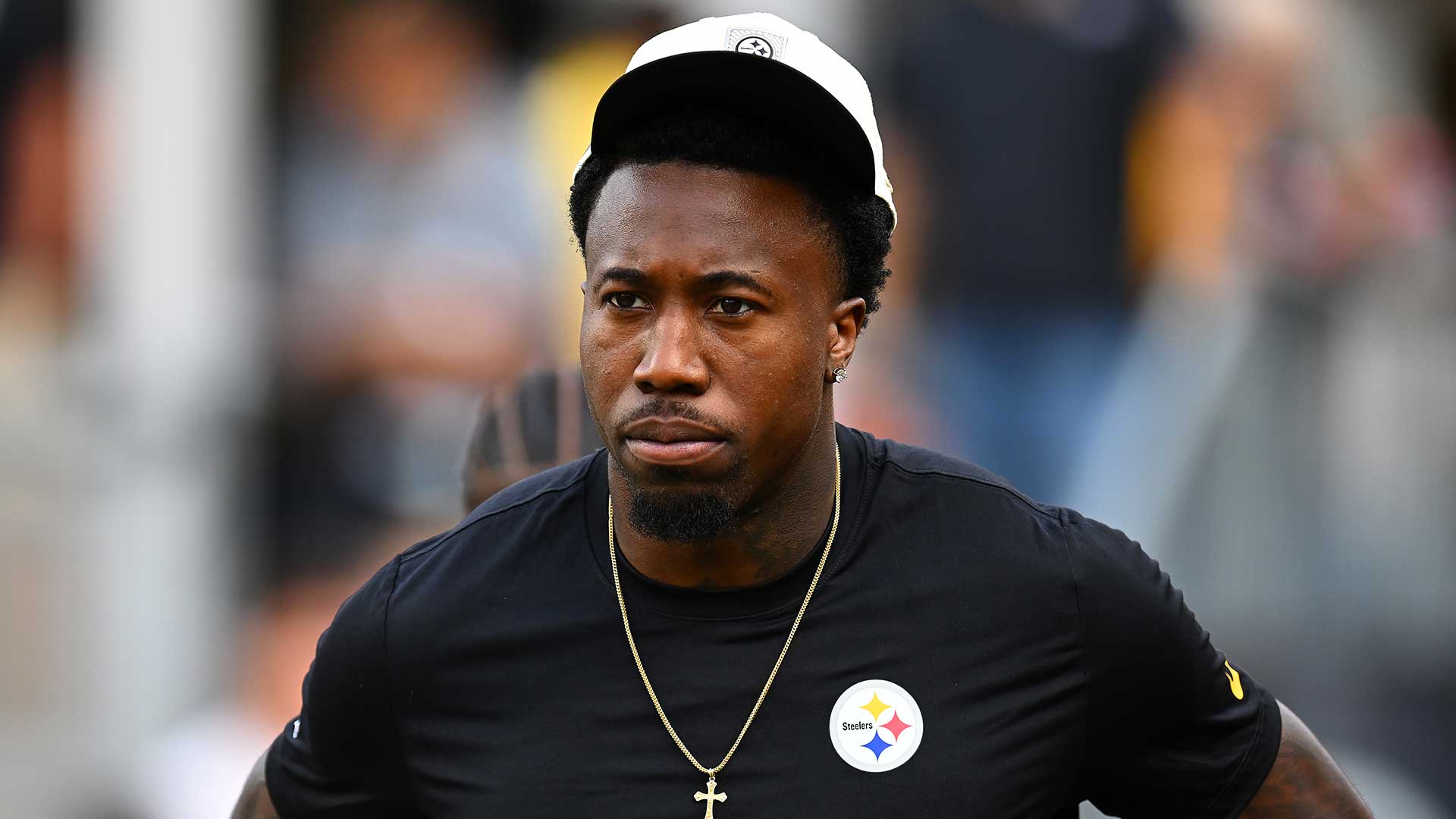
The emotional toll of this stalemate is a story that rarely gets told between the lines of a playbook. For Porter, the decision to sit out was not made lightly. He is a competitor, a fighter who craves the adrenaline of a Sunday afternoon collision. Every day he stands on the sideline in a baseball cap and shorts, he feels a piece of his identity erode. He watches his teammates grind through drills, and his hands itch with the urge to jam a receiver at the line of scrimmage. The back issue, while likely a real, residual tightness, was amplified by the mental stress of his financial future. He is essentially “holding in”—practicing only in a limited capacity, enough to maintain his conditioning but avoiding the high-impact contact that could jeopardize his leverage. It’s a gambler’s move, a high-stakes bet that his talent is too valuable for the organization to let him walk. But it also pains him because of his deep emotional ties to the city. He wore the black and gold for his father, for the fans who chanted his name at Penn State and at Heinz Field. He wanted to be here. He wanted to be the next great Steelers defender, the heir to the legacy of Rod Woodson and Troy Polamalu. Now, he finds himself on the outside looking in, isolated by the very business that brought him to this point. “It’s just that he has this deep sense of belonging,” one unnamed teammate confided. “He’s not doing this to be a distraction. He’s doing this because he feels he’s earned the right to be here, fully, without financial doubt. He wants to be the man, but he also wants to be respected like the man.” This duality—of pride and loyalty—makes the standoff heartbreaking. He is not a mercenary; he is a son of the soil, and the conflict feels like a family feud, where both parties love each other but cannot agree on the value of the relationship.
For the coaching staff, led by Mike McCarthy, this situation is a crucible of leadership. The defensive staff is entirely new, a fresh collective of minds trying to install a complex scheme on the fly. They need their best defensive player on the field to teach, to set the tempo, and to communicate the nuances of the playbook. McCarthy acknowledged the difficulty, stating, “We have a new defensive staff for the first time here, and they’re working through the install process. It’s a challenge to do that when your top corner is in street clothes.” He is trying to maintain a positive atmosphere, but the absence weighs heavily on the defense. Veteran safety Jalen Ramsey, a future Hall of Famer and a player who has seen his own share of contract battles, returned to the practice field on Monday after recovering from a knee injury. Ramsey, who knows the value of a dominant corner, made an impassioned plea to the organization. “They need to pay Joey Porter,” Ramsey declared to the gathered media, his voice firm and laced with veteran authority. Ramsey understood that Porter’s presence not only elevated the secondary but also allowed him to play more freely, to jump routes and take risks knowing that Porter’s shadow was erasing the second receiver. Ramsey’s return was a boost, but his words highlighted the fact that without Porter, the defense was only a shell of what they could be. Meanwhile, rookie first-round offensive tackle Max Iheanachor, who had been on the sidelines since August 6 with an upper body injury, also returned to practice. Iheanachor’s return gave the offense a tangible boost, but his progress was a subplot to the main drama. McCarthy was cautiously optimistic about Iheanachor, noting that they have two padded practices this week before a preseason finale in Buffalo on Thursday night. “It will be a great indication of where he is physically. We’ll see how much he can go,” McCarthy said, momentarily shifting the focus from the Porter saga to the necessity of finalizing the 53-man roster.
As the sun began to dip below the horizon of the Pittsburgh skyline, the unresolved question remained. The preseason game in Buffalo loomed as a partial answer, a venue where the defense could start to solidify their identity, but the identity will remain incomplete as long as Joey Porter Jr. is watching from the sidelines. McCarthy ended his press conference with a philosophical shrug, stating, “Every man on this roster has a contract, and the organization has beliefs they need to uphold. We are where we are. We have to focus on those who are ready to go.” But the subtext was undeniable. The upcoming game is a test for the depth, but the real test is a test of wills between a desperate young star and a resolute front office. For Porter, this isn’t just about money; it’s about validation. He has spent his entire life fighting to be recognized as more than just “Joey Porter’s kid.” He has proven his worth on the field, and now he demands the financial respect that accompanies that proof. For the organization, it’s about fiscal sanity and avoiding the trap of paying a player based on potential rather than guaranteed longevity. Yet, in the complex, human crucible of the NFL, these abstract principles collide with the flesh-and-blood reality of a young man who wants to secure his future while honoring the city he loves. The season is approaching, the crowds are ready to roar, but the true battle is being fought in a quiet, dimly lit office where the phone rarely rings. For Joey Porter Jr., for Mike McCarthy, and for the entire Steelers nation, the wait is a painful, torturous limbo, a reminder that football, at its very highest level, is always more than just a game—it is a messy, beautiful, and often agonizing affair of the heart and the wallet. The story is far from over, and the next chapter will be written under the lights of Atlanta, whether the prodigal corner is fitted for pads or left to watch from his living room. Only time, and a signature on a contract, will tell.