


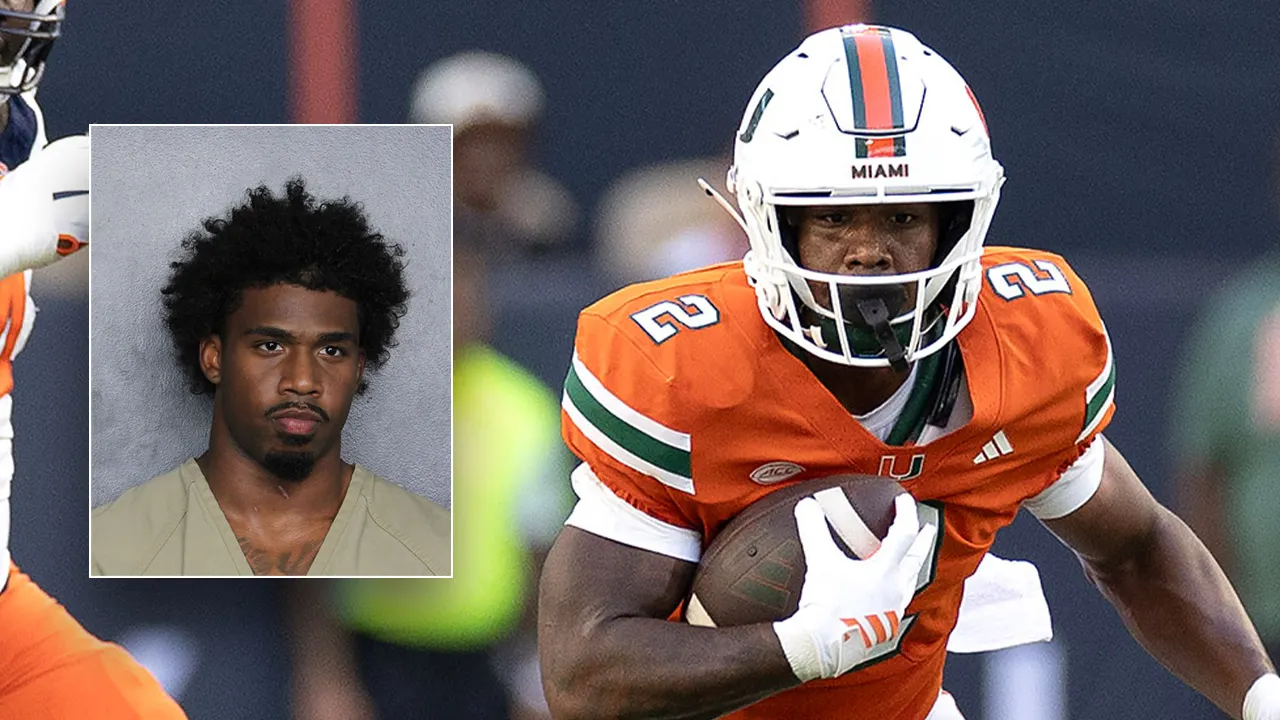
The college football world is often defined by sudden ascents and equally sudden, jarring descents. For Jordan Lyle, the promising 20-year-old running back for the Miami Hurricanes, the trajectory of his junior season hit a devastating roadblock not on the gridiron, but in the thin, unforgiving air of a jailhouse booking. On Thursday, news broke that Lyle was arrested in Broward County, Florida, facing a felony complaint of aggravated fleeing or eluding law enforcement. The legal language paints a grim picture: he is accused of driving with “a wanton disregard for the safety of persons or property” and “willfully” attempting to evade police. What began as what should have been his breakout year—a year earmarked for stardom following his explosive freshman debut—has instead devolved into a legal quagmire that threatens not only his season, but his freedom, his scholarship, and his future in the sport he loves. The stark contrast between the height of his athletic promise and the depth of this legal predicament is almost too obvious to ignore, a sobering reminder of how precarious the lives of young athletes can be when they step outside the white lines of the field and into the responsibilities of the real world. The charge itself is not a minor traffic infraction; in Florida, aggravated fleeing and eluding is a third-degree felony, carrying potential penalties of rigorous jail time, substantial fines, and a permanent criminal record that will follow him long after his football cleats are hung up. The very nature of the accusation—that he drove in a manner that endangered lives—suggests a moment of sheer panic or reckless bravado, a decision that could have ended in tragedy for himself or innocent bystanders. For a team coming off a championship appearance, this is a chaotic distraction that threatens to undermine all the hard work put in during the offseason.
The University of Miami’s official response has been predictably terse, a standard legal carving of words meant to shield the institution from premature judgment. “We are aware of an incident involving student-athlete Jordan Lyle. As due legal process runs its course, we will have no further comment at this time,” the program stated. This boilerplate statement, however, masks the profound level of internal turmoil. For coaches, the arrest of a starter is a logistical nightmare; for teammates, it is a betrayal of trust; for the athletic department, it is a public relations minefield. Lyle’s legal woes extend far beyond the courtroom. In the modern era of college athletics, a felony arrest often triggers immediate internal investigations under the school’s code of conduct, pending the outcome of the criminal case. This usually means an immediate suspension from team activities, stripping him of practice time, meeting time, and the essential chemistry that builds with his offensive line. Furthermore, the NCAA’s transfer portal and NIL landscape are unforgiving. Lyle was projected to be a vital cog in Miami’s offense, potentially splitting carries or even challenging the starter for the top spot. Now, potential NIL deals—endorsements, local appearances, and sponsorships that rely heavily on a clean public image—are likely evaporating or are on hold. The financial and developmental setback is staggering. At twenty years old, Lyle must now face the harsh reality that his athletic brilliance is secondary to the criminal complaint against him, and every headline, every social media post, and every news segment will scrutinize not his yardage or his acceleration, but his mugshot and the details of his alleged high-speed flight. For the Canes, who are entering the fray of a brutal ACC schedule with high hopes, this incident drains valuable focus from the locker room. Head coach Mario Cristobal is a disciplinarian who preaches character and accountability; he now has to balance his paternal concern for Lyle’s well-being with the stringent demands of a program that cannot afford off-field distractions. The legal process itself will be arduous; Lyle will need to secure competent legal counsel, navigate arraignment hearings, and face the uncertainty of bail conditions, electronic monitoring, or supervised release. While he is presumed innocent until proven guilty, the court of public opinion is swift and merciless. The physical toll of the arrest—the stress, the endless phone calls to lawyers and family—will inevitably weigh on him as he tries to stay in shape, though he may not even be allowed to use team facilities depending on the suspension rules. This is more than just a blip; it is a fissure in the foundation of his career.
To understand the tragedy of this arrest, one must look at the sheer, unfulfilled potential that Lyle brought to Coral Gables. His freshman season was a tantalizing glimpse of a future superstar. In just 12 games, he carried the ball 54 times and amassed 400 yards—an astronomically impressive 7.4 yards per carry—and found the end zone four times. His explosive burst and vision made him a fan favorite and a nightmare for opposing defenses. However, the sophomore campaign was a cruel, drawn-out battle against his own body. He appeared in only six games, serving as a backup to the ACC’s leading rusher, Mark Fletcher Jr. The trouble began early: in Miami’s very first game of the season, Lyle suffered an injury. The initial optimism was that it was minor, but the ailment proved to be stubborn and persistent. He attempted to come back several weeks later, but the spark was clearly missing. His burst was hampered, his cutting was labored, and he was limited to never playing more than eight snaps upon his return from the sideline. By November 8th, during the game against Syracuse, the coaching staff made the difficult decision to shut him down entirely. His final statistics for that frustrating year were a shadow of his capability: 35 carries for a meager 108 yards and just a single touchdown. The silence that followed his injury was deafening. He had to watch from the bench as his teammates competed for a championship, knowing that his body had betrayed him at the worst possible moment. The emotional toll of that kind of season—the grueling rehab sessions, the whispers about fragility, the pressure to prove he wasn’t a bust—is immense. For a young man who had tasted glory in his first year, sitting out and struggling through the grind of recovery is a humbling, isolating experience that often tests an athlete’s mental fortitude more than any physical opponent ever could. It is against this backdrop of physical rehabilitation and mental distress that we must view Lyle’s mindset entering this offseason. He was not just running to get back into shape; he was running to reclaim his identity, to prove that the 7.4 yards-per-carry freshman was still alive and capable of carrying the load.
Nothing makes the timing of Lyle’s arrest more heartbreaking than the effusive praise he received from his head coach just two days prior. On Tuesday, after a practice session that had glowing reviews from insiders, Coach Mario Cristobal was beaming with optimism about his young running back. “I see the Jordan Lyle that we saw a year ago in many respects, but with better physical traits,” Cristobal told reporters. “He is healthy now, which I think is a really important part. I don’t think people really knew the extent of how banged up he was last year and we see the full speed player now. I am really excited about him.” Cristobal further elaborated, noting that Lyle had taken his strength and conditioning supremely seriously, resulting in marked improvements in his change of direction, acceleration, and deceleration rates. These are not throwaway compliments; in the high-stakes world of major college football, a coach’s public endorsement of this caliber signifies a player on the precipice of a breakout. Cristobal was essentially telegraphing to the ACC that Lyle was back and ready to terrorize defenses. The imagery is stark: a player finally feeling 100% healthy, his body responding to his will, his legs churning with renewed power during practice, only to watch that hard-earned progress evaporate in the rearview mirror of a police chase. The irony is cruel and biting. The “full speed player” that Cristobal was so excited about demonstrably showed that speed to the authorities, albeit with a reckless twist that completely undermined his professional standing. This juxtaposition highlights the razor-thin line between redemption and ruin for young athletes. One moment he is being praised as a cornerstone of the team’s future, soaring with confidence; a few days later, he is staring at a felony charge, his promising trajectory halted. The coach’s words now hang in the air as a painful, haunting reminder of what could have been—a memorial to a potential that has been placed under a dark cloud. For Lyle, the memory of that Tuesday, the pride he felt in his coach’s praise, must now feel like a distant, mocking echo in the cold, stark setting of a police station.
The “why” behind the alleged decision to flee is the most humanizing, yet difficult, aspect of this story. For a 20-year-old, the instinct to hit the gas when blue lights flash in the rearview mirror is often a cocktail of raw panic, poor judgment, and a desperate, irrational hope that they can outrun the consequences of whatever they did right before. Whether Lyle was speeding, had a suspended license, or was simply terrified of being pulled over for a minor infraction that could jeopardize his meticulous training, his alleged choice to disregard the safety of others to evade police illustrates a catastrophic lapse in executive function. The pressures of being a high-profile athlete can warp a young person’s sense of reality. They are constantly surrounded by an entourage, told they are special, and insulated from normal consequences. This bubble often leads to a feeling of invincibility—the reckless belief that traffic laws, curfews, and police orders don’t apply to them. However, the road does not care about recruiting rankings, and the law does not distinguish between a starting running back and an average citizen. It is crucial to remember that Lyle is more than just a statistic or a rap sheet. He is a kid who has dedicated his life to a punishing sport, who has bled for his team, who has suffered the emotional agony of watching his body fail him, and who has likely spent countless lonely hours rehabbing. The demon of fear, the ego of youth, and the high-octane environment of celebrity combine to create situations where a split-second decision to flee becomes a life-altering choice. This is not to excuse his alleged actions—driving with wanton disregard is an egregious offense that could have killed someone—but to understand is to see the complex, frightened human being inside the helmet. He likely wasn’t thinking about the felony charge; he was thinking about the horrible shame of being arrested, the disappointment in his coach’s eyes, and the immediate destruction of the dream he has chased since he was a child holding a football for the first time. His family, who have supported him through every tackle and every setback, now face the added horror of receiving calls from lawyers instead of proud texts about practice reps. This is a nightmare scenario for any parent, and the weight of that reality will rest on his shoulders as he asks them for forgiveness while simultaneously preparing a legal defense.
Looking forward, the road ahead for Jordan Lyle is steep and uncertain. The judicial system will run its course, and until then, his football career is effectively in limbo. He will likely face a team-imposed suspension immediately, perhaps missing critical games or the entire season. The university’s Office of Student Conduct will conduct its own review, which can result in sanctions independent of the criminal courts. Depending on how the case unfolds, he might face plea negotiations, probation, or potentially, worse. But regardless of the legal outcome, the reputational damage is done. On the field, Miami must now recalibrate its offense without its most explosive returning weapon, forcing other backs into the spotlight. Off the field, Lyle has to grapple with a profound identity crisis. He is no longer just “the bright future of the Miami backfield”; he is “the guy who fled from the police.” Yet, this does not have to be the end of his story. American sports culture is uniquely forgiving of athletes who show genuine remorse and take accountability. If Lyle can accept responsibility for his actions, undergo whatever counseling or community service is mandated, and return to the discipline of the game he loves, he could still salvage his career—though it would take years to rebuild the trust he has broken. For now, the noise is loud, the headlines are harsh, and the future is dim, but a person’s character is not defined solely by their worst mistake, but by how they rise from the ashes of it. As he stands on the precipice of a very dark valley, Lyle must dig deep to find the same resilience he discovered on the training table during his injury-plagued sophomore year. The football field gave him everything; it can give him a path to redemption, but only if he has the wisdom and courage to walk off the accelerator, face the music, and prove that he is more than the felony charge that temporarily bears his name. For a young man with so much to give, the hope is that this terrifying detour becomes the harsh lesson that ultimately saves him from an even darker fate. Time will tell if he can turn this ruin into a foundation for a new, wiser—and slower—chapter of his life.