


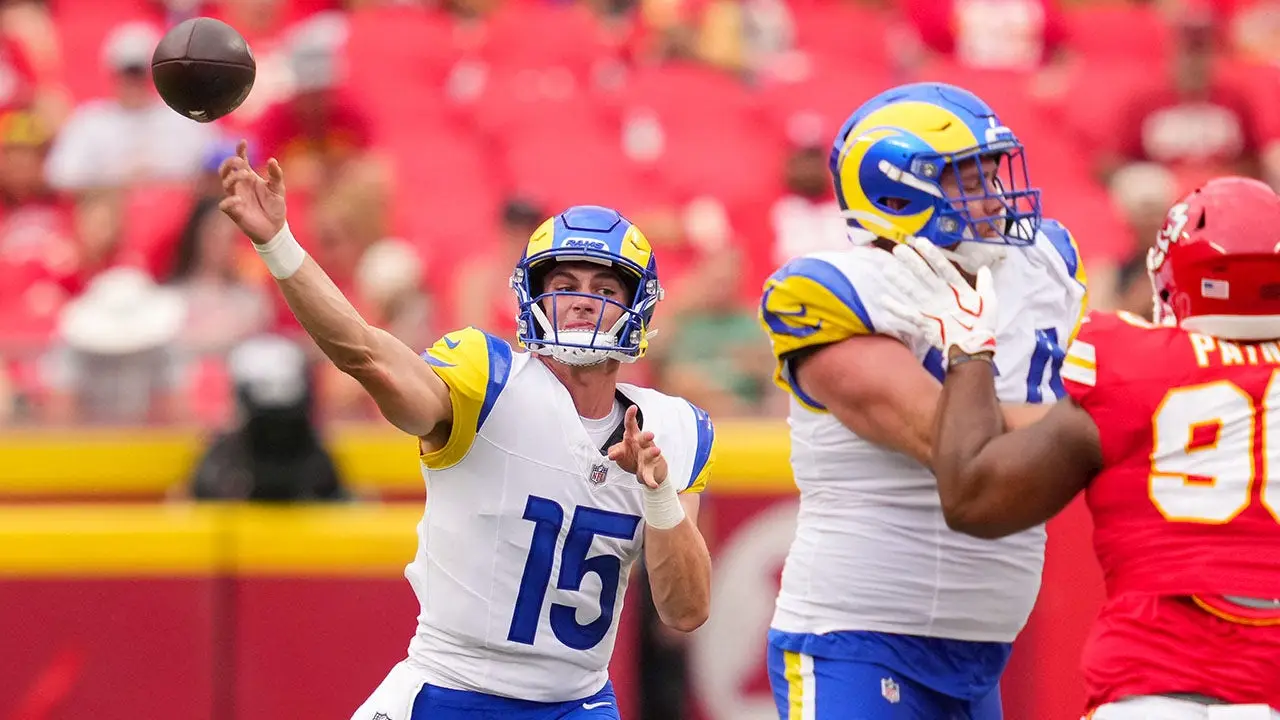
There are moments in sports that feel less like a debut and more like a homecoming, and Ty Simpson’s first NFL action had that strange, warm glow. It happened on a Saturday afternoon, in a Los Angeles Rams uniform, against the Kansas City Chiefs, one of the most explosive and intimidating teams in the league. Simpson is a rookie, raw and still learning, and the spotlight should have been too bright. But before the game, his father, Jason, sent a text that turned everything back to the beginning. “My dad just talked to me like I was four years old again,” Simpson said. “He told me to catch every snap, make the easy ones easy, go do what you love, and I love you.” Those words, simple and tender, carried more weight than any playbook. Simpson went out and did exactly what his father asked. He caught every snap. He made the easy throws look effortless. And he played with the loose, free feeling of a kid who just wanted to be out there. It was a stunning introduction, especially because the moment could have overwhelmed him. The Chiefs are a measuring stick. The Rams are a team with Super Bowl aspirations. And Simpson, a first-round pick, was expected to be patient and wait his turn behind a future Hall of Famer. But on this particular Saturday, in the strange and quiet world of the preseason, he reminded everyone why Los Angeles invested in him. He didn’t just survive. He seemed at home. There was no panic in his eyes and no hesitation in his feet. When he dropped back, he looked like he belonged. When he walked off the field, with the praise of his coach ringing in his ears, he carried the quiet confidence of a young man who knew exactly where he came from and where he was going. The text message from his father was still on his phone, a small anchor in the middle of a whirlwind, and that anchor made all the difference.
The numbers tell the story of a guy who played like he had been in the league for a decade. Simpson, after watching Stetson Bennett handle the first quarter, entered the game and immediately took control. He completed 21 of 25 passes for 190 yards, threw two touchdown passes, did not turn the ball over, and posted a sparkling 125.0 passer rating. This was, by any reasonable measure, a nearly perfect afternoon for a rookie making his professional debut. Coach Sean McVay, a leader not known for empty praise, had trouble hiding his excitement. “It was a really good day for him,” McVay said. “I just felt like he was in good command and it was cool to see a good smile on his face.” That smile mattered just as much as the statistical efficiency. In the often tense, hyperanalyzed world of quarterback development, a happy rookie playing free and confident is a wonderful sight for a coaching staff. But the wise old football heads will tell you to slow down. They will remind you that the preseason does not present the truth; it lies. It is a shimmering illusion where August stars can burn out by October and end up waiting tables. That is true, and it should be remembered. Simpson is not going to be waiting tables, because his roster spot is secure, but the caution still stands: one shiny afternoon against a diluted defensive scheme does not make a career. So let us offer the proper dose of temperance. Holy moly, Simpson looked like a stud. Holy moly, the Rams might have found something special. And then let us return to the necessary patience, because the kid still has plenty of work to do before he can truly be called the answer.
This is also a moment to remember that the draft critics got it wrong, or at least have so far. There was a long list of analysts, from Bucky Brooks at NFL Network to many voices at ESPN, who questioned whether Simpson was worthy of a first-round pick. They looked at his college tape and saw limitations. They said his arm is not special. They said his deep ball accuracy is unreliable. They said he struggled under pressure and pointed to a late-season regression at Alabama as evidence. The skeptics had enough film to support their concerns, because Simpson was not always flawless with the Crimson Tide. He sometimes held the ball too long, sometimes missed the deep shot, sometimes let the moment speed him up. But there was also Dan Orlovsky, a former quarterback turned analyst who remained a vocal believer, and there was the Rams organization itself. The Rams ignored the noise. They drafted Simpson in the first round with the long-term vision of making him Matthew Stafford’s eventual replacement. That plan became even clearer when Stafford, the reigning NFL MVP, signed an extension worth up to $60 million with incentives. That move did not sound like a team in panic. It sounded like a franchise that wants to win now with Stafford while quietly building a bridge to the future. And in the opener, Simpson justified the faith of those who believed in him. He did not do it by being perfect. He did it by showing the kind of calm command that no combine drill can measure. The draft gurus can rewatch the Alabama tape all they want. But when the lights came on, when the pads went on, when the opponent was actually trying to hit him, Simpson looked like a first-rounder. It was only one game, of course, and the Rams are still a long way from handing him the keys. Yet for one afternoon, the organization looked a lot smarter than the noise surrounding him.
What made the performance even more meaningful was the context. Simpson entered after Bennett, who had played the entire first quarter, and his reps came against a mix of Kansas City’s second and third stringers. That should not entirely diminish what he did, because he still had to read defenders, manage pressure, and execute an NFL game plan. Simpson moved through his progressions with poise. He delivered the ball with touch on short and intermediate routes. He made a few throws that required real anticipation and arm strength, not just wide-open hitch routes. His two touchdown passes were crisp, confident strikes that showed he was reading coverage rather than simply trusting his athleticism. The quiet criticisms of his Alabama year were that he sometimes locked onto his first read or waited for a perfect pocket that never came. On Saturday, he got rid of the football decisively, trusted his legs when necessary, and seemed to understand exactly what the offense wanted from him. He was not perfect, and there were moments when he could have been more aggressive downfield. But the overall impression was that of a quarterback who belonged, a player who had learned from the criticism and was determined to prove his best football is still ahead. For a rookie making his debut in a stadium that can feel like a rock concert, with the Chiefs on the other side and cameras following every snap, he looked unbothered. That, perhaps, is the most encouraging sign of all. Mechanics can be cleaned up. Decision-making can be sharpened. But the inner calm, the ability to shake off the moment and simply play, is not something every quarterback has. Simpson appears to have that gift, and it is the kind of gift that cannot be taught.
Even in the middle of the celebration, McVay was careful to point out that Simpson is not finished. There was one particular situation, a third-down play that could have been bigger, where the rookie chose the safe option instead of the aggressive one. “There was one situation that will be a great learning opportunity on third down where they played a man coverage and [Simpson] threw it to the flat [instead of downfield],” McVay said. “I have to see it, but I think the pocket might have allowed him to progress.” That is coach-speak for: I want my young quarterback to stay in the pocket longer and take a shot downfield. It is a minor complaint, but it is a real one. The same coaches who celebrated Simpson’s efficiency will now begin to challenge him, because that is what good organizations do. The backup battle with Bennett is far from over. Bennett is a proven, rugged competitor who has won at the college level and made his own push for a roster spot, and he will not simply hand over the job. Simpson is the future, and the Rams want him to learn every lesson now so that when his time eventually arrives, he is fully prepared. It was also telling that after the game, McVay gave Simpson the honor of breaking down the team in the locker room. That is not something a coach does for a random rookie. That is something a coach does for a leader, or for a player he wants to grow into a leader. Simpson, in his first taste of NFL action, earned that trust in a single afternoon. It does not mean he has won the backup job. It does not mean he is pushing Stafford out the door. It means he is taking the right steps, one rep, one text message, one learning experience at a time.
For Simpson, all of this feels deeply personal. His father was not just a parent sending encouragement; he was a spiritual guide as well. “He sends me a Bible verse every time, just a quote, to give the glory back to Him,” Simpson said. “And it was just really cool, you know? When I have family members texting me, it’s a comforting feeling.” That faith has become an anchor for a young man navigating the difficult transition from college to professional football, from Alabama to Los Angeles, from being one of the most scrutinized players in the country to being a backup trying to earn the trust of a veteran coaching staff. The text messages are his way of staying grounded. They remind him that no matter how many touchdowns he throws or how high his passer rating climbs, the identity that matters most is not “NFL quarterback” but something deeper. It is the boy who grew up in a family that loved him, who learned to catch every snap, who made the easy ones easy, who heard his father’s voice in his heart whenever he needed it most. The Rams have a long-term plan for Simpson, but no one knows exactly how it will unfold. Stafford is still the MVP, still the starter, still the face of the franchise. The backup position is not guaranteed. The future is uncertain, as it always is in the NFL. But if Saturday taught us anything, it is that Simpson has something that cannot be measured with a stopwatch or a draft grade. He has an internal quietness, a sense of belonging that turns pressure into joy. He has his eyes on the field and his mind on something higher. He has a father who knows exactly what to say and a faith that carries him. That will not make every game perfect. But it is a beautiful foundation for a long journey, and as Simpson walked through the locker room with one professional game behind him, he was probably already thinking about the next lesson, the next rep, and the next message from home. The story is just beginning, and so far, it is a beautiful one.