


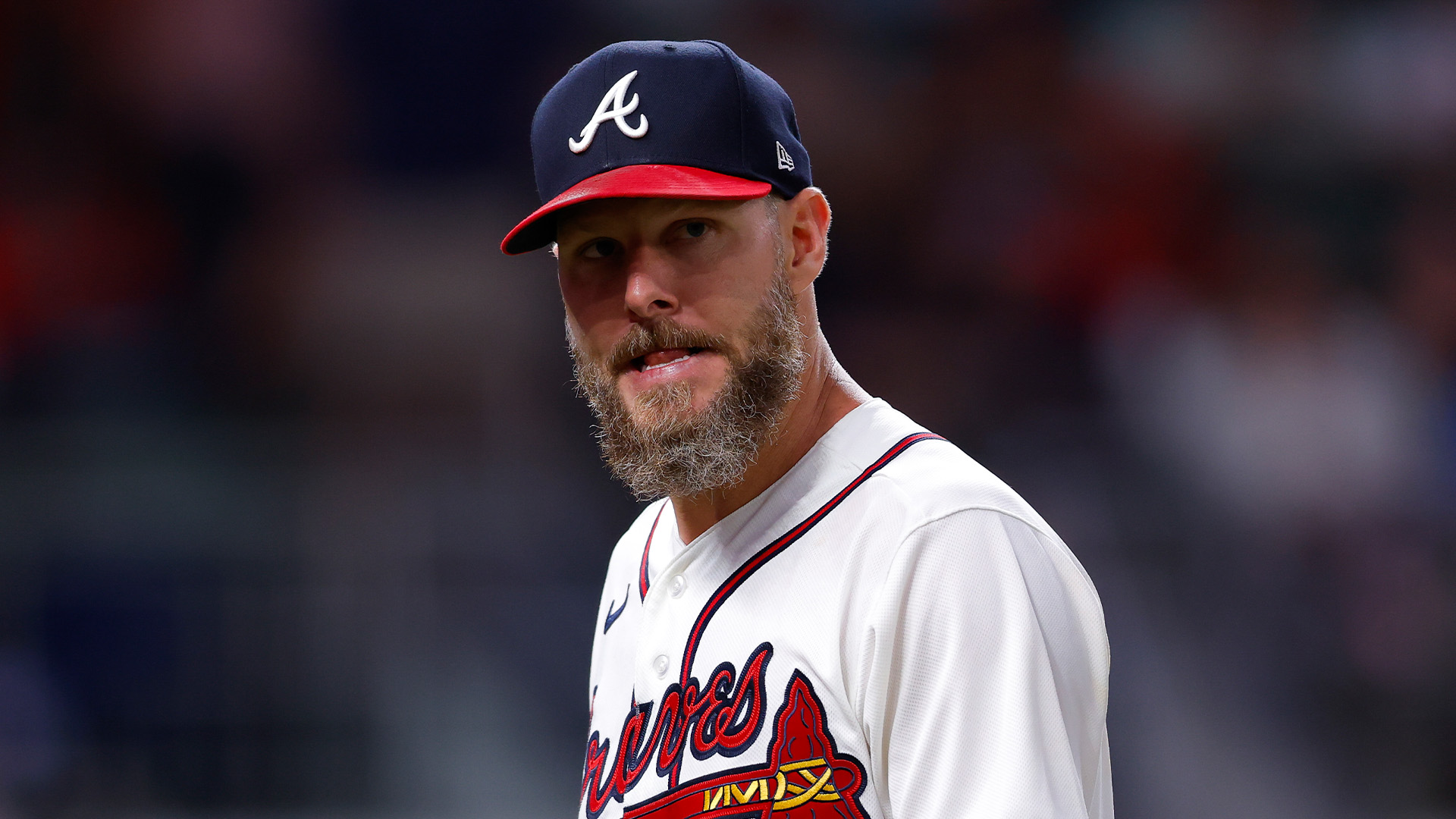
The morning of the National League Wild Card Series clincher had barely begun, and already Walt Weiss was carrying a weight he didn’t want to name. The Atlanta Braves’ manager had walked into Truist Park with a plan, and that plan was to keep his mouth shut. Two days earlier, Chris Sale had stood on that same mound and delivered five innings of one-run baseball in a tense, playoff-opening victory over the Philadelphia Phillies. Now, with the season on the line and one win separating the Braves from a trip to Los Angeles, Weiss knew there was a chance he might need his ace again — not for a start, not on full rest, but for an inning here, an inning there, whatever the game demanded. And that was exactly the conversation he had sworn to himself he would not start. Because he knew Chris Sale. He knew the fire that burned behind those calm eyes, the stubborn pride that had carried the left-hander through injuries, doubt, and years of relentless competition. If Weiss asked Sale whether he could pitch, even with his arm hanging by a thread, Sale would say yes every single time. So Weiss made a quiet promise: he would not put his best player in that impossible position. He would let Sale decide for himself. What Weiss didn’t know, as he walked through the corridors of the ballpark and braced for a day of impossible decisions, was that Sale had already made up his mind long before either of them spoke a word.
When Weiss finally reached his office that afternoon, he found the chair across from his desk already occupied. Chris Sale was sitting there, waiting, calm and still like a man who had already settled something inside himself. Weiss paused, caught off guard. Then Sale looked up and said the only words that mattered: “I feel amazing.” That was it. No hedging, no “if you need me,” no complicated conversation about pitch counts or recovery windows or the risk of sacrificing his next start. Just two words, simple and absolute, spoken with the quiet certainty of someone who had already decided he would not let his team go down without him. Weiss let out a breath. “Well, let’s talk,” he said. And that conversation changed the shape of the night. When the game unfolded with the season hanging in the balance, Sale was ready. He jogged in from the bullpen with the kind of focus that makes entire stadiums hold their breath. The game was close, the Phillies were dangerous, and the Braves needed every out they could get. Sale gave them more than that. He recorded the final four outs of a 6-2 victory, striking out Bryce Harper to end the eighth inning with the kind of overpowering stuff that has defined his career. Then, in the ninth, he closed the door completely, striking out Bryan De La Cruz and pinch-hitter Otto Kemp to send the Braves to the next round. It was not a textbook save. It was something better — a warrior’s performance, a statement that when everything mattered most, Chris Sale would not be denied.
For Weiss, the moment felt bigger than any box score. He had spent the entire season watching Sale become something rare, a player who transcended statistics and awards. Weeks earlier, at age 37, Sale had finished the regular season with a 14-9 record and a 2.16 ERA, striking out 200 batters in 162 2/3 innings. He had done it by learning to listen to his body, by accepting extra rest, by preserving the arm that had already given baseball so much. There were nights when the Braves held him back, night after night of cautious whispers and long discussions about workload management, all in the hope that he would be this version of himself in October. And now, here he was, sitting in the manager’s office, volunteering to pitch on two days’ rest because he felt amazing and because he wanted to win. Weiss shook his head when he tried to put it into words. “I was hoping he only had to go one, but he had to get to four outs,” he said. “But what a warrior, man. This guy, I’ve run out of superlatives for Chris Sale. Been talking about him all year. He’s one of the best I’ve ever been around. When you take everything into consideration; teammate, competitor, performer, work ethic, all those things, he’s as good as I’ve ever been around.” There was a pause, the kind of pause that comes when a manager knows he has witnessed something he will remember long after he leaves the game. Weiss did not talk about Sunday. He did not talk about the National League Division Series or the Los Angeles Dodgers or whether Sale might start again on short rest. That was a question for another day. Thursday night belonged entirely to the present.
The Braves reached this moment not because of one heroic performance, but because of a season full of them, especially from players who were supposed to be afterthoughts. Their rotation had been decimated by injuries all year, a relentless parade of names disappearing from the roster like soldiers falling in battle. Spencer Schwellenbach, one of their brightest young starters, had missed time. Spencer Strider, their overpowering ace, had been lost for the season. Reynaldo Lopez, another key piece, had gone down. Hurston Waldrep, a promising arm, had also disappeared. And Martin Perez, a veteran left-hander who was supposed to be part of the postseason rotation, had landed on the 15-day injured list with lower back inflammation on September 24, just when the Braves needed him most. Even as they arrived for the Wild Card Series, the injuries kept coming. Tyler Mahle started Game 2 and somehow allowed only one run in seven innings, but he did it while dealing with an abdominal pull he suffered during his pregame warmup. Weiss admitted later that he was worried Mahle might not even make it to the mound, and though Mahle felt a little better on Thursday, the pain was still there. The Braves were not just winning with star power. They were winning with grit, with guys like Ray Kerr, a reliever who took the ball in the opener Thursday and spun 3 1/3 scoreless innings, allowing only one hit and feeding off the roar of the crowd. “I was feeding off the crowd from the first pitch of the game,” Kerr said. “They motivated me to keep going, throw even harder, throw even more. Every time I threw a strike, they were yelling, so I have to give it up to the fans.” In a season when the Braves’ starting rotation looked like a hospital ward, Kerr and others somehow found a way to keep the team upright.
Weiss was not surprised, though he was amazed. He knew exactly what the outside world had said about this team, and he had collected every slight, every doubt, every headline declaring the Braves finished. “There’s nobody on the planet that had us,” he said, and he meant it. The injuries had mounted so high that even the most optimistic projections could not picture Atlanta in the postseason, not with so many frontline starters missing, not with the lineup forced to lean on names that had barely played in the big leagues. But the Braves had found their way anyway, and Weiss believed the credit belonged to the players in the clubhouse who refused to surrender to bad luck. “Nobody had us making the playoffs,” Weiss said. “These guys have overcome so much. … It’s guys like Ray Kerr and everybody else that step up and perform when the stakes are highest. It’s such a great group.” Those words carried extra weight because they came from a man who had spent the whole season watching his team get counted out. Every time another starter went down, the narrative grew louder, the coffin seemed more permanent. But the Braves kept finding arms from somewhere. They kept believing in one another, kept showing up, kept finding ways to steal innings and grind out wins. Now, with the Wild Card Series behind them, they were still alive, still dangerous, still unbreakable. And there was more help on the way, maybe. Bryce Elder had thrown off the mound during Monday’s workout before the Wild Card Series, and the right-hander, who had surgery on his right knee on September 7, was getting closer and closer to a return. Other options such as AJ Smith-Shawver and JR Ritchie also remained, young arms with something to prove and nothing to lose.
So the story shifted west. The Braves would travel to Los Angeles for the first two games of the best-of-five National League Division Series on Saturday and Sunday, then return to Truist Park for Tuesday and Wednesday if necessary, with a potential Game 5 back in Los Angeles just beyond that. The matchup carried its own weight, a chance for a resilient, battered team to measure itself against the mighty Dodgers, a franchise built on stars and payroll and expectations. But no one in Atlanta was thinking about the odds anymore, because the odds had already been wrong about this team all year long. Chris Sale would certainly be an option for Sunday, though Weiss did not want to talk about it, not yet. “I don’t know. I have no idea. We weren’t even worried about that. We haven’t even talked about that. We didn’t look past tonight,” he said, and there was something almost noble in that refusal to look ahead. The Braves had earned the right to spend at least one night celebrating what they had just done, to savor the image of Chris Sale striking out Harper, to remember the sound of a home crowd roaring as the final out was caught. They had lost so much this season, endured so many injuries and heartbreaks, and yet there they were, standing in the middle of the diamond with champagne dripping from their uniforms, no longer the team nobody believed in. They were the team that refused to die. And at the center of it all, at least for this night, was a 37-year-old ace who had walked into a manager’s office with two simple words and a will strong enough to carry the entire organization. “I feel amazing.” In the end, that was all anyone needed to know.