





The global arena of sports has historically served as a sanctuary of unity, a rare and precious space where geopolitical tensions are temporarily shelved, and people from all walks of life gather to speak the universal language of athleticism and national pride. However, this fragile peace was abruptly shattered on a Thursday afternoon when the California Democratic Party took to social media to draw a sharp, exclusionary line in the sand just as the excitement for the 2026 FIFA Men’s World Cup was reaching a fever pitch. In a post that quickly reverberated across the digital landscape, the state’s ruling political party declared, “You’re not allowed to watch the World Cup if you’ve ever voted against immigration.” This provocative statement instantly ignited a firestorm of public outrage, transforming what should have been a weekend of shared anticipation and camaraderie into a highly charged debate about political correctness, national identity, and the boundaries of cultural enjoyment. For millions of ordinary Americans who were dusting off their red, white, and blue jerseys to cheer on Team USA in their highly anticipated opening match, the post felt less like a genuine advocacy tool and more like an unwelcome lecture from an overreaching authority figure. In an era already characterized by pervasive polarization, where almost every facet of daily life has been conscripted into the ongoing culture wars, this attempt to gatekeep the world’s most popular sport struck a deeply sensitive nerve. The backlash was immediate and widespread, transcending traditional political boundaries as fans from across the ideological spectrum voiced their frustration at having a rare moment of collective celebration intercepted by partisan finger-pointing. By linking the enjoyment of a sporting event to a voter’s stance on a highly complex and sensitive policy issue like immigration, the post highlighted a growing disconnect between high-level political strategists and the everyday public who simply want to escape the relentless noise of politics and enjoy a soccer match with their families.
The digital fallout from the post was swift, intense, and heavily flavored with a mixture of disbelief and sarcasm, as users on X ran the gamut from analytical deconstructions to mocking memes. Many critics immediately pointed out the glaring logical fallacies inherent in the California Democrats’ assertion, noting that soccer is a global game played by nations with incredibly diverse, and often exceptionally stringent, immigration frameworks. “Every one of those other countries has its own immigration policy, where you can’t just cross the border,” wrote one social media user, highlighting what they viewed as a massive hypocrisy in suggesting that enjoying international soccer requires a blanket endorsement of open borders. Another bewildered user captured the sentiment of the silent majority by asking a simple, poignant question: “Why? I don’t even understand the logic to this post.” This sentiment of profound confusion echoed across the internet, as people struggled to find any rational connection between supporting a national athletic team and one’s voting patterns on domestic border security policies. The viral nature of these critical responses underscored a collective weariness among the public, who feel increasingly cornered by political tribalism that demands total conformity on every issue before one is allowed to participate in public life. Rather than fostering a productive dialogue about the vital contributions of immigrants to global sports, the inflammatory tweet instead alienated moderate voices and served as a lightning rod for those who argue that progressive elites have lost touch with common sense. The intense online scrutiny demonstrated that while immigration remains one of the most hotly contested issues in American politics—with civil rights groups even issuing travel advisories for certain states due to strict enforcement tactics—weaponizing a beloved sporting event to shame political opponents is a self-defeating strategy that only deepens the cultural chasm.
Seizing on the widespread public frustration, the California Republican Party was quick to issue a formal response that sought to contrast their platform with what they characterized as the divisive tactics of their opponents. Francisco Bedoya, the Communications Manager for the California Republican Party, delivered a statement that resonated deeply with those who felt alienated by the Democrats’ gatekeeping. “The World Cup is a beautiful event that brings people together from around the world and should have nothing to do with politics,” Bedoya asserted, appealing directly to the universal values of sportsmanship and global community. In a highly relatable piece of advice that quickly became a talking point of its own, he added, “Rather than trolling on social media, they should put their phones down, touch some grass, and enjoy this historic World Cup.” By using the popular internet colloquialism “touch some grass”—a phrase used to urge people to step away from online echo chambers and reconnect with the real world—Bedoya tapped into a broader cultural desire for authenticity and sanity in our political discourse. He went on to warn that if the Democrats insisted on politicizing the beautiful game and continuing to sow division among Americans, the Republican party stood ready to call out their blatant hypocrisy. This rhetorical counterpunch effectively positioned the GOP as the defenders of ordinary, everyday experiences, arguing that some aspects of life should remain sacred and free from the relentless encroachment of political battle lines. The exchange highlighted how California, a state known for its fierce partisan battles, serves as a microcosm for the nation’s larger struggles, where even a game of soccer becomes a proxy war for competing visions of American society.
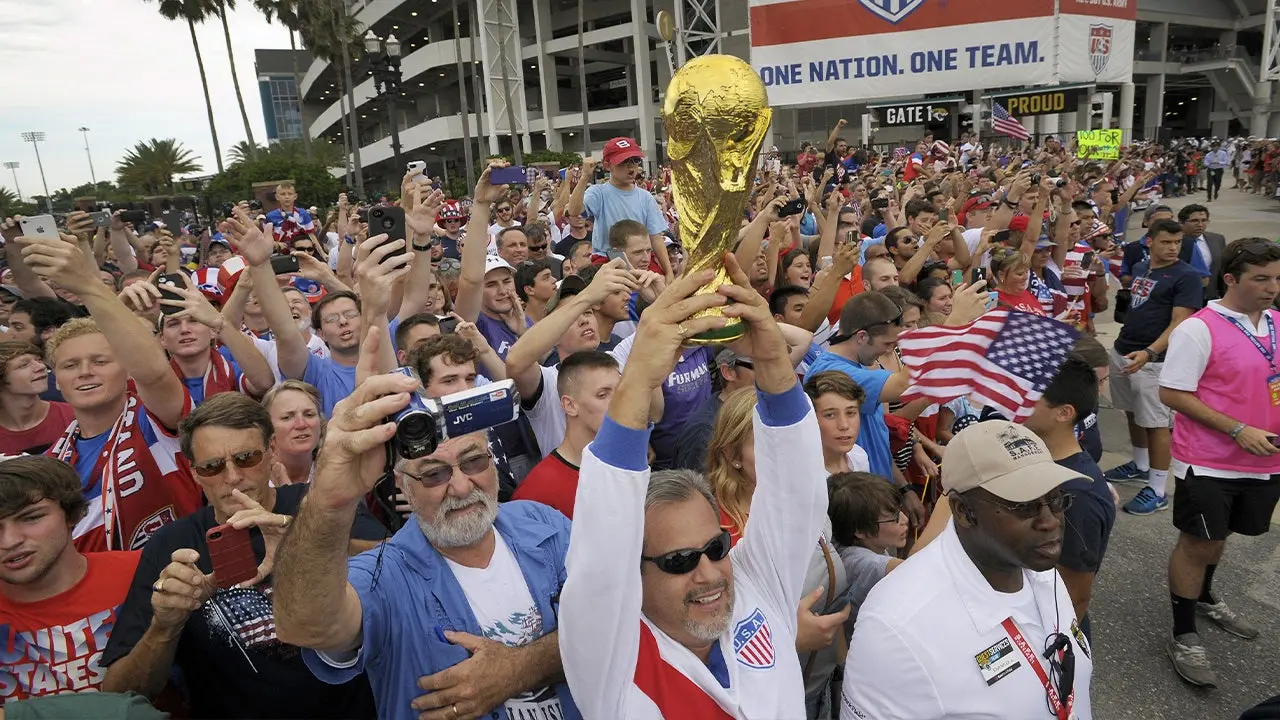
This political skirmish is set against the backdrop of an incredibly monumental event: the United States is co-hosting the 2026 Men’s World Cup alongside its North American neighbors, Canada and Mexico. This historic tripartite collaboration marks the first time the United States has hosted the prestigious global tournament since the iconic summer of 1994, an event that originally catalyzed the modern growth of soccer across the country. The cooperative nature of this tournament is, in many ways, the ultimate rebuttal to the divisive rhetoric surrounding it; it is an event built on the foundation of international partnership, requiring seamless collaboration across borders, agencies, and cultures to welcome millions of visitors from every corner of the globe. By its very design, the World Cup is a celebration of diversity, migration, and the peaceful assembly of nations, making the attempt to use it as a domestic political weapon feel particularly out of step with the tournament’s overarching philosophy. The joint bid was celebrated precisely because it symbolized a shared North American future, demonstrating that despite political disagreements and trade disputes, Canada, Mexico, and the United States could come together to stage the largest sporting spectacle on Earth. For soccer fans who remember the magic of 1994, this tournament represents a long-awaited homecoming and a chance to showcase how much the sport has grown in the American consciousness over the past three decades. To reduce this grand, decades-in-the-making celebration of human achievement and diplomatic cooperation down to a petty, localized partisan purity test does a profound disservice to the thousands of athletes, organizers, and volunteers who have spent years working to make this dream a reality.
The scale of the 2026 World Cup is unprecedented, with the United States shouldering the vast majority of the tournament’s logistical and operational responsibilities. Out of the 104 matches scheduled to take place throughout this month of high-stakes soccer, a staggering 78 matches will be hosted on American soil, spread across 11 major metropolitan areas that represent the rich cultural tapestry of the nation. Furthermore, all of the tournament’s most crucial, high-stakes games—including the intense quarterfinals, the nerve-wracking semifinals, and the historic final match itself—will take place within the United States, putting the country squarely in the global spotlight. This massive undertaking requires an extraordinary level of civic pride and local coordination, as cities from coast to coast prepare to welcome diverse international fanbases into their stadiums, restaurants, hotels, and public squares. It is an opportunity for local communities to showcase the very best of American hospitality, proving that our cities are open, vibrant, and capable of hosting the world with grace and enthusiasm. The economic impact is projected to be immense, injecting billions of dollars into local economies and creating countless seasonal jobs, but more importantly, the cultural impact will leave a lasting legacy for the next generation of American soccer players and fans. When foreign visitors arrive in these host cities, they will not be asked about their political beliefs or how they voted in the last election; instead, they will be greeted with the shared excitement of a common passion, demonstrating that the true spirit of the World Cup is defined by hospitality, mutual respect, and a collective appreciation for the beautiful game.
The long-anticipated tournament is set to kick off in truly spectacular fashion as Team USA takes on Paraguay in their crucial opening match at the state-of-the-art SoFi Stadium in Inglewood, California. This highly anticipated matchup at 9 p.m. Eastern Time (6 p.m. local time) is not merely a display of world-class athleticism, but a critical first step in determining the trajectory of both teams in Group D, a highly competitive group that also features formidable opponents in Australia and Turkey. Inside the roaring arena, and in millions of living rooms, bars, and community centers across the country, fans of every conceivable background will sit shoulder-to-shoulder, holding their breath with every pass, tackle, and shot on goal. In those tense, exhilarating ninety minutes, the political arguments that dominated social media feeds earlier in the week will fade into insignificance, replaced by the collective heartbeat of a nation rooting for its team. The players on the pitch, carrying the hopes of a diverse and complex nation, do not play for a political party; they play for the crest on their jerseys and the people who cheer them on, representing a vibrant mosaic of backgrounds that defines the modern American story. Ultimately, the California Democratic Party’s controversial social media post served as a stark reminder of our current political exhaustion, but the actual game of soccer offers a powerful antidote. When the referee blows the starting whistle at SoFi Stadium, it will be a triumphant reminder that the World Cup does not belong to the politicians, the pundits, or the online trolls; it belongs to the fans, the families, and the athletes who understand that, at its core, the beautiful game has always had the unique, unmatched power to heal divides and unite us all under one banner of shared humanity.