


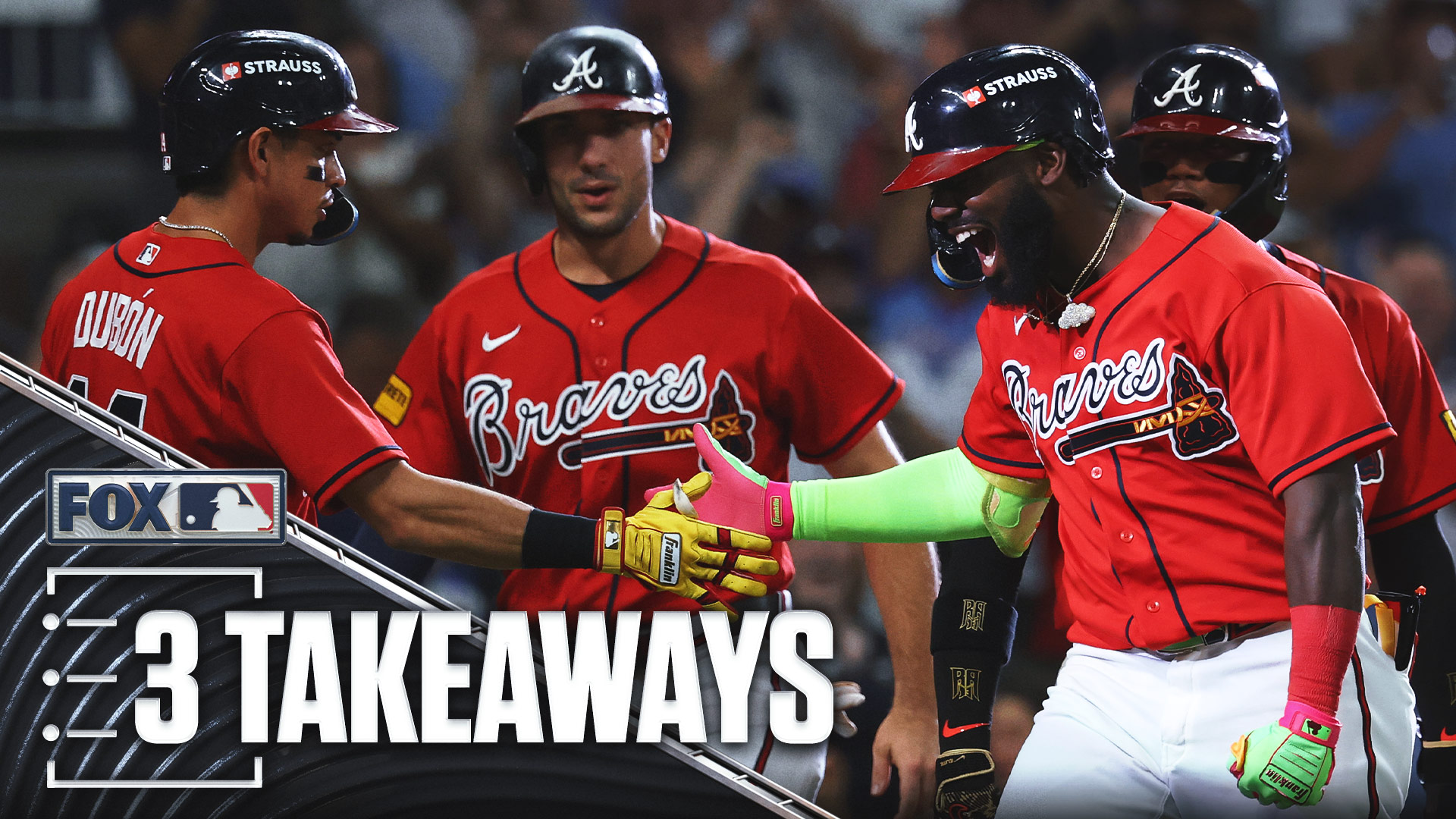
The night air at Truist Park felt heavy with the kind of tension that only October baseball can bring. Just twenty-four hours earlier, the Phillies had ripped Atlanta’s hearts out in the most cruel way possible, erasing a late deficit and walking off with a tenth-inning home run that sent the home crowd home stunned. But baseball has a way of turning heartbreak into redemption faster than any other sport, and when the Braves took the field for Game 3 of the Wild Card series, they played like a team possessed. It wasn’t supposed to be easy. They were turning to a bullpen game in a winner-take-all affair, putting their fate in the hands of a 32-year-old left-hander nobody outside the organization had heard of a few years ago. Yet by the time the final out was recorded, Atlanta had done something that felt almost inevitable: they had shut the door on Philadelphia,and booked their ticket to the National League Division Series against the two-time defending champion Los Angeles Dodgers. Michael Harris II delivered the early knockout blow, Ozzie Albies and Matt Olson added insurance, and the Braves’ patchwork pitching staff refused to break. Somewhere in the jubilant clubhouse,burgundy-and-blue confetti falling like snow, it was hard not to feel that this team had been through too much this season to let the opportunity slip away.
The first and most glaring lesson from Thursday night’s elimination game was simple: thee Phillies should have started Zack Wheeler. Instead, manager Don Mattingly handed the ball to Aaron Nola, their mercurial right-hander, hoping that his second-half resurgence would outweight a season-long pattern of inconsistency. It was a gamble that felt foolish even before first pitch, and it unraveled almost immediately. Nola was never able to find his footing in the first inning, serving upa three-run homer to Michael Harris II that turned Truist Park into a furnace. By the time he recorded the shortest postseason start of his career, lasting just one and two-thirds innings, Philadelphia was already in a 3-0 hole that felt closer to a canyon. Mattingly finally turned to Wheeler in the top of the third, but the damage was done. Wheeler, the reliable ace, pitched four innings and allowed only a two-run homer to Ozzie Albies—by then, tho game was essentially over anyway. The irony was impossible to ignore: Wheeler had pitched six innings of one-run ball against the Rays just days earlier, and he clearly had enough left in the tank to handle this assignment. He didn’t need to be saved. There was no tomorrow to save him for. In an elimination game, you start your best pitcher, full stop. The Phillies tried to get cute, hoping Nola’s second-half numbers—3.33 ERA across fourteen starts—would translate to clutch October performance. But Nola had spent the firs half of the year spinning his wheels to a 5.75 ERA, and old habits die hard. Save Wheeler for Game 1 of an NLDS the Phillies never reached? That is the kind of managerial cleverness that gets second-guessed all winter. Mattingly and his staff learned a painful lesson about postseason baseball: the window is tiny, auf momentum is everything, and an ace on the mound is worth more than any statistical split.
Amid Philadelphia’s managerial miscalculation stood one of the more remarkable human stories in recent postseason memory. Ray Kerr, a 32-year-old southpaw who opened the game for Atlanta, has a path to this stage that reads less like a baseball bio and more like a screenplay. He grew up in foster care, bouncing around in ways that would have crushed most kids. He worked at a 7-Eleven and a movie theater in Reno, Nevada, just trying to get by, before the Seattle Mariners offered him a minor-league contract in 2017. From there, he clawed his way through the minors, eventually reaching the Padres for a brief cup of coffee, then landed with the Braves in 2024. Just as his career began to gain traction, he blew out his elbow and underwent Tommy John surgery, missing months that felt like years. Most players would have quietly faded. But Kerr refused. He made it back to a major league mound in August of this season and posted a 1.47 ERA over nine appearances, earning the kind of trust that manager Walt Weiss had no choice but to honor in the most critical moment of the season. And then, with everything on the line, Kerr went out and delivered 3⅓ scoreless innings against a Phillies lineup filled with household names, allowing just one hit and one walk while striking out two. It wasn’t just the stat line that made it special. It was everything he had overcome to get there. Foster care. Minimum-wage jobs. Tommy John scars. The Braves’ rotation had been decimated by injuries all season, losing starter after starter, yet because of players like Kerr, their pitching staff still finished with the fifth-best ERA in baseball at 3.63. That’s not luck. That’s culture. That’s a next-man-up mentality forged in fire, and Kerr embodied it perfectly on the biggest stage of his life.
If there was a silver lining for the Phillies in this brutal loss, it was that they still had chances to climb back into the game—they just couldn’t cash them in. After spotting Atlanta an early 3-0 lead, Philadelphia clawed and scratched to keep hope alive, but every time the game begged for a clutch hit, their bats went silent. Their best opportunity came in the sixth inning, when Kyle Schwarber stroked a one-out single and Bryce Harper ripped a double into the gap, putting runners on second and third with just one out. The crowd at Truist Park fell into an uneasy hush, sensing that one big swing could flip the entire narrative. Instead, Alec Bohm grounded out weakly, and Bryson Stott flew out to end the threat. Air left the ballpark. Again in the eighth, pinch-hitter Derek Hill led off with a triple, giving Philadelphia a jolt of life, and Trea Turner brought him home with a sacrifice fly. But that was all they could muster. With two outs, Braves manager Walt Weiss summoned his most devastating weapon from the bullpen: Chris Sale, the cutthroat left-hander who had reinvented himself this season, sprinting in from the bullpen like some sort of avenging angel. Sale needed just four pitches to strike out Bryce Harper, and none of them came anywhere close to the strike zone. It was a sequence thatfelt less like pitching and more like psychological warfare. By the time Sale closed out the ninth, the Phillies had gone 0-for-6 with runners in scoring position and left five men on base. Their season, which had nearly ended in outright collapse a week earlier before they miraculously grabbed a Wild Card spot, sputtered to a close not with a bang, but with a whimper. This was not an unfamiliar feeling for Philadelphia. Their recent Octobers have been littered with heartbreak, from the World Series loss to Houston in 2022 to yet another disappointing exit. The pain never gets easier to swallow, but scratching heads about “what if”is the cruelest part of all.
Now the Braves turn their attention to the behemoth waiting in Los Angeles. The two-time defending champion Dodgers have become the gold standard of modern baseball, a superteam built on massive payroll, analytical brilliance, and an embarrassment of riches at every position. They will be rested, dangerous, and absolutely not intimidated by Atlanta’s momentum. But these Braves are not the same team that limped through injuries earlier in the season. They are battered but unbroken, led by a rotation that somehow keeps finding arms, a lineup that can erase deficits in seconds, and a bullpen that now believes it can get anybody out. The NLDS will be a battle of two franchises that have spent the past decade building entirely different models of sustained success: the Dodgers with their relentless star power and financial muscle, the Braves with their homegrown core, creative player development, and castoffs like Ray Kerr who refuse to stop believing. In many ways, this series is a referendum on which approach matters more when the lights shine brightest. Atlanta will need every ounce of that resilience against a Dodgers lineup that can make a single mistake disappear into the bleachers. But if Thursday night proved anything, it’s that these Braves are dangerous precisely because they don’t care what anyone thinks they should do. They don’t need to be the most talented team on paper. They just need to be the last one standing.
And so, with the confetti barely swept off Truist Park’s warning track, we are left with the beautiful, cruel unpredictability of October baseball. One team’s greatest triumph is always another team’s deepest wound. For Philadelphia, the questions will echo all winter long: Why wasn’t Zack Wheeler on the mound from the start? How did a lineup with Bryce Harper, Kyle Schwarber, and Trea Turner go ice-cold at the worst possible moments? And what does this mean for a core группа that has now tasted October heartbreak over and over again? There are no easy answers. Baseball does not give refunds for good intentions. For Atlanta, meanwhile, the focus shifts forward, toward aging challenge of dethroning the Dodgers—a task so monumental that few outsiders give them much of a chance. But if you watched Ray Kerr pitch through his emotions, Michael Harris II round the bases after his homer, or Chris Sale snarl through Harper’s at-bat, you understand that these Braves are not simply happy to be here. They came to take something. They came to win. And on this humid Georgia night, against a desperate division rival, they reminded the entire sport of something easy to forget when you look at payrolls and projections: baseball is still played by human beings, with broken pasts, unshakeable beliefs, and moments that make everything worth it. That is what made Thursday’s game special. That is what makes the next round worth watching. The Dodgers await, and somehow, after all the chaos and carnage of this Wild Card week, these Braves look like exactly the kind of team that might just do something foolish—beautiful, impossible, unforgettable.