





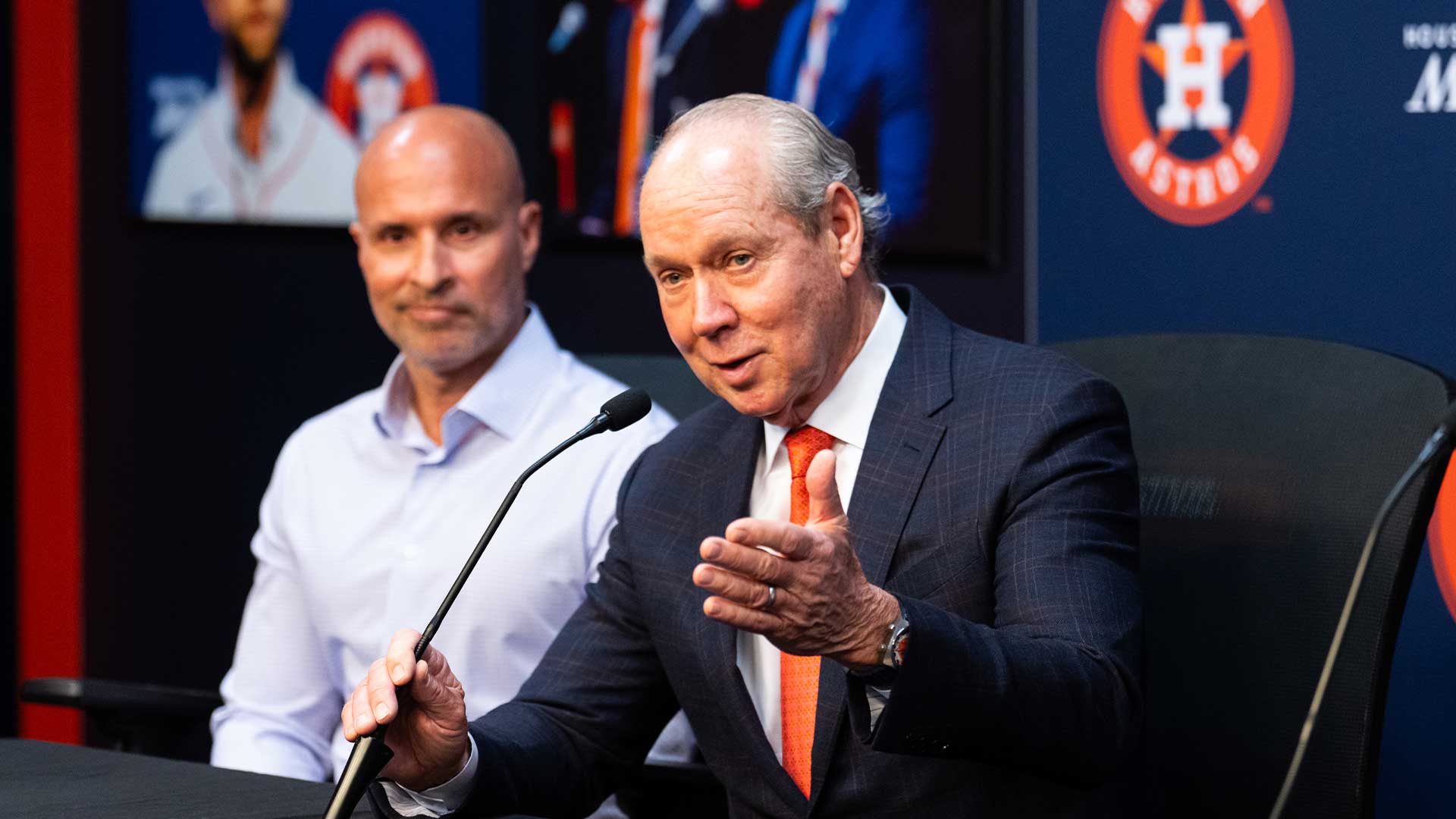
The Houston Astros, a franchise defined by sustained excellence and an insatiable appetite for October baseball, woke up to a startling reality on a crisp Tuesday morning. With the New York Yankees in town for a pivotal three-game series at Minute Maid Park, the organization made a seismic move that sent shockwaves through the clubhouse and the baseball world alike. They parted ways with General Manager Dana Brown. The decision, announced just hours before the first pitch, was characterized as “mutual,” a diplomatic phrase often used to soften the inherent awkwardness of a termination, but the timing felt undeniably abrupt. Owner Jim Crane, standing before a bank of microphones, confirmed the end of Brown’s tenure, noting that his contract was set to expire at the season’s end. The move wasn’t entirely unexpected—rumblings of front-office discord had circulated for weeks—but the specific moment, a day before facing a division rival in a heated stretch, injected a sense of urgency and finality. For a ballclub that had grown accustomed to stability in the dugout and the front office, this sudden shift threatened to destabilize the very foundation upon which their dynastic run had been built. The players, many of whom learned the news through their phones while filtering into the clubhouse, wore expressions ranging from confusion to resignation, acutely aware that the business of baseball never sleeps, even as their personal connections to their GM remained strong.
In the wake of Brown’s departure, the Astros did not look far for a replacement, instead turning inward to a trio of trusted baseball minds who understood the franchise’s DNA. The legendary Hall of Fame third baseman Jeff Bagwell, an icon who had served as a senior adviser, was thrust into the spotlight as the interim architect of baseball operations, tasked with steering the ship through the turbulent final weeks of the regular season. He was joined by assistant general managers Charles Cook and Gavin Dickey, along with Connor Huff, each absorbing expanded responsibilities in a collaborative, committee-style approach. Owner Jim Crane himself took on a more hands-on oversight role, signaling his desire to maintain stability and a clear chain of command during this critical juncture. Bagwell’s elevation was a poignant narrative, as it brought a beloved player back to the center of the franchise’s strategic heart, but it also carried a sense of improvisation. The new structure was designed to spread the workload and the scrutiny, yet it lacked the singular, authoritative voice that typically guides a championship contender. For the front-office staff, the shift meant adapting to a new hierarchy, reporting to multiple figures who each brought their own philosophies and priorities. Scouts and analysts now had to navigate a divided landscape, wondering which voice held the final say on trades, waivers, and roster moves. The players, ever pragmatic, understood that the game on the field remained unchanged, but the presence of Bagwell in the operations wing served as a reminder of the franchise’s storied history, a desperate attempt to recapture a winning formula that had recently felt elusive.
Jim Crane, a billionaire owner not typically known for public sentimentality, offered a surprisingly empathetic defense of the decision during his press conference. He framed the separation not as a firing born of anger, but as a deliberate act of respect aimed at giving Brown the space to regroup and flourish elsewhere. “There’s no good time for any of that, you know, when you let someone go,” Crane said, his tone tinged with a hint of reluctance. He emphasized that the move was about preserving Brown’s dignity and career prospects, explaining, “Just out of respect for Dana, we thought that was a time that would give him a little space to regroup.” Crane praised Brown as a “great talent” and recognized his extensive experience in the baseball industry, stating that he “has been in the business a long time to get settled and to get back to work somewhere else.” These words, while familiar in the lexicon of dismissals, carried a paternal weight, suggesting that Crane saw this as a necessary parting of ways for both parties’ long-term benefit. He was quick to deflect any notion that recent on-field performance—the team’s slow start, its middling record, and a recent slump—had triggered the move. “That didn’t have anything to do with it,” he asserted firmly, redirecting the narrative toward a misalignment of strategic vision and philosophical direction between himself and Brown. For Crane, this was about recalibrating the organization’s long-term approach, ensuring that the front office and ownership were working from the same playbook, even if it meant making a tough call that disrupted the momentum of a ballclub fighting for a playoff spot.
The most poignant reaction to the news came from the dugout, where manager Joe Espada stood as the emotional bridge between the front office and the players on the field. Espada, who had been promoted from bench coach to the helm before the 2023 season, shared a deep, three-and-a-half-year working relationship with Brown, a partnership forged in the crucible of high-stakes baseball. “We worked together very closely for three and a half years,” Espada said, his voice carrying the weight of genuine loss. He credited Brown with giving him the opportunity to manage an elite team, a debt of gratitude that clearly lingered in his words. “He gave me the opportunity to be manager,” Espada noted, acknowledging the professional confidence Brown had placed in him. The conversation where Espada learned of the GM’s departure was, by his own admission, emotionally difficult. “It was a tough conversation,” he conceded, his gaze softening as he recalled the moment. Yet, even amidst the sadness, Espada found room for gratitude. “But he was grateful for the opportunity and I’m grateful for our relationship and how we grind through this together,” he said, using the quintessential baseball term “grind” to encapsulate the grueling daily rituals, the bus rides, the late-night film sessions, and the shared burdens of a long season. Espada spoke of the “lot of emotions behind our conversation,” acknowledging the human cost of a business decision. But, as a consummate professional, he swiftly pivoted to his responsibilities, declaring, “Focus on winning today, that’s how I left that.” His response reflected a deep maturity—honoring the past while committing himself fully to the mission ahead, knowing that the team’s playoff aspirations required all hands on deck, free from the paralysis of grief.
To fully comprehend Brown’s departure, one must examine the arc of his tenure, a rollercoaster ride defined by immense pressure and sky-high expectations. He inherited a franchise that had just reached its seventh consecutive ALCS in 2023, a streak that was both a blessing and a curse. Though they fell to the Texas Rangers in seven games that year, the mandate was clear: reload, don’t rebuild. Brown’s first full season in 2024 saw the Astros stumble to a wild-card loss against the Detroit Tigers, a bitter pill for a team accustomed to deep October runs. Then came the most recent season, one that saw the team miss the playoffs entirely for the first time since 2016, finishing just three games behind the Seattle Mariners in the AL West and losing a tiebreaker to the Tigers for the final wild-card spot. That failure, though not directly cited by Crane as the reason for the dismissal, cast a dark shadow over Brown’s leadership. He had been brought in to preserve a dynasty, but time and injuries had eroded the dynasty’s margin for error. The comparison to his predecessor, James Click, was unavoidable—Click had won a World Series in 2022 and was fired just six days later due to philosophical clashes with Crane. Brown, in essence, inherited an impossible standard: win it all, or be sent packing, regardless of your track record. The revolving door in the front office became a symptom of an organization that demanded perfection and offered precious little patience. Brown’s tenure saw him make bold trade deadline moves and navigate a complex payroll, but the results—a wild-card exit and a missed postseason—were ultimately insufficient for a fanbase that had tasted ultimate glory. He was a “great talent,” as Crane said, but talent alone couldn’t overcome the relentless ticking of the luxury-tax clock and the existential dread of a season slipping away.
As the Yankees took the field and the series commenced, the Astros found themselves standing at a crossroads, not just in the standings but in their entire organizational philosophy. Crane’s assertion that the decision wasn’t based on recent performance may have rung hollow to some, but it underscored a deeper truth: baseball is a results-driven business, yet the human element—the relationships, the timing, the respect—often dictates the final narrative. The new collaboration of Bagwell, Cook, Dickey, and Huff represented a return to the franchise’s roots, a collective attempt to recapture the magic that defined their past championships. For Espada, the immediate task was to galvanize a clubhouse that had just witnessed a seismic shift, to channel the raw emotion into a focused push toward the postseason. The team had shown resilience all year, recovering from a disastrous 20-31 start to climb back above .500, only to stumble again in recent weeks with nine losses in their last fourteen games. But baseball is a marathon, and the interim leadership had to prove they could navigate the waiver wire, September call-ups, and the tactical decisions that define a championship run. Ultimately, Dana Brown’s departure served as a stark reminder that in Major League Baseball, no one is indispensable, yet everyone leaves an indelible mark. His farewell was handled with a measure of grace—Crane offering respect, Espada offering gratitude, and the organization offering a clean slate. As the season barreled toward its conclusion, the Astros had to rely on a blend of legends and new voices to write their next chapter. The game would go on, the players would compete, and the front office would adapt. But for those who knew Brown, the echo of his time in Houston—his grind, his vision, and his tender farewell—would resonate for a long time. In the end, baseball is not just about statistics or championships; it’s about the people who pass through the clubhouse doors, and the bonds forged in the fire of a pennant race. By letting Brown go, the Astros hoped to turn the page, but the ink of his tenure was still wet, a testament to a talented baseball man who met an unforgiving mandate, and together, they forever rewrote the contours of a franchise’s history.