


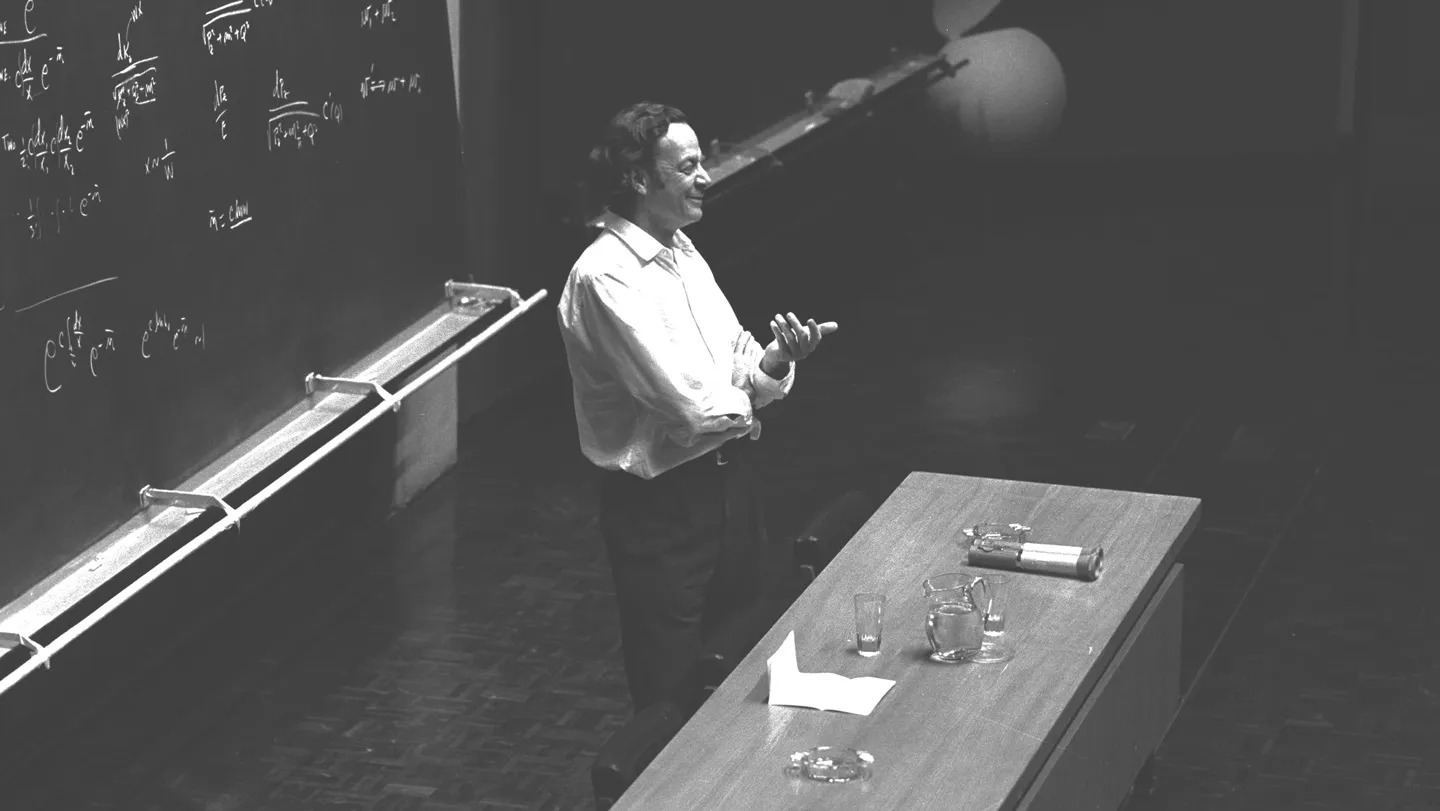
Richard Phillips Feynman was a man perpetually fascinated by the hidden beauty of the commonplace world. While his elite colleagues at Caltech spent their days unraveling quantum mysteries or calculating the stellar behaviors of distant galaxies, Feynman was just as likely to be found staring intensely at the wobble of a falling cafeteria plate or tracking the exact path of ants marching across his filing cabinet. His mind possessed an insatiable curiosity that refused to separate the world into the academic and the ordinary; to Feynman, everything was a dynamic puzzle waiting to be unlocked by the application of rigorous, playful logic. This restless intellectual spirit eventually collided with one of the most thoroughly relatable and quietly frustrating dilemmas of daily human existence: the frequent dilemma of deciding where to eat lunch. As he walked the sunlit streets of Pasadena alongside his colleagues, Feynman grew increasingly fascinated by the choices and negotiations that accompanied every single midday meal. He observed that his fellow scientists spent an enormous amount of intellectual energy debating whether to visit a familiar, highly predictable campus diner or risk their afternoon comfort on a newly opened noodle shop down the street. Instead of dismissing this as a trivial distraction, Feynman recognized it as a profound mathematical optimization problem. He realized that this simple culinary chore was a physical manifestation of a fundamental statistical dilemma: how to balance the security of comfortable habits against the perilous but potentially rewarding pursuit of novelty. Armed with nothing but his characteristic determination, a pen, and a stack of yellowed papers, Feynman set out to transform his hunger into an elegant mathematical model, seeking to discover if there was an absolute, scientifically optimal way to choose where to eat to maximize a person’s culinary satisfaction over their remaining days on Earth.
For decades, this thought experiment remained buried within the vast archives of Feynman’s personal papers, undeciphered beneath layers of complex quantum equations. It was only recently that a dedicated team of researchers and statistical physicists, fueled by historical curiosity, embarked on an archival treasure hunt to locate and finally decode these long-overlooked pages. Handling the delicate sheets with care, the researchers deciphered his energetic handwriting, interspersed with stray coffee stains and mathematical shorthand. What they uncovered was a brilliant, albeit incomplete, formalization of what modern decision theorists refer to as the “exploration-exploitation trade-off” or “optimal stopping theory.” Feynman had constructed a sophisticated, dynamic model that attempted to calculate the exact tipping point at which a diner should stop searching for new restaurants and instead commit to their favorite established spots. In his characteristic style, Feynman did not merely look for a simple rule of thumb; he sought to establish a rigorous, predictive framework that calculated the long-term utility of information. He understood that when you try a brand-new restaurant, you are not just purchasing a single meal; you are purchasing valuable information that could vastly improve your dining experiences for years to come, even if that immediate meal turns out to be a disappointing disaster. The researchers painstakingly reconstructed his fragmentary derivations, translating his highly personalized, eccentric notations into modern mathematical language to reveal an elegant set of equations that quantified the hidden trade-offs of appetite and risk, successfully solving a problem that Feynman had scribbled down simply to pass the time between physics lectures. By doing so, the researchers bridged a generational gap, connecting Feynman’s mid-century lunchtime musings with the cutting edge of contemporary decision science, paving the way for a deeper investigation into how the human brain processes choices.
To appreciate Feynman’s lunch equations, one must dive into the mechanics of the “exploration-exploitation” dilemma. At its core, the problem is defined by a mathematical tension between risk and reward, structured by the finite nature of time. If you decide to explore a new restaurant, you risk eating a terrible meal, but open up the possibility of discovering an extraordinary gem that will bring joy for years. Conversely, if you choose to exploit your favorite restaurant, you are guaranteed a consistently good meal, but you shut the door on any potential improvement, slowly sinking into a dull routine of safe, predictable dining. Feynman managed to translate these emotional experiences of anticipation, disappointment, and comfort into precise numerical variables, incorporating factors such as a person’s estimated lifespan, the statistical probability of a new restaurant being exceptionally good or dreadfully bad, and the declining value of new information as one grows older. His math proved that the worth of exploration is heavily front-loaded in life: when you are young and have decades of eating ahead of you, the mathematical return on taking risks is incredibly high because you have plenty of time to enjoy any hidden gems you discover. However, as your personal time horizon shrinks, the math dictates a logical shift toward exploitation, as there are fewer remaining opportunities to cash in on the value of newly discovered information. Through tables of probability and dynamic programming, Feynman created a precise mathematical boundary—a threshold of diminishing returns—where the intellectual value of trying something new officially drops below the reliable comfort of the familiar. This threshold was not a static rule, but a fluid, living calculation that adapted to how many restaurants a person had already tried and the general quality of the culinary landscape around them. It was a beautiful, mathematical map of the human heart’s struggle between the thrill of adventure and the solace of home.
The modern breakthrough went beyond proving Feynman’s math sound; researchers wanted to see how his theory measured against the messy reality of human behavior. To accomplish this, they designed behavioral experiments and analyzed extensive datasets of consumer choices, tracking how real people actually select lunch spots, navigate unfamiliar menus, or decide to break their established habits. Intuition might suggest that when faced with such complex statistical probability, everyday people would act highly erratically, falling victim to irrational impulses, temporary moods, or sheer laziness. Yet, to the absolute astonishment of the scientific team, the data revealed an incredibly striking pattern: human subjects, operating purely on gut instinct and basic hunger, naturally make choices that closely approximate Feynman’s highly optimized mathematical solution. Without having studied dynamic programming, the average person seems to possess an innate subconscious algorithm that guides them toward the perfect balance. The research demonstrated that people instinctively understand when they have gathered enough culinary information to justify settling down with a favorite dish, and they naturally accelerate or decelerate their willingness to try new places in a way that beautifully mirrors Feynman’s mathematical curves. It was a stunning revelation that suggested deep, underlying forces were at play within the human mind, proving that our everyday, seemingly chaotic behaviors are governed by an invisible, highly rational geometry that aligns perfectly with the calculations of a Nobel laureate. This remarkable alignment suggests that our brains are constantly running sophisticated, silent simulations in the background of our consciousness. We think we are merely craving a specific sandwich or feeling a sudden whim to try a new taco truck, but our cognitive systems are executing highly refined statistical analyses, calculating probabilities with a speed and accuracy that rival the scribbled equations on Feynman’s legendary yellow notepad.
To understand why ordinary people are so remarkably adept at solving this complex mathematical problem without any formal training, we must look backward through the lens of evolutionary biology and human history. Long before Pasadena existed, and long before Feynman sat in a Caltech cafeteria, our ancestors were forced to solve the exact same exploration-exploitation dilemma every single day of their lives, albeit with far higher stakes than a mediocre lunch. In the brutal Pleistocene landscape, a hominid had to decide whether to remain at a safe berry bush or brave the deep forest to search for a richer food source. Making the wrong decision could mean starvation or death by predation; if they explored too much, they wasted precious energy and exposed themselves to lethal threats, but if they never explored, they would eventually deplete their local resources and perish. Consequently, natural selection acted as an unforgiving statistician, weeding out those with poor foraging habits and heavily rewarding those whose brains could intuitively calculate the perfect balance of risk and reward. Over millions of years, these calculations became hardwired into our neural circuitry, giving rise to intuitive cognitive shortcuts that navigate decisions with minimal effort. Thus, when we stand on a modern street corner debating our lunch options, we are not using a newly invented cognitive tool; we are running the ancient, battle-tested software of mammalian survival, using deep neurological pathways that have been meticulously shaped by natural selection to solve the exact optimization mathematics that Feynman put to paper. This biological realization completely reframes the relationship between science and human nature, demonstrating that the elegant equations discovered by physicists are not artificial human inventions, but rather the formal description of the very laws that have guided our physical survival and cognitive development since the dawn of our species.
Ultimately, the decoding of Feynman’s lunch notes offers a profound, humanizing perspective on both scientific genius and the brilliance of the human mind. It serves as a beautiful reminder that science is not a cold, alienating discipline practiced exclusively in sterile laboratories and ivory towers, but a warm, vibrant lens through which we can more deeply appreciate the texture of our daily lives. Feynman’s genius lay not in his ability to escape the mundane world, but in his capacity to find infinite wonder within it, demonstrating that even a casual conversation about where to find a good sandwich is worthy of mathematical immortality. By validating our raw human intuition with rigorous mathematical proof, this research reminds us that we do not need a Nobel Prize in physics to think like a genius, because the universe’s most complex equations are already written into the quiet, instinctive choreography of our daily choices. The next time you stand before a menu, torn between safety and uncertainty, take comfort knowing your brain is performing a poetic dance of optimization. In that simple, human moment of indecision, you are not just a hungry person looking for a meal; you are an active participant in an elegant, evolutionary symphony of mathematics, proving that we are all, in our own quiet ways, practicing a profound form of physics with every single bite we take. The legacy of Feynman’s lunch problem is that it breaks down the fictitious barrier between the intellectual elite and the rest of humanity, showing that our gut feelings are often just highly compressed, incredibly sophisticated mathematical truths waiting to be recognized. Ultimately, it reassures us that our minds are beautifully negotiated to the wonderful, messy environment we inhabit, demonstrating that even our most trivial instincts are anchored in the sublime laws of reality.