



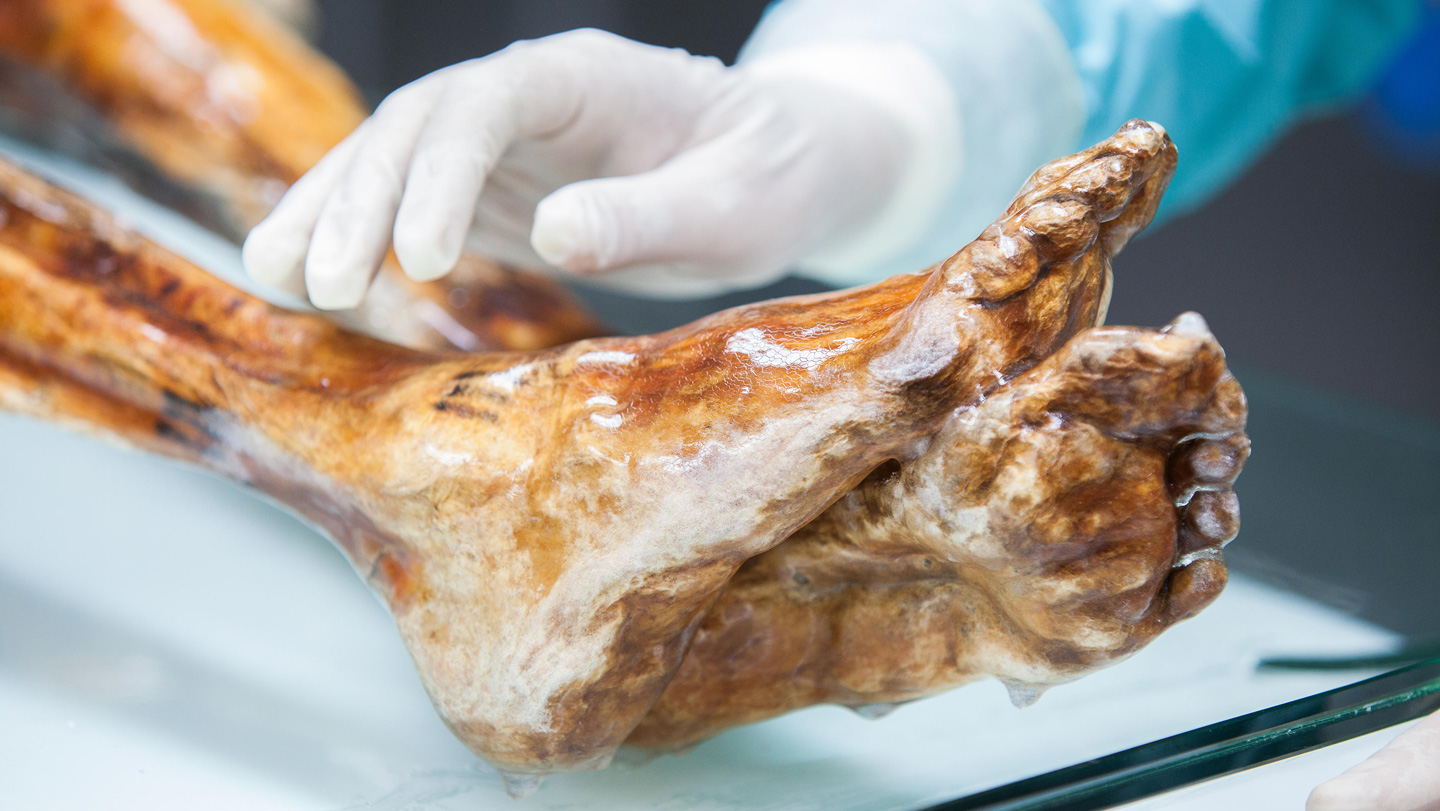
For more than three decades, the world has looked upon Ötzi the Iceman as the ultimate frozen messenger, a prehistoric time traveler locked in a pristine, icy slumber since the Copper Age. When his remarkably preserved body was first discovered by German hikers in the Ötztal Alps in 1991, it felt as though humanity had stumbled upon a miraculous anomaly of nature—a man frozen mid-stride, complete with his leather garments, a sophisticated copper ax, and the poignant remnants of his agonizing final moments etched directly into his tissues. For generations of archaeologists and curious onlookers alike, Ötzi represented an absolute pause button on the decay of time. We collectively imagined that the harsh, sub-zero temperatures of the high-altitude glaciers had acted as a perfect, static vault, isolating him completely from the chaotic, degrading forces of the natural world. This romanticized view of cryopreservation suggested that once a body was encased in ice, all biological, geological, and chemical activity ceased entirely, leaving a perfect specimen trapped inside a sterile temporal capsule. However, a groundbreaking discovery is fundamentally challenging this assumption, showing that what we perceived as a static, lifeless relic is actually a shifting, dynamic biological ecosystem. The ice was not a clean room or a sterile tomb; instead, it was a silent theater for an ongoing micro-organic drama. For five millennia, while human empires rose and fell, and the climate of the earth ebbed and flowed, a secret community of microscopic life forms was quietly coexisting with, and perhaps even feeding upon, the ancient traveler. This realization humanizes our relationship with Ötzi, turning him from a cold, mineralized artifact into an active biological interface, a bridge of flesh and bone that still interacts with the microscopic world around him. It reminds us that even in death and deep freeze, the fundamental processes of life and decomposition never truly surrender; they merely slow to a crawl, waiting for the right moment to awaken.
The true nature of this hidden microscopic world came to light in a stunning new study published in the journal Microbiome, which revealed that Ötzi’s body has been colonized by a variety of cold-adapted yeast species capable of surviving in extreme environments. Under normal circumstances, we assume that five thousand years of deep-freeze conditions would destroy any chance of microbial survival, leaving behind nothing but fragmented, degraded DNA. Yet, when a specialized international research team analyzed the runoff water and tissue swabs collected from the mummy, they discovered something extraordinary: four distinct species of yeast that are not only present but remain completely viable. These yeasts are what scientists call psychrophiles—specialized, cold-loving organisms that have adapted to thrive in the punishing, sub-zero conditions of glacial ice where almost no other life can survive. According to Albert Zink, a prominent anthropologist formerly associated with the Eurac Research Center and now based at the Ludwig Maximilian University of Munich, the team did not just find the genetic ghosts of these fungi; they successfully cultured living, growing colonies from them in the laboratory. This means that these yeasts have persisted alongside Ötzi throughout the millennia, surviving the immense, fluctuating pressures of the glacier. This remarkable survival story aligns with geological and archaeological evidence suggesting that Ötzi’s icy tomb was not always a perfectly stable environment. Over the last five thousand years, particularly during the first fifteen centuries following his violent death, the glacier underwent periodic cycles of warming and cooling, causing the ice to partially thaw and refreeze. During these brief warm spells, as liquid water pooled around the mummy, these resilient yeasts likely awakened, metabolized, and colonized his skin and tissues, embedding themselves deep within his biological structure. They are, in essence, living time capsules that have traveled alongside him, keeping him company across the vast expanse of human history.
To unlock these microscopic secrets without destroying the most famous mummy on Earth, researchers had to design an incredibly delicate and high-stakes scientific protocol. Ordinarily, Ötzi is kept under lock and key in a highly specialized, sterile conservation facility at the South Tyrol Museum of Archaeology in Bolzano, Italy. Here, scientists maintain a strict preservation environment, keeping his chamber at a constant –6° Celsius (21.2° Fahrenheit) and a high relative humidity to perfectly mimic the natural conditions of the glacier from which he was painstakingly recovered. To study his microbiome, however, the research team had to temporarily disrupt this freezing status quo. In a carefully timed and monitored operation, they raised the chamber’s temperature to 4° Celsius (39.2° Fahrenheit) for a brief window of just five hours, allowing a controlled, minimal thaw. As the frost on his skin began to liquefy, the scientists, clad in sterile suits, collected every drop of the resulting runoff water with absolute precision. They also gathered a comprehensive suite of samples directly from his body, taking direct swabs from key anatomical locations, alongside tiny scrapes of his skin and deeper mummified tissues. To guarantee that their findings were truly ancient and not the result of modern contamination, the researchers also conducted a rigorous environmental audit. They analyzed soil samples originally collected from the Alpine gully where Ötzi was found in 1991, tested the air circulating inside the museum’s laboratories, and sampled the water used to humidify his custom-built display chamber. This multi-layered approach was essential to prove that the viable yeasts they isolated were genuine relics of his glacial history rather than common household molds introduced by modern visitors or museum staff.
When the researchers took these precious samples back to the laboratory to reconstruct the genetic makeup of the organisms living on the Iceman, they entered a domain where biology and history blur. Through advanced metagenomic sequencing, they were able to map out the diverse community of microbes that call Ötzi home, distinguishing between modern contaminants, ancient colonial yeasts, and the internal microbes he carried inside his body on the day he died. While the team met with spectacular success in growing living colonies of the four cold-adapted yeast species, their attempts to culture his ancient internal gut bacteria yielded no living results. This distinction is vital for understanding the limits of ancient preservation; while the outer surfaces of the body, exposed to the elements and the moisture of the glacier, became a home for resilient, cold-tolerant fungi, his internal organs remained a closed system where the anaerobic bacteria of his microbiome eventually perished, leaving behind only their genetic blueprint. Yet, even this dead DNA holds immense value for historical reconstruction. By analyzing the genetic remnants of the microbes in his digestive tract, scientists have previously reconstructed his final hours with astonishing intimacy, revealing that his last meal was a heavy, high-fat feast of wild ibex meat, red deer, and ancient grains. The discovery of these active, viable yeasts on his exterior, however, presents an entirely new paradigm for archaeological conservation. It suggests that Ötzi is not merely a static, dried artifact like a piece of ancient wood or pottery, but rather a dynamic biological interface where ancient biology meets modern science, carrying an active, living microbiome that is still capable of responding to the environment around it.
The deep fascination we hold for Ötzi stems from this intense human connection; he is not just a scientific specimen, but a mirror of our ancient ancestors, an ordinary man whose life was suddenly cut short by a violent act in the mountains. Over the decades, scientific analysis of his remains has painted an incredibly detailed, humanizing portrait of this Copper Age traveler. We know that he was around forty-five years old when he died, stood about five feet, three inches tall, was predisposed to genetic baldness, and suffered from joint pain, which he appears to have treated with a series of therapeutic tattoos inked over his acupuncture points. He carried a remarkable toolkit that speaks to his resourcefulness and social status, including a highly valuable copper-bladed ax whose metal has been traced to sources hundreds of miles away in Central Italy, a flint dagger, and a quiver of arrows. His clothing was a masterclass in ancient survival gear, stitched together from the hides of domesticated and wild animals, including goat, sheep, cow, and bear. To look at Ötzi is to look at ourselves, stripped of the complexities of modern technology, fighting the same raw elements of nature. The revelation that his body is host to a living, reproducing community of ancient yeasts adds yet another layer of complexity to this portrait, reminding us that we are never truly alone. Just as we carry billions of microbes that assist us in life, Ötzi carried his own micro-world into the ice, and a select few of those organisms have survived long enough to tell their own side of his story. Protecting this precious physical link to our collective past requires us to understand not just the macroscopic details of his clothes and tools, but also the invisible, microscopic forces that are still active upon his skin.
This ongoing biological activity is precisely why the study’s findings are so critical for the future of archaeological preservation. According to Patrick Hunt, a renowned Alpine archaeologist at Stanford University, Ötzi’s remains represent arguably the most significant archaeological science breakthrough of the twentieth century and beyond. However, Hunt warns that this invaluable window into the past is under constant threat if we do not fully comprehend the microbial ecosystems that exist on and around the mummy. The survival of these viable, cold-loving yeasts is a double-edged sword: while they offer a fascinating look at ancient micro-organisms, they also pose an active threat of biodegradation. At temperatures above freezing, or if the environmental controls of his tomb-like display chamber fail even slightly, these yeasts could rapidly multiply, feeding on the ancient skin and lipids that have kept him preserved for fifty-three centuries. The team’s analytical breakthroughs detailing this ongoing microbial landscape are therefore absolutely vital for designing future chemical and physical interventions to keep him safe. It reveals a beautiful, ironic truth of modern archaeology: to preserve the physical remains of our ancient ancestors, we must become masters of the microscopic organisms that live upon them. By understanding the yeasts and bacteria that have shared Ötzi’s long journey through the ice, we can ensure that this frozen traveler continues to stand as a sentinel of history, bridging the ancient Copper Age and our modern scientific world for generations to come.