



The Strange 324-Million-Year-Old Insect That Rewrites Evolution
When we think of insects, we almost instinctively picture the familiar six-legged creatures that crawl, fly, and scuttle across our world. But a remarkable discovery in West Texas has shattered that assumption, revealing that insects weren’t always defined by their six-legged body plan. A fossil unearthed from shale deposits in the region, dating back an astonishing 324 million years, has been found to possess a dramatically different anatomy—one that included a staggering 18 additional legs along its underside. This bizarre configuration bears no resemblance to any insect living today, making it one of the most peculiar and potentially significant finds in the study of insect evolution.
The discovery, detailed in the journal Nature, has excited paleontologists who see it as a crucial missing link in understanding how insects evolved. Erik Tihelka, a paleoentomologist at the University of Cambridge, describes the finding as spanning a significant gap in the fossil record. The specimen offers a rare glimpse into the transitional phase between the many-legged, shrimp-like ancestors of insects and the six-legged creatures that would eventually dominate terrestrial ecosystems. According to Tihelka, this fossil demonstrates that transitional forms existed along the evolutionary path, before insects shed their surplus legs and settled on the six we recognize today.
The journey to recognizing this fossil’s true significance was an unlikely one, spanning decades and continents. Originally collected in 1985 from a rocky outcrop north of Big Bend National Park, the specimen was initially dismissed as a juvenile crustacean called Tesnusocaris goldichi, a species found in the same dark shale deposits. For years, it sat largely forgotten in a museum drawer in San Diego, its true nature hidden by assumption and oversight. The breakthrough came when Tihelka spotted a line drawing of the fossil in a secondhand Russian paleontology textbook. Intrigued, he tracked down the original papers but felt uneasy about the specimen’s classification as a crustacean. His suspicions led him to travel to the San Diego Museum of Natural History to examine the fossil firsthand.
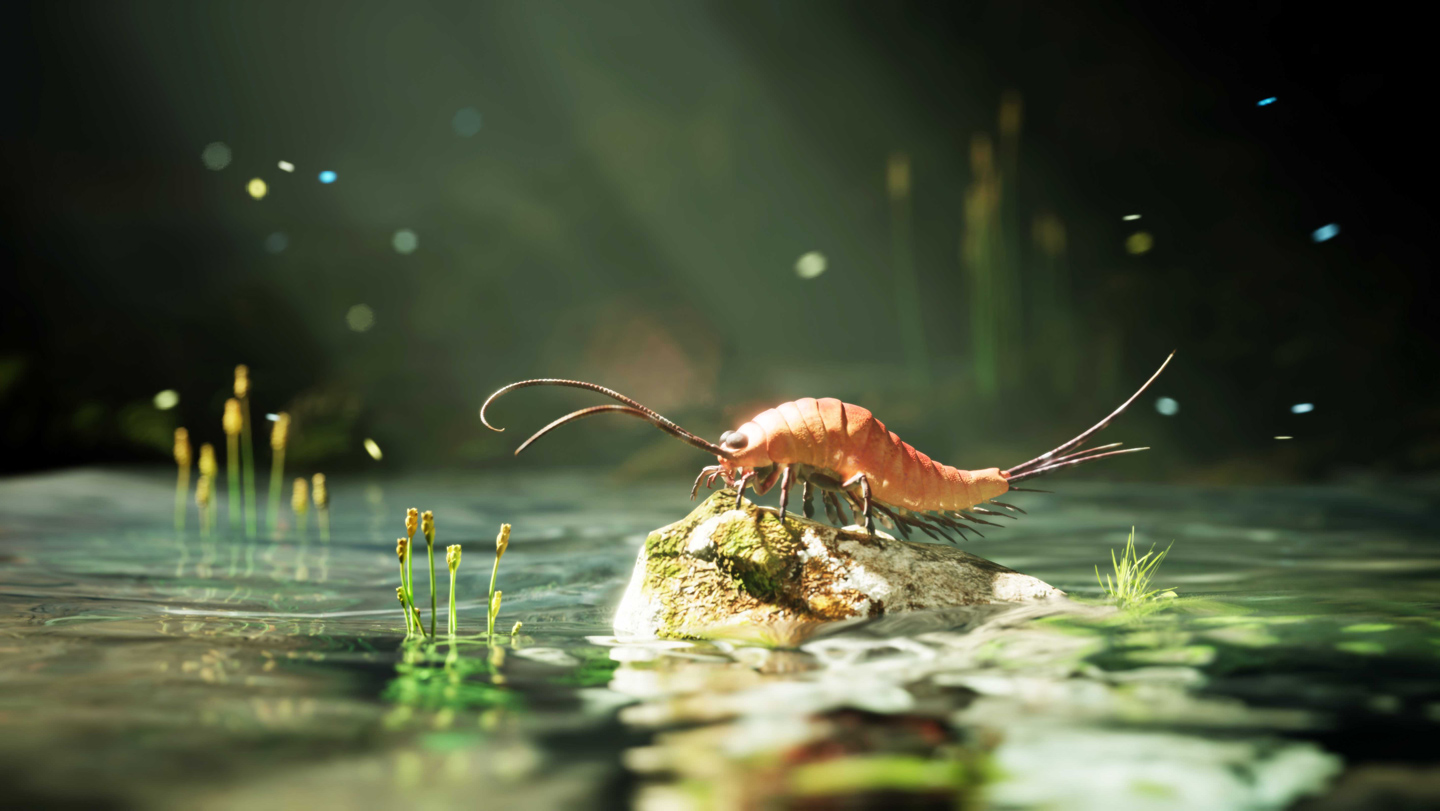
At first glance, the fossil appeared to be little more than a mysterious black smudge, unremarkable to the untrained eye. But when Tihelka examined it under polarized light filters—which reduce glare and enhance contrast—a world of anatomical detail emerged. The specimen revealed features that unmistakably pointed to its insect identity: a three-segmented thorax, an elongated abdomen with eleven distinct sections, whip-like antennae, a long central tail flanked by two shorter ones, a rigid tube for egg-laying, and the expected three pairs of walking legs. However, there was an extraordinary anomaly. The fossil also possessed nine additional pairs of short, stubby legs along its abdomen, with the rear pairs ending in flattened, grooved paddles that may have enabled swimming or movement through muddy, shallow seas.
This remarkable creature has been named Chosha praecursor, a name inspired by Navajo creation mythology, which speaks of a primordial world inhabited by insect-like beings whose descendants would eventually populate the Earth. The name combines the Navajo word for insect with the Latin term for predecessor, honoring both the cultural heritage of the region and the fossil’s evolutionary significance. Intriguingly, Tihelka recognized similarities between Chosha and other fossils he had encountered, including a 405-million-year-old specimen from Scotland and two undescribed multi-legged, insect-like fossils from the Mazon Creek beds of Illinois. When he compared all these ancient oddities with known insects and crustaceans, both living and extinct, a clear picture emerged: they all occupied a position just outside the group containing all modern insects, with crustaceans branching off even further back in evolutionary history.
The broader implications of this discovery are profound. These many-legged proto-insects, with their extra limbs and paddle-like appendages, appear to have lived semi-aquatic lifestyles. At some point in evolutionary history, one such creature presumably transitioned to a fully terrestrial existence, gradually shedding its surplus legs until only six remained. This ancestral insect would then have given rise to the millions of insect species that now inhabit virtually every corner of our planet. Tihelka notes the irony that insects are called “hexapods,” meaning six-legged, when it turns out their original ancestors had far more. Dany Azar, a paleoentomologist at Lebanese University and the Nanjing Institute of Geology and Palaeontology, describes the fossil as a major milestone in understanding a puzzling period when life was transitioning from aquatic to terrestrial environments, a time with almost no fossil evidence. William Shear, a retired paleobiologist, echoes this enthusiasm, stating that the discovery opens many doors to the study of insect evolution and expressing hope that further searching will uncover more fossils of this extraordinary creature.