


For generations, one of the most mesmerizing chapters in the grand story of life has been the moment our ancient, water-dwelling ancestors first crawled out of the dark primeval oceans and onto the unexplored shores of the Earth. Schoolchildren and seasoned researchers alike have long been taught that this monumental leap—the transition of vertebrates from water to land—was bridged by a dramatic bodily overhaul. This theory held that the earliest land-goers, known as early tetrapods, began their lives as aquatic larvae, breathing through delicate external gills and swimming with flimsy tail fins, before undergoing a radical, amphibian-like metamorphosis to gain their land legs and lungs. This “tadpole-to-frog” model was widely accepted as the default evolutionary template, a biological necessity for surviving the harsh, dry world above the waves. However, a groundbreaking scientific discovery is completely overturning this deep-seated dogma, revealing that the pioneering creatures of the Carboniferous period did not actually need a magical mid-life transformation to conquer the land. Instead, new fossil evidence from the hatchlings of three incredibly distinct ancient lineages shows that these animals emerged from their eggs already looking like miniature versions of their adult selves. Led by paleontologist Jason Pardo of the Field Museum in Chicago, this paradigm-shifting research indicates that these ancient pioneers bypassed the vulnerable larval stage entirely, hatching with their adult body plans fully intact. This revelation fundamentally reshapes our understanding of the origin of all four-limbed animals—including reptiles, amphibians, birds, and mammals—demonstrating that the capacity to walk on land was already deeply programmed into their biological development from the very moment they broke free from their shells, inviting us to view our own evolutionary journey through a dramatically different lens.
This prehistoric revelation was made possible by the extraordinary fossil beds of Mazon Creek, Illinois, a legendary paleontological sanctuary that has spent the last 308 million years preserving the delicate mysteries of our planet’s deep past. Within these ironstone nodules, researchers Jason Pardo and Arjan Mann discovered the incredibly rare, millimeter-scale remains of newborn early tetrapods and their close relatives that perished shortly after hatching. Because fossilizing delicate baby animals is an almost impossible geological miracle, the team had to employ state-of-the-art scanning electron microscopes to peer through the stone, uncovering details that are normally lost to the march of time. To their absolute amazement, they were able to map out beautifully preserved soft tissues, including fossilized skin, fragile cartilage, and developing bone matrices, which revealed a striking biological truth: these tiny creatures lacked even a single trace of larval anatomy. There were no external gills, no temporary larval structures, and no signs of the incomplete skeletal development typical of modern tadpoles. Perhaps the most poignant, humanizing detail discovered during this meticulous microscopic analysis was the presence of a tiny, fossilized yolk sac nestled inside the abdomen of a one-centimeter-long baby embolomere. This miniature nutritional pocket proved that the creature was an absolute newborn, having died almost immediately after hatching. For the scientists, staring at this incredibly fragile, ancient infant felt like looking at a photograph taken more than three hundred million years ago, a breathtakingly intimate moment of connection with a tiny life that came into the world fully formed, skipping the arduous process of metamorphosis before it even had the chance to take its first steps.
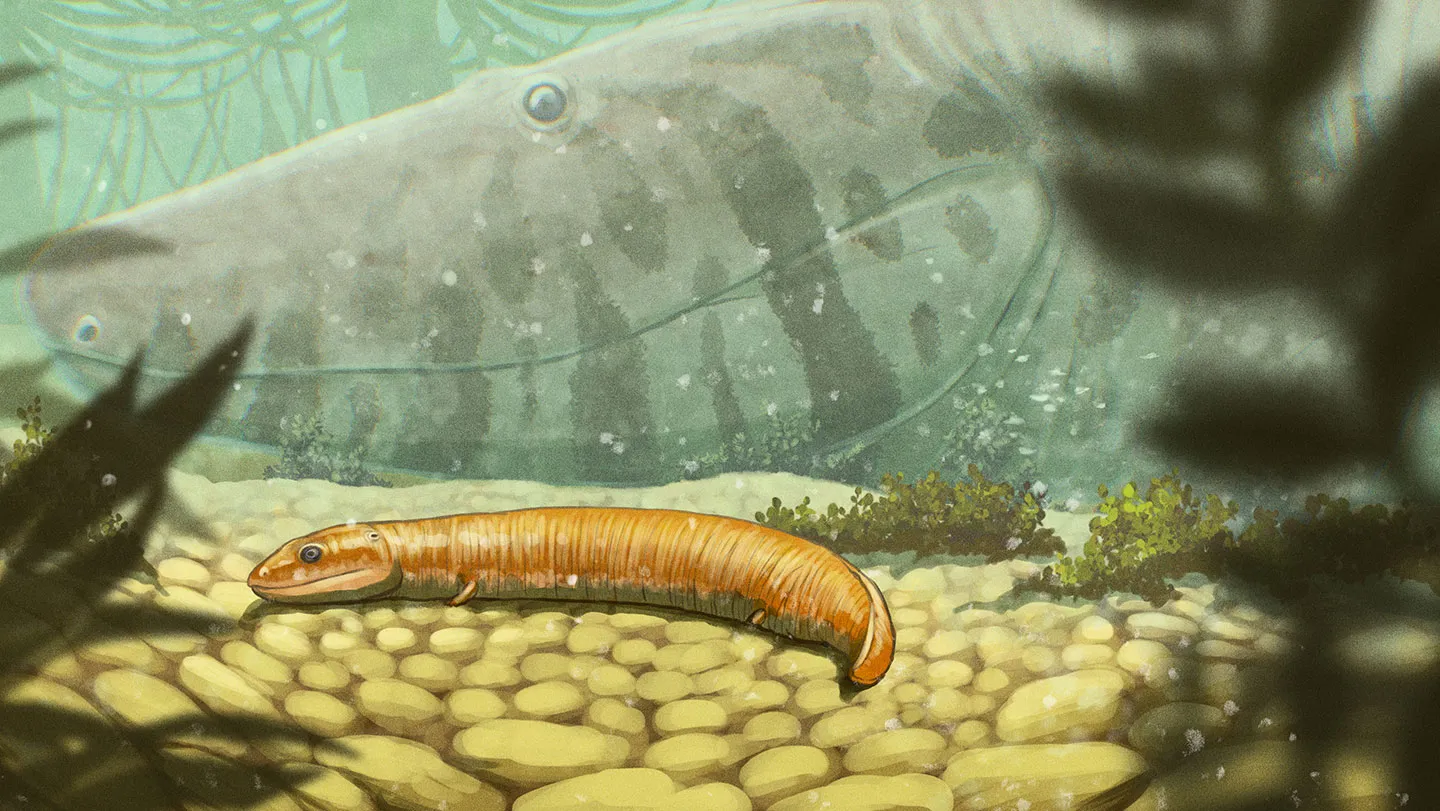
To build an airtight case against the long-held metamorphosis theory, the researchers intentionally focused their efforts on three highly diverse extinct lineages, ensuring their findings reflected a broad evolutionary rule rather than an isolated fluke. The first of these creatures was the embolomere, a formidable, aquatic predator of the Carboniferous Period that grew into a massive hunter resembling a peculiar cross between a sleek modern crocodile and a freshwater eel. While adult embolomeres spent the vast majority of their lives prowling muddy lagoons, they possessed small but functional limbs that allowed them to haul themselves onto land for short journeys. The second animal was a megalichthyid, a robust, heavily scaled fish-like relative of tetrapods that possessed internal skeletal features that directly foreshadowed the hands and feet of modern land-dwellers. The third animal was an aïstopod, a truly bizarre, serpentine creature that had completely shed its limbs over evolutionary time, slithering through the ancient undergrowth like a prehistoric snake while remaining firmly rooted in the tetrapod family tree. By examining the hatchlings of these three incredibly distinct animal groups—representing vastly different lifestyles, ecological niches, and physical body shapes—and discovering the exact same lack of larval traits across all of them, the scientific team established a remarkably powerful pattern of direct development. These findings prove that these ancient creatures were born with their adult characteristics, suggesting that this direct-development lifestyle was the primitive, ancestral state for all early land-goers, rather than a specialized adaptation that developed later in Earth’s history.
This realization forces us to carefully deconstruct why the scientific community fell in love with the idea of a universal metamorphosis in the first place, revealing how easily modern analogies can cloud our view of the ancient past. For over a century, the spectacular, two-stage life cycle of modern amphibians—like frogs transforming from water-bound tadpoles into land-dwelling adults—was viewed as a perfect biological time machine, reflecting the exact steps our ancestors took when they first dry-docked on primeval shores. Scientists assumed that because transitioning from water to land is such a massive physiological hurdle, ancient animals must have solved the problem the same way frogs do today, by gradually dissolving gills, rearranging skull structures, growing new legs, and expanding lung capacity mid-way through their lives. However, this new fossil evidence exposes that modern amphibians, with their dramatic metamorphic transformations, are not primitive evolutionary templates at all, but are actually highly specialized survivors that developed this complex double-life strategy much later in their evolutionary history. Instead of being the default pathway for the first land-walking creatures, metamorphosis appears to be a specialized, derived trait that evolved independently as a way to help modern species conquer specific ecological niches, allowing babies and adults to avoid competing with one another for the same food sources. By uncoupling the physical transition to land from the chaotic biological drama of metamorphosis, this research reveals that the very first steps taken on dry land were not made by creatures undergoing a frantic mid-life structural crisis, but by tiny, resilient babies who had already mastered both worlds from the moment they hatched.
The human side of this evolutionary rewrite represents a beautiful, humbling testament to the self-correcting and highly collaborative nature of modern science, reminding us that cherished scientific dogmas must always bow to the physical evidence of the natural world. External experts who were not involved in the initial study, such as evolutionary biologist Laura Porro of University College London, have enthusiastically celebrated the findings, pointing out that the sheer geological diversity and perfect preservation of the three fossil groups provide an undeniable, conclusive blow to the old assumptions. This discovery highlights the profound intellectual humility required by paleontologists, who must remain constantly willing to allow a single, well-preserved fragment of ancient stone to completely shatter over a century of established textbook teachings. For Pardo, Mann, and their colleagues, the journey of examining these incredibly tiny Carboniferous babies has been one of deep emotional and scientific awe, realizing that these microscopic, fragile bones have the immense power to restructure how humanity understands its own biological heritage. It underscores the beautiful reality that our museums and fossil archives are not dusty repositories of static, unchangeable facts, but are instead vibrant, evolving libraries of clues waiting for the next generation of creative minds and advanced technologies to unlock their hidden truths. This collaborative spirit of discovery breathes fresh life into the ancient past, proving that we are all deeply connected to these primordial lineages, and that by listening to the stories written in the stones beneath our feet, we can slowly unravel the beautiful mystery of how we came to inherit the Earth.
Looking toward the future, this monumental shift in our understanding of early tetrapod development opens up an exciting array of new questions and investigative paths, encouraging researchers around the globe to re-examine existing fossil collections with entirely fresh eyes. We still find ourselves standing on the edge of many profound evolutionary mysteries, such as exactly how many times different animal families independently made the brave leap from the water to the shore, and the precise environmental pressures that coaxed them onto the land. Yet, as the dust settles on this historic study, we are left with a vastly more beautiful, elegant, and simplified picture of those first historic footsteps in the ancient mud—a journey defined not by a chaotic, shapeshifting struggle for physical survival, but by the quiet, steady resilience of tiny hatchlings taking their very first breaths of fresh air, perfectly formed and ready to face the world. This elegant shift in our evolutionary story serves as a poetic reminder of how much of our planet’s rich history remains waiting to be discovered, locked within ancient rocks, silently waiting for the perfect moment to challenge everything we thought we knew about our beginnings. Ultimately, it reassures us that our own ancient passage from the dark, nurturing waters of the primordial seas to the bright, open lands of the modern world was a journey marked by an innate, born-ready strength—a legacy of adaptability and quiet determination that continues to beat in the heart of every terrestrial creature walking the Earth today.