


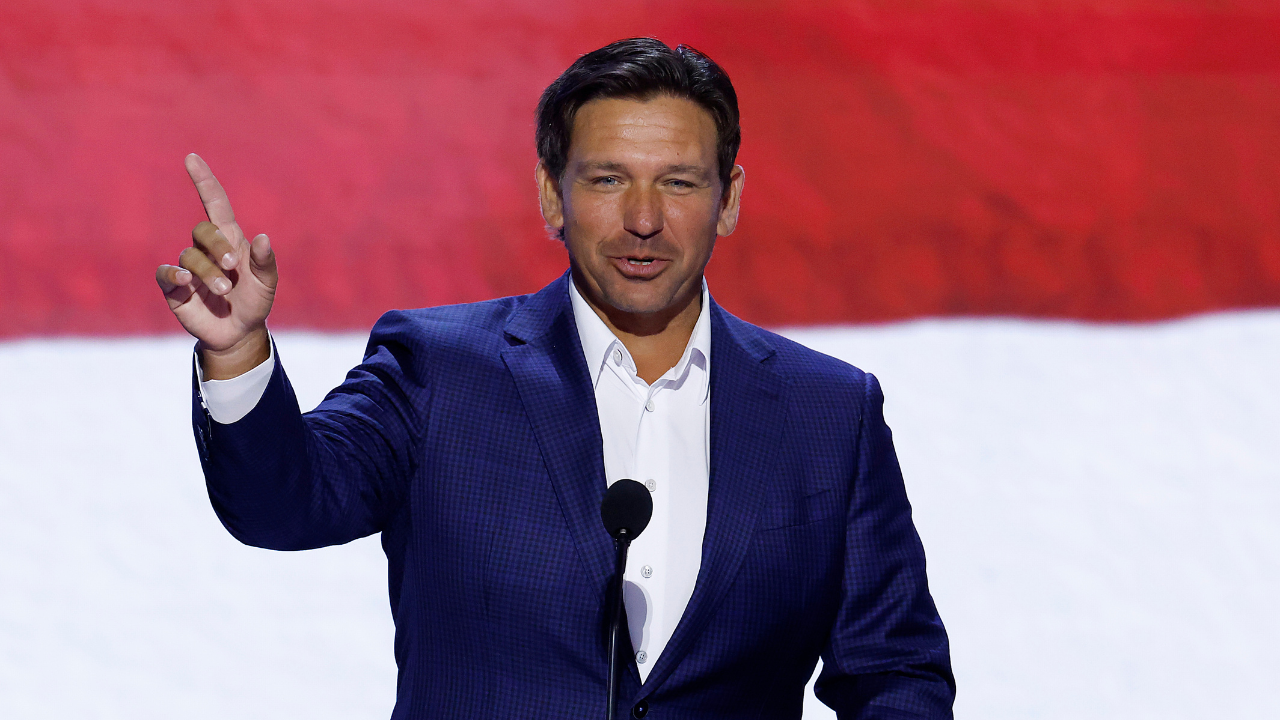
There was something electric in the air inside a St. Cloud venue Tuesday night, and it wasn’t just the usual pre-election adrenaline. Gov. Ron DeSantis stood before a packed crowd in Osceola County and made the case that Florida is not simply a place where Republicans have learned to win—it’s a laboratory, a living example, and maybe the last best model for how to turn conservative principles into actual governing. The occasion was a rally for Dan Green, a Navy veteran and Republican candidate looking to flip Florida’s 9th Congressional District, but DeSantis made clear the stakes were bigger than one seat. He was there to offer a blueprint. From the moment he started speaking, he framed Green’s campaign as part of a larger movement to export what he called Florida-style governance to Washington, D.C. The crowd didn’t have to strain to hear the message: if you want a Congress that fights the way Florida has fought, send people who understand the difference between posting a press release and taking a punch. DeSantis didn’t stand behind a podium and recite talking points. He preached. He rallied. He repeated his greatest hits and dared anyone in the room to say they weren’t true. For the faithful who packed the space, it was a two-term governor telling them that they were part of something that had not only changed Florida but could change a country that seems exhausted by gridlock, infighting, and empty promises. For those who have followed his career, the setting felt familiar: a governor who governs like he’s still campaigning, and a campaign that feels less like a routine election stop and more like a revival service for the conservative movement. The explicit message was simple—support Green, send Florida’s playbook to Congress—but the deeper message was even more personal: don’t be afraid to fight, because you just might win.
Once DeSantis got rolling, he gave the crowd a tour of his administration’s battles, and he did it with the confidence of a man who genuinely believes he won every fight worth having. He ticked off the names that usually send politicians scrambling for cover: Dr. Fauci, Disney, George Soros, Martha’s Vineyard, the Muslim Brotherhood, teachers unions, SEIU. One by one, he listed what Florida did and what it proved. Florida beat Fauci on COVID by keeping schools open and beaches open when other states were locking down. Florida beat Disney on gender ideology by refusing to let a corporation impose its values on children. Florida beat Soros on crime by removing two elected prosecutors who refused to do their jobs. Florida beat Martha’s Vineyard on illegal immigration by sending a plane full of migrants to a state that had declared itself a sanctuary. Florida beat the Muslim Brotherhood by banning Sharia law. Florida beat the teachers unions by delivering universal school choice. Florida beat SEIU with paycheck protection. The rhythm was almost like a preacher at a tent revival. Every time he said “we beat,” the crowd had reason to cheer, because each of these wasn’t just a policy decision; it was a confrontation with an institution that most politicians on the right would rather ignore than fight. And that, DeSantis insisted, is exactly the point. Anyone can win an easy fight or ride a wave when things feel good. But the battles that matter are the ones where the other side has more money, more power, and more friends in the media—and you still don’t back down. He told the crowd that Florida has fought every big fight there was to fight, and Florida has won every big fight there was to win. It was a sweeping claim, and surely not everyone would agree with every part of it, but for the people in that room it sounded less like a boast and more like a promise: send Dan Green to Congress, and he’ll bring that same stubborn spirit with him. The victory-lap tone wasn’t accidental. DeSantis wanted voters to believe that conservative governance is not about ideology alone—it’s about winning, and winning changes the lives of regular people who are tired of watching politicians get beaten down by the left’s most powerful institutions.
Perhaps no fight has come to define DeSantis the way his showdown with Disney has. He brought it up not as a stale talking point, but with the relish of someone who knows he did what no Florida governor had ever done before. “Nobody in the history of the state had ever taken on Disney in anything,” he said, and he didn’t need to explain why that mattered. Disney is not just a company in Florida; it’s a political force, an economic engine, and a cultural icon all wrapped into one. For decades, politicians of both parties treated it as untouchable. DeSantis took it on anyway, and he made the fight personal. He framed it in simple moral terms: do you want a society where six-year-olds are told they can change gender, or do you want a society rooted in truth? He said that if you want truth, you have to stand up even when the biggest, most powerful corporation in the state is against you. And then he added the line that seemed to sum up his whole political identity: “We fought, and we won.” The story served a larger point about leadership. DeSantis acknowledged that a lot of people told him he was making a mistake when he challenged Disney, just as they told him he was making a mistake when he refused to shut down beaches during the pandemic. They said he was frittering away his governorship, that he would lose in 2022, that his political career was going to crash. But he didn’t listen. He insisted that his job was not to protect his own political hide, but to protect the liberty, jobs, and businesses of the people he was elected to serve. His phrase “we started the fire, and we gave them his right” was hard to fully parse, but it clearly meant something to him—something about taking the heat and staying on the offensive. The crowd understood the message: convictions matter more than comfort, and leadership is only leadership when it costs you something. By making the Disney fight so central to his speech, DeSantis was signaling to the audience that courage is not an accident. It’s a choice you make every time a powerful group tells you to sit down and be quiet.
DeSantis then switched from the culture wars to the wallet. He spent time talking about Florida’s fiscal record, and he tried to make numbers feel personal. He reminded the crowd that Florida has reduced its budget four years in a row—something he said almost no other state can claim. He announced that during his tenure, Florida will retire 54 percent of the entire state debt accumulated over its whole history, cutting it by more than half. He talked about education freedom, ranking Florida No. 1 in the country, and he avoided the usual catchphrases in favor of a simple, concrete fact: the state’s public university system is No. 1, and in-state tuition is exactly what it was on his first day in office. It did not go up a single penny. He paused to let that sink in, then added a joke that sounded like something you’d hear at a kitchen table rather than a political rally. Everything else has gone up, he said, even the dollar menu at McDonald’s, which is now $2.99. But Florida tuition didn’t go up. It was a folksy way to make a point about competence and discipline, and it worked. He also reminded voters that Florida has delivered about $10 billion in tax relief over his tenure, including permanent cuts like no tax on baby items, back-to-school items, and business rent. But then he got to what he called “the big enchilada”: Amendment 3, the ballot proposal that would allow voters to eliminate non-school property taxes and give people more control over their own homes. He told the crowd to vote yes on 3, warning that they shouldn’t let the government tax them to death. This wasn’t just a budget lecture; it was a promise that conservative governance means something real in people’s everyday lives. It means less money dragged out of their paychecks. It means parents have choices. It means the state isn’t digging a hole for the next generation. For the people in the room, these were not abstract numbers. They were reasons to believe that Florida’s approach was not just about fighting the right cultural battles, but also about running the government in a way that leaves people alone and lets them keep more of what they earn. In an era when Washington keeps spending and the federal debt has topped $40 trillion, DeSantis used Florida’s books as a quiet rebuke to the whole way the capital does business.
Near the end of his speech, DeSantis turned to the political landscape, and he tried to make his story feel like the voters’ story. He reminded everyone that when he ran for governor in 2018, much like now, Republicans were facing a headwind. People were saying it was a blue year. Florida was supposedly a purple state, a swing state that had been decided by one point for a decade. There were all these warnings about people moving into Florida from Puerto Rico and the Northeast, changing the demographics, turning the state blue. A lot of people didn’t think he could win under those circumstances. He ran anyway. He won narrowly, and then he had to decide what kind of governor he would be. He had a choice, as he put it: tiptoe around the tulips, try not to offend anybody, and walk a tight line between the two parties. Or he could decide that he wasn’t elected to follow—he was elected to lead. He chose the second path. And to prove it, he made a bold claim that most politicians would never dare to make: he has never polled a single issue in his entire time as governor. Not one. He explained that polls can be manipulated by the way the questions are asked, and that the same issue can produce different results depending on how you phrase it. But more than that, a poll tells a politician what people already think; it doesn’t tell them what is right. He quoted Popeye, of all people: “I am what I am.” The choice of a cartoon sailor might have drawn a few laughs, but it was also a serious statement about authenticity. In a political age where everything is focus-grouped, message-tested, and timed for the next news cycle, DeSantis was telling the crowd that he would rather be disliked for who he is than embraced for what he isn’t. He would rather lose doing what he believes in than win doing what someone else’s survey says is safe. That’s the kind of personality that drives his supporters to adore him and his critics to despair. It’s also the attitude he wants voters to send to Washington, where too many Republicans have fallen into the habit of letting the other side define the argument and then trying to explain themselves afterward.
Finally, DeSantis made sure everyone remembered why they were there. This was not just a celebration of the past six years in Florida; it was a call to action for Dan Green and for every Republican on the ballot. Green is a Navy veteran, and DeSantis called him a man who has served this country and served for the right reasons. He asked the crowd to get him elected to Congress. He also talked about term limits, which he supports for members of Congress. Until those exist, he said, “you can show your current guy the term limit by kicking him out of office.” That line got one of the loudest reactions of the night. The message was simple: don’t wait for term limits to get rid of the old way of doing things; do it yourself with your vote. DeSantis said Florida can be a model for Green and for other states, because it’s not about “peacocking” or putting out social media press releases without getting anything done. It’s about actually winning fights. He talked about flying the banner of bold colors, not pale pastels, and about a governing philosophy that is unapologetic and unshakeable. For the people seated in St. Cloud, the night ended with a feeling that the fight is not over. There are midterm headwinds, there are national currents, there are all the usual reasons to be nervous. But if you look at Florida, DeSantis seemed to say, you can see evidence that a conservative movement can still thrive if it refuses to be defined by fear. The rally for Dan Green was about one congressional race, but it was also about something bigger: the belief that what happened in Florida doesn’t have to stay in Florida. The crowd left with a clear assignment—vote for Green, vote yes on Amendment 3, and maybe, just maybe, send the same courage that has defined the governor’s house in Tallahassee to the halls of Congress. Whether that blueprint will work for other candidates remains to be seen, but on a warm Tuesday night in Osceola County, it felt possible in a way that pure political analysis rarely captures.