

The atmosphere inside the Senate Homeland Security and Governmental Affairs Committee hearing room on Wednesday morning was nothing short of electric, crackling with the kind of intense, deeply personal rivalry that can only build over years of public ideological warfare. For years, Senator Rand Paul, R-Ky., a physician by trade before entering politics, and Dr. Anthony Fauci, the former head of the National Institute of Allergy and Infectious Diseases, have engaged in a highly public, fiercely adversarial debate over the government’s response to the COVID-19 pandemic. Their past encounters were marked by sharp verbal barbs and academic disagreements, but this hearing instantly felt different, carrying the heavy weight of a final reckoning. The crowd in the gallery sat in hushed, nervous anticipation as the proceedings got off to an incredibly rocky and dramatic start. Rather than engaging in the spirited, defensive exchanges that had characterized his previous congressional appearances, Dr. Fauci chose a path of absolute silence. Under advice from his extensive legal counsel, Fauci repeatedly invoked his Fifth Amendment rights, refusing to answer Paul’s pointed questions regarding the pandemic’s origins and his past policy decisions. This abrupt shift from a highly vocal public health champion to a silent figure shielding himself behind the Constitution set a tense, adversarial tone that defined the high-stakes legal and political drama about to unfold.
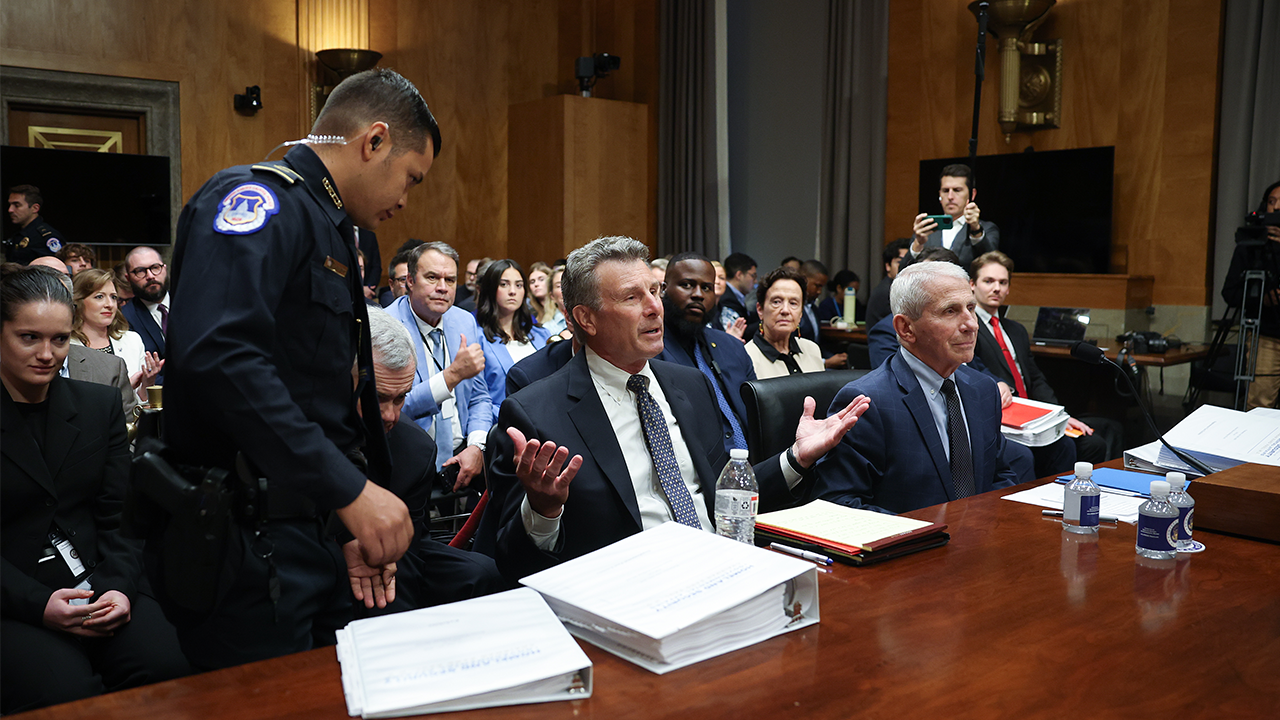
The fragile order of the hearing room shattered completely when one of Fauci’s attorneys, whom Senator Paul identified as David Schertler, decided to step out of his traditional advisory role and directly challenge the committee’s rules. Schertler, who was one of “half a dozen” lawyers Fauci brought to Capitol Hill for support, had insisted on sitting directly at the main witness table alongside Fauci, despite being instructed by committee staff to sit in the row of seats directly behind. The physical positioning was a subtle but clear assertion of authority, and the tension boiled over when Schertler repeatedly attempted to speak and interrupt the proceedings without being recognized by the chair. A visibly displeased Rand Paul immediately tried to de-escalate the disruption with a stern warning, telling the attorney, “You are not recognized, you’re not recognized. If you are unruly, you will be removed from the proceeding.” Despite this direct and explicit admonition from the senator, Schertler refused to back down, continuing to speak over the committee members in what appeared to be an attempt to shield his client from the pressure of the moment. This defiance transformed a legislative oversight hearing into a raw, captivating struggle over authority, showcasing the deep-seated frustration of a Senate panel determined to assert its constitutional power over a defiant witness and his defensive legal team.
As the attorney continued to speak out of turn, Senator Paul’s patience wore entirely thin, leading to a fiery, highly cinematic exchange that laid bare the mutual contempt between the two sides of the table. Paul rebuked the attorney with a severe tongue-lashing, demanding that he respect the gravity of the congressional proceedings. “You will respect these proceedings. You were told not to sit at the table. You insist on sitting at the table. And we told you would not be recognized. You are not invited here for testimony, sir. You are being disruptive,” Paul declared, his voice echoing through the quiet chamber. The senator then drew a sharp, humanizing comparison to a court of law, asking Schertler if he would ever dare behave in such a disrespectful manner in front of a judge, pointing out that a judge would have swiftly thrown him in jail for contempt. Though Paul acknowledged that he, as a senator, lacked the immediate power to incarcerate him, he warned that his patience was fully exhausted, telling the attorney, “Another word and you’re gone.” The ranking member of the committee, Senator Gary Peters, D-Mich., attempted to intervene on the lawyer’s behalf, suggesting that the committee should hear what the attorney had to say. However, Paul fiercely shut down this effort, arguing that the hearing was meant for Dr. Fauci’s testimony, not a game played by a massive team of lawyers who were refusing to play by the rules.
When Schertler once again refused to remain silent, defying the final warning, Senator Paul turned to the security detail in the room and issued a direct order: “Please remove him from the room.” The dramatic climax of a lawyer being physically escorted out of a Senate hearing by Capitol Police was met with an immediate, unexpected reaction from the gallery, as several spectators broke out into spontaneous applause. The applause highlighted the deep public polarization surrounding the entire event, showing how Fauci remains a highly divisive figure whose actions are viewed through vastly different lenses by the American public. As Schertler was led away, Paul kept the pressure on, dryly noting for the official record that Dr. Fauci would still have the advice of the approximately half a dozen other attorneys he had brought along with him that day. This cutting remark emphasized the perception of Fauci as a highly insulated, elite bureaucrat protected by an army of legal defenders. The sight of a legendary public servant, who once enjoyed nearly universal praise at the height of the pandemic, sitting silently while his lawyer was ejected from a government building, served as a powerful visual metaphor for his complex, heavily scrutinized legacy.
Behind this dramatic courtroom-style theater lay a deep well of political and scientific resentment that has been brewing since the early days of 2020. The hearing took place against a backdrop of newly exposed documents that critics argue paint a highly contradictory picture of Fauci’s public persona versus his private actions. Recently released private diary entries revealed that Fauci had privately taken credit for the highly controversial societal lockdowns while publicly denying his direct influence over them, a revelation that has deeply angered many lawmakers who blame those policies for widespread economic and educational damage. Furthermore, internal Slack messages released by Paul appeared to show that the authors of a key scientific paper on the origins of COVID-19 held major, private doubts about the natural origin narrative even as they publicly dismissed the lab-leak theory as a conspiracy. To Paul and his supporters, these documents represent a profound betrayal of the public trust, suggesting that the pandemic response was managed through a carefully constructed public relations narrative rather than transparent science. For Fauci’s defenders, however, the hearing was viewed as a continuation of a partisan, personalized crusade designed to tear down a dedicated public servant who had to make impossibly difficult decisions under unprecedented pressure.
Adding a final, critical layer of legal complexity to Wednesday’s high-stakes confrontation was the political shadow cast by former President Joe Biden’s recent decision to grant Anthony Fauci an unconditional, preemptive pardon. While this controversial executive action protected Fauci from potential federal criminal prosecutions related to his official actions during the pandemic, Senate Republicans were quick to emphasize that the shield of a presidential pardon does not grant a license to lie to a congressional committee. They warned that if Fauci or his remaining legal team chose to mislead Congress or commit perjury during their high-profile testimony, they could still face severe, newly generated legal consequences that would not be covered by the existing pardon. This crucial legal boundary explained why Fauci’s remaining lawyers were so hyper-vigilant and highly defensive, and why the atmosphere in the room remained so incredibly tense even after Schertler’s departure. As the dust settled on the day’s chaotic opening, the hearing served as a stark, humanizing reminder of the enduring scars left by the pandemic era, proving that the struggle over truth, accountability, and the limits of governmental power remains one of the most passionate and deeply unresolved conflicts in modern American life.