





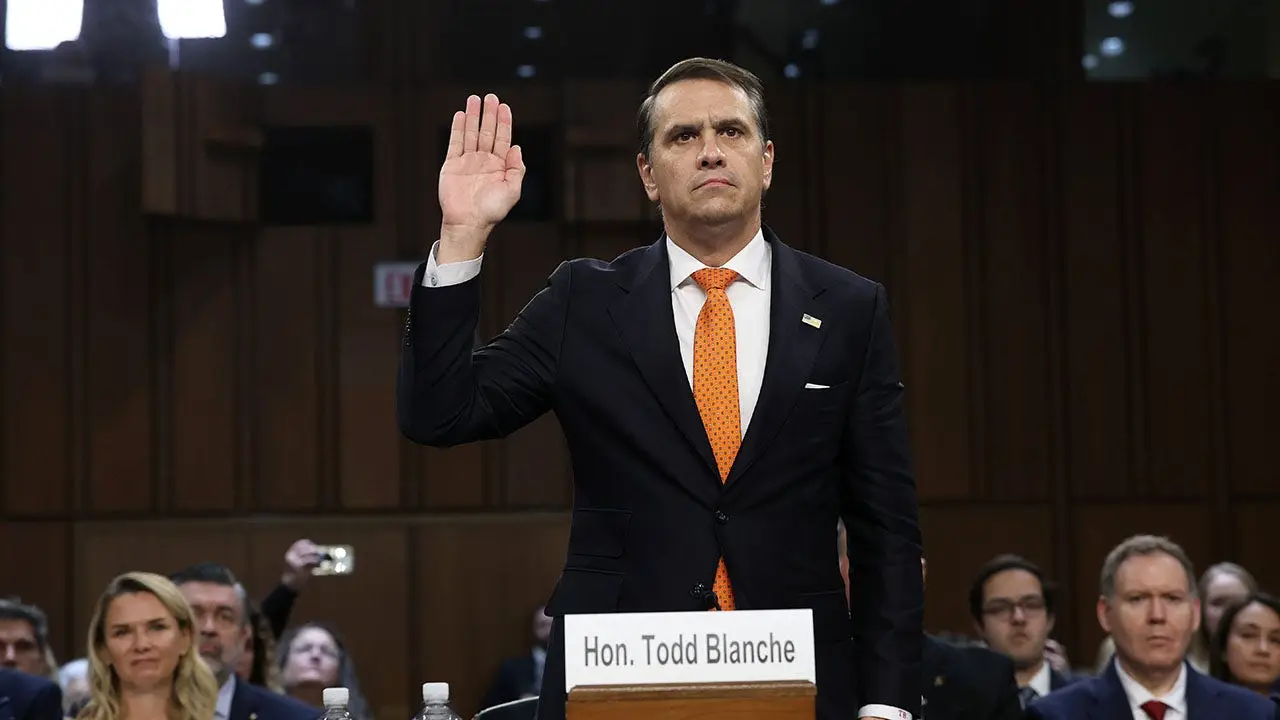
The journey to the pinnacle of American law enforcement is rarely a straight line, but for Acting Attorney General Todd Blanche, the path has resembled an intense, high-stakes obstacle course where the most formidable hurdles were unexpectedly set up by members of his own political family. On a quiet Sunday afternoon that belied the frantic, pressure-cooker negotiations occurring behind closed doors in Washington, Blanche took a massive, highly calculated step toward securing his permanent Senate confirmation. He did so by executing a maneuver that politicians often find excruciatingly difficult: capitulating entirely to the demands of his party’s most vocal skeptics. For several anxious weeks, Blanche had found himself trapped in a frustrating professional limbo, serving merely as the temporary custodian of the Justice Department after taking over from Pam Bondi in April, while his official nomination languished in legislative purgatory. Interestingly, the primary source of this paralysis did not stem from across the aisle—where Democrats have maintained a unified, highly predictable wall of total opposition—but rather from within the ranks of the Republican Party itself. Senators John Cornyn of Texas and Thom Tillis of North Carolina had effectively placed a firm chokehold on his nomination, refusing to let it advance to a vote without significant, legally binding concessions regarding executive power. This dramatic standoff highlighted the delicate, often deeply agonizing human element that underpins major political appointments, where personal ambitions, institutional duties, and fierce party loyalty constantly collide in the public square. Blanche, a seasoned and remarkably pragmatic former defense attorney who previously shielded Donald Trump during some of his most perilous legal battles, had to leverage every ounce of his interpersonal diplomacy and legal acumen to navigate this internal party crisis. Ultimately, he chose to prioritize the long-term stability of his confirmation over the immediate defense of a highly controversial administration policy, demonstrating the cold, unsentimental calculations required to survive in modern Washington.
At the absolute center of this political firestorm was a massive, highly controversial policy proposal known as the “anti-weaponization fund”—a staggering $1.8 billion initiative born out of the Trump administration’s long-standing grievances with the Internal Revenue Service and other federal agencies. To the administration’s most loyal supporters, this fund was envisioned as a vital shield designed to protect conservative organizations, faith-based groups, and everyday citizens who felt they had been unfairly targeted, harassed, or “weaponized” against by a hostile federal bureaucracy. However, to more traditional, institutionally minded lawmakers like Cornyn and Tillis, the fund represented an unprecedented, highly dangerous fiscal mechanism that completely lacked proper legislative oversight and carried deeply troubling moral implications. The chief concern among these skeptical lawmakers was the looming, highly toxic possibility that this enormous pot of taxpayer money could eventually be utilized to provide financial relief, legal representation, or direct payouts to individuals convicted of violent offenses during the January 6, 2021, attack on the United States Capitol. Senator Tillis was particularly vocal and unsparing in his public criticism of the plan, famously referring to the potential recipients of these funds as “punks” and warning that the administration was attempting to inappropriately establish a “bogus fund” that would bypass the constitutional spending power of Congress entirely. The very idea of taxpayer dollars being funneled to individuals involved in the Capitol riot was a political third rail that mainstream Senate Republicans were utterly unwilling to touch, fearing massive backlash from moderate voters. Furthermore, the fund was closely linked to a highly sensitive IRS audit settlement involving President Trump himself, raising immediate red flags among ethics watchdogs about potential conflicts of interest and the sweeping nature of future-use tax protections. Although the Justice Department insisted that the fund was entirely dormant—meaning no members had been appointed, no funds had actually been transferred, no claim processes had been established, and absolutely no payments had been made—the mere existence of the proposal was enough to completely stall the nomination of the country’s chief law enforcement officer.
The standoff rapidly escalated into a fascinating, high-stakes test of political wills, particularly after President Donald Trump publicly lashed out at the “rogue” Republican senators who were holding up Blanche’s nomination, vowing to fight fiercely for his anti-weaponization legislation in the future. For Blanche, this public intervention by the president created an incredibly precarious, deeply stressful tightrope walk; he had to remain fiercely loyal to the powerful man who had appointed him while simultaneously appeasing the very senators who held the keys to his professional future. The political tension reached a boiling point when the Senate Judiciary Committee was forced to postpone an earlier scheduled vote on Blanche’s nomination, with Cornyn and Tillis demanding a rock-solid, written commitment from the administration rather than mere verbal assurances or backroom handshakes. Recognizing that his window of opportunity was rapidly closing and that a failed nomination would permanently damage his legal career, Blanche engaged in weeks of intensive, highly personal negotiations with committee members to de-escalate the crisis. On Sunday, Blanche took the unusual step of using his personal social media platform to publicly declare that his team had successfully addressed all outstanding questions and concerns, praising the productive, good-faith nature of the discussions. He then issued a formal, binding executive order that effectively terminated the May 18 directive establishing the controversial fund, proving that in the ruthless, pragmatic arithmetic of Washington confirmation battles, survival almost always triumphs over ideological purity. By taking personal responsibility for dismantling the fund, Blanche shielded the administration from a humiliating legislative defeat while quietly demonstrating his own capacity for independent action and institutional respect. This strategic pivot revealed a highly sophisticated understanding of Senate dynamics, showing that Blanche was willing to risk the ire of the administration’s more radical elements to secure the institutional legitimacy that only a formal Senate confirmation can provide.
The specific details of the written agreement reached between Todd Blanche and the skeptical senators are as legally precise as they are politically significant, focusing heavily on narrowing the scope of the controversial IRS settlement. Specifically, the newly issued formal order makes it explicitly clear in a binding written document that the tax-related protections negotiated in the settlement apply strictly on a retroactive basis. This crucial distinction ensures that the protections are limited only to past actions and do not under any circumstances extend to future tax filings or provide a permanent shield against future IRS scrutiny. Furthermore, the document limits the scope of the audit settlement exclusively to the original plaintiffs—which includes President Trump—and the IRS itself, preventing any broader application of the settlement’s favorable terms to other individuals, corporations, or political allies. Natalie Yezbick, a spokesperson for Senator Cornyn, confirmed the breakthrough to the media, expressing deep satisfaction that the Justice Department had agreed to permanently terminate the anti-weaponization fund in a legally binding manner. This precise legal tailoring was designed to strip away any potential ambiguity that could have allowed a future administration to quietly resurrect the fund or expand the tax protections beyond their intended scope. For Senator Cornyn, securing this written commitment was not just a political victory, but a crucial assertion of the Senate’s constitutional authority to oversee the executive branch and protect the integrity of the nation’s tax system. By forcing the acting attorney general to put these strict limitations in writing, the senators successfully defanged a highly controversial policy while preserving their own political capital, illustrating the intricate, often tedious legal maneuvers that occur behind the closed doors of Capitol Hill. This compromise serves as a masterclass in legislative leverage, proving that even in a highly polarized era, senators can still use their advice-and-consent powers to force meaningful policy changes from the executive branch.
The timing of this hard-fought compromise is incredibly urgent, as the Senate Judiciary Committee is scheduled to convene for a crucial vote on Tuesday morning, with Republican leadership aiming to advance Blanche’s nomination to the full Senate floor before the end of the week. Under normal circumstances, confirming an attorney general would be a straightforward party-line vote, but the current political landscape is anything but normal. Because Senate Democrats remain entirely and fiercely opposed to Blanche’s nomination—viewing him as a partisan loyalist who is too closely aligned with Trump’s personal legal battles—Republicans simply cannot afford a single defection within their own ranks. If even one Republican senator votes against Blanche or chooses to abstain, the nomination would stall in committee, delivering a massive political embarrassment to the administration and leaving the Justice Department in a prolonged state of leadership uncertainty. This razor-thin margin of error explains why the cooperation of Cornyn and Tillis was so absolutely vital, and why Blanche was willing to make such substantial policy concessions to win their support. Blanche has been steering the Justice Department as acting attorney general since April, a challenging transitional period following the departure of Pam Bondi, and the lack of a permanent, Senate-confirmed leader has undoubtedly hindered the department’s long-term planning, morale, and authority. For mainstream Republicans, the prospect of failing to confirm their own president’s choice for attorney general due to internal bickering was a nightmare scenario that had to be avoided at all costs. The frantic negotiations of the past weekend were therefore fueled by a shared, desperate desire to project a unified front and avoid a highly damaging public collapse on the Senate floor. This desperation ultimately forced all parties to the table, demonstrating that the threat of political mutual assured destruction is often the most effective catalyst for compromise in a divided government.
As Washington holds its breath ahead of Tuesday’s pivotal committee vote, the resolution of the standoff over Todd Blanche’s nomination offers a profound, humanizing glimpse into the complex machinery of American governance and the personal sacrifices required of those who seek to lead it. For Blanche, the path to confirmation has been a grueling trial by fire, forcing him to balance his loyalty to a highly demanding president with the rigid, unyielding demands of a skeptical legislature. The ultimate demise of the $1.8 billion anti-weaponization fund is a stark reminder that even the most powerful executive figures must ultimately bow to the system of checks and balances that forms the absolute bedrock of the American republic. While some hardline supporters of the president may view Blanche’s concessions as a disappointing retreat, the reality is that his willingness to compromise has successfully preserved his path to power, positioning him to lead the nation’s most powerful legal apparatus. Senator Tillis, who had previously expressed deep skepticism about the administration’s intentions, is now widely expected to join Cornyn in supporting Blanche, signaling that the written commitments have successfully mollified the internal rebellion. This dramatic episode highlights the enduring truth of American politics: that behind the grand speeches, the public outcries, and the fiery social media posts, the real business of governing is still done through quiet compromise, meticulous legal drafting, and the pragmatic recognition of political reality. As Todd Blanche prepares to face the Judiciary Committee, he does so not just as a president’s personal defender, but as a seasoned political survivor who has proven he can navigate the treacherous, unpredictable waters of Capitol Hill to claim his place in history, forever changing the trajectory of the Department of Justice and proving his readiness to lead.