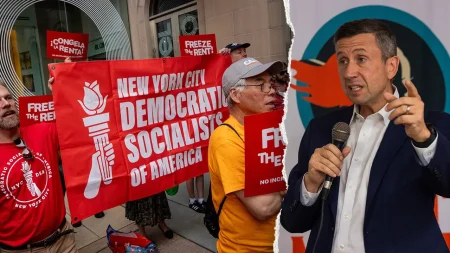



As an unprecedented summer heatwave swelters across the eastern half of the United States, leaving millions of citizens searching for any possible way to stay cool, a different kind of thermodynamic shift is rapidly warming up the internal politics of the Democratic Party. To casual observers, the language echoing through recent campaign rallies might feel like a bizarre, time-bending trip back to the mid-twentieth century, leaving many to wonder if they have somehow fallen through a crack in the space-time continuum and landed straight back in the Soviet Union. However, this is not Moscow in the height of the Cold War; this is the modern-day American electoral landscape, where a newly emboldened and highly organized faction of Democratic Socialists is actively rewriting the party’s vocabulary and policy goals. At union rallies and victory parties across major metropolitan centers, the word “comrade”—a term historically weighted with the heavy baggage of authoritarian communism—is being proudly dusted off, revitalized, and deployed by a new generation of progressive candidates. From New York Congressional nominee Darializa Avila Chevalier telling union workers that they deserve to have their “international comrades” working alongside them, to Colorado’s Melat Kiros celebrating her primary victory by shouting out her newly minted “comrades” in the crowd, the linguistic boundaries of American liberalism are shifting. For these young, passionate candidates, the word is not a dog-whistle to totalitarianism, but rather a warm, unifying expression of working-class solidarity. To their critics, however, it represents a shocking leftward lurch that threatens to alienate moderate voters and hand control of the federal government back to the Republican Party.
This sudden ideological transformation is no longer confined to the intellectual salons of lower Manhattan or the progressive bubbles of coastal academic towns; it is actively spreading to the geographic heart of the country, proving that the populist left’s economic messaging has a surprisingly broad appeal. The most startling evidence of this geographic expansion occurred in Denver, Colorado, where 29-year-old Democratic Socialist challenger Melat Kiros managed to pull off a shocking upset against Diana DeGette, a formidable 29-year veteran of the House of Representatives. Kiros’s victory sent shockwaves through the Washington establishment, signaling that the hunger for structural economic change is just as potent in the shadow of the Rocky Mountains as it is in the urban canyons of New York City. The platform driving these victories is unapologetically radical compared to the cautious incrementalism of the traditional corporate Democratic establishment, explicitly calling for Medicare for All, universal subsidized childcare, the complete abolition of Immigration and Customs Enforcement (ICE), and an immediate halt to foreign military entanglements. Prominent progressive leaders, such as Washington Representative Pramila Jayapal, argue that focusing too much on the “socialist” label misses the point of why these candidates are winning. In Jayapal’s view, these policies are not fringe theories; they are highly popular, common-sense solutions to the crushing cost of living, skyrocketing healthcare premiums, and stagnant wages that everyday Americans experience regardless of their geographical location or party affiliation. According to progressive cultural influencers like Hasan Piker, this populist wave is only the beginning of a nationwide political realignment, promising that this brand of bottom-up, left-wing economic populism will soon be coming to a congressional district near you.
Yet, this rapid ideological migration presents an incredibly delicate and intellectually agonizing tightrope walk for the mainstream leadership of the Democratic Party, most notably for House Minority Leader Hakeem Jeffries. As the top Democrat in the House, Jeffries faces the monumental task of reclaiming the speakership, a goal that requires absolute party unity and victorious campaigns in both ultra-progressive urban strongholds and highly conservative suburban swing districts. When asked about the victories of these highly vocal Democratic Socialists whom he did not endorse during the primaries, Jeffries offered a carefully calibrated, highly nuanced response, pledging to support every single Democratic nominee on the ballot while keeping their controversial rhetoric at arm’s length. The tension reached a boiling point when journalists confronted Jeffries regarding past social media posts from candidate Darializa Avila Chevalier, which resurfaced to reveal her praising communism and advocating for Marxist literature in public school libraries. When pressed on whether these candidates should apologize or clarify their controversial histories, Jeffries repeatedly dodged direct condemnation, choosing to let his past generalized statements speak for themselves rather than alienating her passionate young base of supporters. This media dance perfectly illustrates the quiet agony of the modern Democratic establishment: they desperately need the raw energy, grassroots volunteer networks, and voter turnout that these progressive firebrands generate, but they live in constant terror of the political weapons these candidates hand to their conservative opponents.
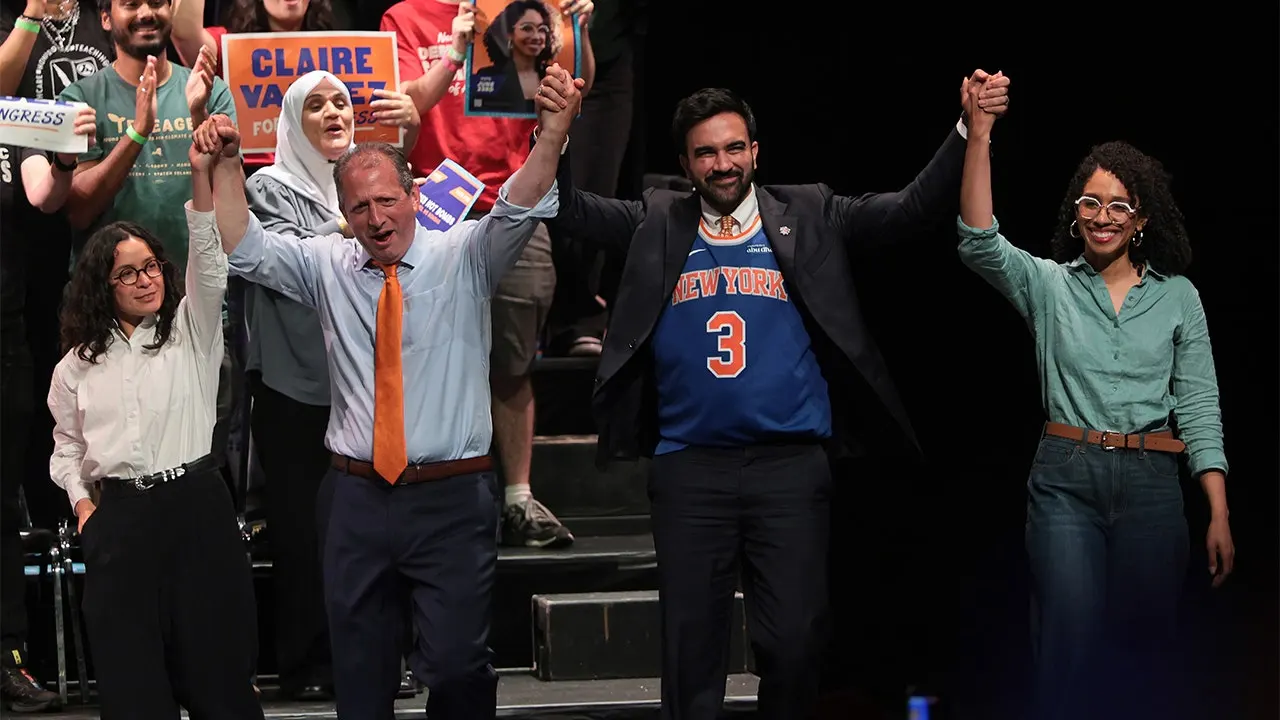
This widening generational and ideological chasm is causing immense friction among rank-and-file Democrats, particularly those who represent moderate, politically diverse battleground districts where the word “socialist” remains highly toxic. Representative Greg Landsman of Ohio, a moderate Democrat representing a swing district that Donald Trump carried in the 2024 presidential election, expressed deep concern over the party’s leftward drift, arguing that average working-class voters are looking for normal, pragmatic leaders who want to solve everyday problems rather than engage in ideological warfare. Landsman warned that some of the rhetoric coming from the party’s furthest-left wing is “beyond the pale” and expressed hope that the party leadership would find the political courage to speak out against extreme candidates who could jeopardize the party’s moderate coalition. This sentiment is echoed by retiring congressional veterans who are watching their life-long achievements handed over to a new guard with whom they share very little ideological common ground. For instance, after representing her New York district for over three decades, veteran Representative Nydia Velazquez visibly struggled when questioned about her likely successor, Claire Valdez, an ardent Democratic Socialist. With a heavy, telling sigh, Velazquez quietly admitted that they do not see eye-to-eye on many fundamental issues, though she ultimately conceded to the democratic process and offered a peaceful transition of power. This internal awkwardness has not escaped the notice of House Republicans, who accuse Democratic leadership of being deeply terrified of their own radicalizing base, asserting that the party’s refusal to publicly police its own ranks represents a tacit endorsement of far-left ideology.
In response to these mounting criticisms, other segments of the party are desperately trying to frame this ideological civil war as a uniquely American strength, painting the Democratic Party as a “big tent” capable of housing diverse economic perspectives. Florida Representative Maxwell Frost, the first member of Generation Z elected to Congress, argued that a healthy, forward-looking political party must have room for robust internal debates about its future direction and must remain open to evolving coalitions rather than relying on a rigid, top-down hierarchy. This defensive posture is shared by Michigan Representative Debbie Dingell, a veteran policymaker with deep roots in the Midwest’s industrial working class. Dingell strongly criticized the media and political commentators for sensationalizing these internal debates, accusing journalists of actively trying to stir up division and pit different factions of the party against one another for cheap television ratings. When questioned about the highly controversial statements made by candidates like Avila Chevalier, Dingell pragmatically pointed out that she does not have to agree with every single word uttered by her colleagues in other states, arguing that the voters of New York, not national media commentators, should decide who represents them. Dingell’s perspective highlights the raw, localized reality of coalition politics: while Washington commentators obsess over semantics and purity tests, local campaigns are often won on the ground by matching the specific, unique ideological hunger of individual communities, even if those ideas shock the national mainstream.
Ultimately, these internal Democratic squabbles have handed the Republican Party a massive, ready-made cultural weapon as they fight to maintain their fragile majority in the House of Representatives. By painting the entire Democratic apparatus with a broad brush, conservative strategists can easily frame every moderate Democrat running in a swing district as an accomplice to a modern-day socialist takeover, making candidates like Darializa Avila Chevalier the theoretical face of the entire party. Republicans like South Carolina Representative Ralph Norman argue that the Democrats have fundamentally transformed into a socialist party, demanding that they either fully own the label or explicitly distance themselves from it. This rhetorical battle mirrors past cultural panics in American history; when the Beatles released their hit song “Back in the USSR” in the late 1960s, conservative commentators of the era screamed that the band was quietly brainwashing American youth with communist propaganda. Today, a remarkably similar existential drama is playing out on the campaign trail, leaving American voters to grapple with a profound and defining question: is this progressive, self-described “comrade” movement a dangerous, regressive step backward toward the failed collectivist experiments of the twentieth century, or is it a authentic, home-grown cry for survival in an increasingly unequal modern economy?