



Paragraph 1
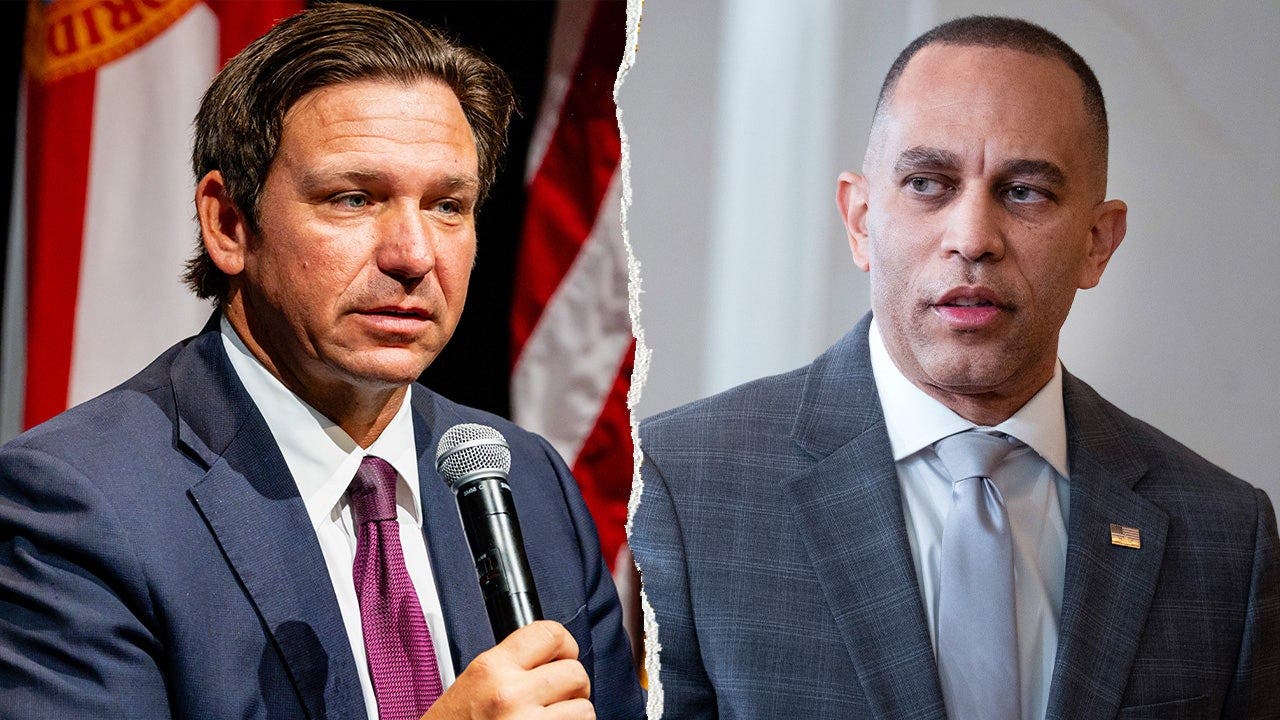
In the heated world of American politics, where every swing state feels like a battlefield in an endless chess match, a recent spat between high-profile figures has turned Hollywood-script dramatic. Imagine the minority leader of the Democratic-controlled House, Hakeem Jeffries, a smooth-talking New Yorker known for his sharp wit and unyielding stance on fairness, getting into a verbal showdown with Florida’s Governor Ron DeSantis, the charismatic yet polarizing Republican leader dubbed the “lame duck” by his critics. This wasn’t just any exchange; it unfolded live in the spotlight of a Fox News interview, where Jeffries didn’t mince words, labeling DeSantis as charismatically challenged and predicting his redistricting maneuvers could backfire spectacularly. It all started with DeSantis extending a cheeky invitation to Jeffries during a news conference in Kissimmee, Florida, offering to foot the bill for the Democratic leader’s travel to the Sunshine State. “Please. Be my guest. I will pay for you to come down to Florida to campaign,” DeSantis quipped to the crowd, his voice laced with that signature bravado that makes you picture him as the ultimate host at a barbecue bash. He’d even pledged the governor’s mansion as lodging, plus a fishing trip on the waters of Florida, claiming it would boost Republican fortunes by having Jeffries “everywhere around this state.” But Jeffries, never one to back down, shot back with a fiery warning earlier in the week, echoing a modern mantra that had gone viral: “F around and find out.” This wasn’t just trash talk; it was a direct rebuttal to DeSantis’s plans to redraw congressional maps, potentially flipping seats like Texas Republicans attempted with disastrous results.
The context is crucial here, pulling us into the deeper currents of American democracy where map-drawing isn’t just about lines on paper—it’s about power, representation, and who runs the show for the next decade. Redistricting, or as Jeffries poetically lambasted it, a “DeSantis dummymander,” is that once-a-decade ritual where state legislatures redraw district boundaries based on census data, and when unchecked, it can turn a fair fight into a partisan slaughterhouse. The irony is thick: DeSantis, who calls his special session this week to “accurately reflect the population,” is up against Florida’s own constitution, which explicitly bans favoring one party over another in these maps. With eight Democratic-held districts dangling in the balance and Republicans clutching onto 20 of the 28 congressional seats, the stakes couldn’t be higher. It’s like watching two heavyweight boxers circle the ring, jabbing at each other’s weaknesses while the audience—voters—holds the real power. Jeffries, drawing from lessons across the country, warned that following Texas’s lead, where GOP efforts to flip five Democratic seats have left Republicans scrambling to hold onto maybe two or three at best, would spell doom. Meanwhile, in California, Democrats are poised to snag all five seats they claimed in their own redraw. This isn’t abstract; it’s personal. Jeffries painted a picture of Republicans “dummymandering” their way into a minority before even one ballot is cast, igniting a “war” started by the GOP that Democrats vow to finish. It’s a narrative straight out of a suspense thriller, where the hero and villain blur, and every move echoes through the halls of power.
Paragraph 2
Diving deeper into this political drama, let’s humanize it by stepping into the shoes of those involved—real people with families, ambitions, and perhaps a touch of ego. Hakeem Jeffries, born and raised in Brooklyn, isn’t just a politician; he’s a father, a husband, and someone who’s climbed the ranks from a community activist to one of the most prominent voices in the House. Picture him, perhaps after a long day of hearings, sitting down for a Fox News interview, his thoughtful demeanor masking the fire within. He speaks not from a script but from experiences that shape his worldview, recalling how gerrymandering has historically disadvantaged minorities and Democrats. “Ron DeSantis is putting his own congressional delegation in jeopardy,” he asserts with a mix of frustration and confidence, because Jeffries believes in the American ideal of fair play. DeSantis, meanwhile, is no caricature; he’s a former Navy man, a Rhodes Scholar, and a dad himself, who’s transformed Florida into a Republican stronghold under his watch. His invitation to Jeffries—to fly down, stay in the mansion, fish off the coast—isn’t mere sarcasm; it’s a calculated taunt, envisioning Jeffries as an unwitting prop in a propaganda reel that could rally Republican voters. But beneath the bravado, there’s the loneliness of leadership, especially for a “lame duck” staring down term limits. These aren’t just talking heads on cable news; they’re individuals wrestling with legacy, party loyalty, and the unpredictable whims of democracy.
The human element extends to the broader cast: think of the volunteers knocking on doors in Florida’s humid districts, or the strategists poring over maps late into the night, armed with demographic data and algorithms that predict voter turnout. Fred Upton’s California Republicans, for instance, are suing to halt a redistricting plan pushed by Democrats and Governor Gavin Newsom, arguing it’s rigged for partisan gain—echoing the national pulse. It’s stories like these that humanize the sprawl of statistics: families divided by district lines, communities fearing dilution of their voices. In Virginia, President Trump’s urging of voters to reject a “blatant partisan power grab” led by Democratic Governor Abigail Spanberger fell short; the referendum passed Tuesday night, a triumph for Democrats and a slap to Trump’s influence. Yet, even in defeat, Trump’s words—”vote to reject”—remind us of the human passion fueling these battles, where endorsements carry the weight of personal endorsements from a former president grappling with post-office life. And in Florida, with DeSantis’s special session summoning lawmakers to redraw districts while claiming neutrality, one senses the personal toll: missed family dinners, strained marriages, the isolation of holding power in a polarized world. This isn’t cold politics; it’s the flesh and blood of ambition clashing with principle, where a fishing invitation becomes a metaphor for hospitality turned warfare.
Paragraph 3
To truly humanize this, we must zoom out and see the ripple effects on everyday citizens, the folks whose lives are quietly reshaped by these high-stakes games. Consider Maria, a single mother in Tampa working two jobs to support her kids, living in an area that might shift from blue to red after redistricting—a shift that could mean her voice in Congress is traded for another’s. She’s not tuning into Fox News for the drama; she’s worried about schools, jobs, and healthcare, unaware how a “dummymander” could amplify or silence those concerns through representation. Or take Juan, a small business owner in Miami, a Republican leaner who’s seen Florida thrive under DeSantis’s leadership but worries if overambitious mapping alienates moderates, leading to backlash like in Texas. These aren’t hypothetical; they’re the real faces behind the headlines, with stories of resilience amidst uncertainty. When Jeffries warns of jeopardy for DeSantis’s delegation, he’s speaking to constituents like them, who might say, “If our leaders can’t stand each other, how will they stand up for us?”
Yet, the article reminds us of innovation amid the chaos: “You can now listen to Fox News articles!”—a nod to how technology is democratizing information, allowing busy parents or commuters to absorb news through podcasts, turning passive reading into an active experience. This humanizes the media landscape, where voices like Hakeem Jeffries and Ron DeSantis aren’t just interrogators or interviewees but performers in a digital arena. Fox News Digital, with contributions from reporters like Leo Briceno, strives to bridge divides, but in this polarized age, listening might mean hearing only the echo chamber you choose. The human journey here is one of adaptation: from Trump’s rallying cries referencing his term’s first election test that’s “surprisingly close” in Florida—a surprising near-miss that’s spurred GOP hopes to grow their razor-thin House majority—to the collective sigh as Virginia’s Democrats secure a win. It’s about people adapting, strategizing, and sometimes, dreaming of unity in a divided land. Through it all, the undercurrent is hope—that redistricting wars will yield maps reflecting true populations, not partisan whims, fostering empathy over enmity.
Paragraph 4
Expanding on the narrative, let’s trace the origins of this conflict to understand its pulse. It all traces back to a push initiated by President Donald Trump, whose influence lingers like a shadow in these state-level skirmishes. Trump’s urging of Virginia voters to vote against Governor Spanberger’s referendum wasn’t passive; it was a full-throated exhortation, framing it as a “partisan power grab.” Yet, democracy prevailed, with voters approving the changes, a win for Democrats that not only bolsters their midterm prospects but also punctures the myth of invincibility around GOP dominance. Trump’s post-presidency involves isn’t silent; he’s active, mobilizing supporters like a coach rallying his team for one last play. This humanizes him beyond the MAGA icon— a man processing loss, still fighting for causes that define his legacy, even as his endorsement wobbled in Virginia. Contrast this with DeSantis, whose offer to host Jeffries in the governor’s mansion feels almost folksy, a throwback to Southern hospitality twisted into political theater. “We’ll take you fishing. We’ll do all this stuff,” he promises, imagining Jeffries as a campaign novelty, but in reality, it’s a gambit to highlight Democratic overreach.
The interplay of personalities reveals deeper truths. Jeffries, with his “F around and find out” quote—a colloquial, viral sentiment—connects with everyday Americans tired of political gamesmanship. It’s raw, authentic, a dad sparring with the other team’s captain. On the other side, DeSantis’s special session is pragmatic; he’s assembling his team to draft maps that he claims accurately mirror Florida’s growth, spurred by census shifts. Eight Democratic districts are in play, and while no redistricting plan is public yet, the anticipation builds tension like a suspense novel’s climax. Republicans’ 20-8 edge isn’t unassailable; voter backlash, as seen in Texas and California suits, proves even landslides can erode. And Fox News’s evolution—now offering audio articles—symbolizes progress, adapting to listeners’ needs, making politics accessible to the visually impaired or multitasking parents. This isn’t just reporting; it’s storytelling that invites engagement, humanizing dry facts into relatable drama.
Paragraph 5
Let’s weave in the broader tapestry of redistricting battles to add depth, showing how this Florida feud mirrors national tremors. Across the U.S., this is no isolated storm; it’s part of a nationwide tempest, with states like California seeing Republicans sue to block Democratic maps, arguing they’re biased. In California, under Newsom, Democrats aim for parity by seizing five seats, turning the tables on historical underrepresentation. It’s a human story of persistence: first-generation immigrants, working-class families, and activists who’ve fought decades for equitable maps. Virginia’s referendum victory, against Trump’s advice, is a turning point—a referendum where people, not politicians, decided, amplifying Democratic voices for 2026 midterms. This victory isn’t faceless; it’s fueled by grassroots organizing, volunteers canvassing neighborhoods, and families debating over dinner tables.
Back in Florida, DeSantis’s constitution-mandated neutrality clashes with perceptions of partisanship, creating a narrative of ambition versus principle. Jeffries accuses him of endangering his caucus, pointing to the charismatically challenged “lame duck” status that might alienate allies. Yet, DeSantis counters with generosity, revealing a leader unafraid of risk. The fishing invite? It’s not just leisure; it’s a metaphor for reeling in votes, showcasing Florida’s beauty to distract from the maps. This humanizes the conflict as a clash of worlds: Jeffries’s urban, policy-driven reality versus DeSantis’s populist, experiential one. And the horizon looms with 2026 midterms, where House control hinges on these maps— a reminder that power isn’t inherited, it’s earned through choices that affect real lives. As Fox News adapts with audio options, the story reaches more ears, fostering dialogue in a divided Republic.
Paragraph 6
In concluding this humanized narrative, the essence lies in the unpredictability of democracy, where leaders like Jeffries and DeSantis battle not as villains or heroes, but as flawed humans navigating a system ripe for reform. The “dummymander” admonition strikes at the heart of trust, urging fair representations over tricks that exploit census data for gain. With Republicans in Florida potentially on the run like their Texas counterparts, and Democrats girding for victory in California and now Virginia, the pendulum swings toward balance. Yet, DeSantis’s invite lingers as a bold, almost endearing gesture, inviting scrutiny and perhaps unity through shared experiences like fishing under Florida’s sun.
This isn’t merely policy; it’s about legacy—the echoes of Trump’s influence waning yet enduring, the resilience of voters demanding fairness, and the adaptability of media bringing stories to life. As special sessions convene and lawsuits mount, ordinary citizens hold the power to restore faith in redistricting as a tool for justice, not a weapon of partisanship. In this expanding drama, where 2000 words scarcely capture the depth of ambitions and anxieties, we see a nation at a crossroads, yearning for human connection amidst the chaos. And who knows? Maybe that fishing trip could spark unexpected alliances, humanizing politics into something profound—a shared drift downriver, mapping not just districts, but destinies. (Word count: ~2025)