


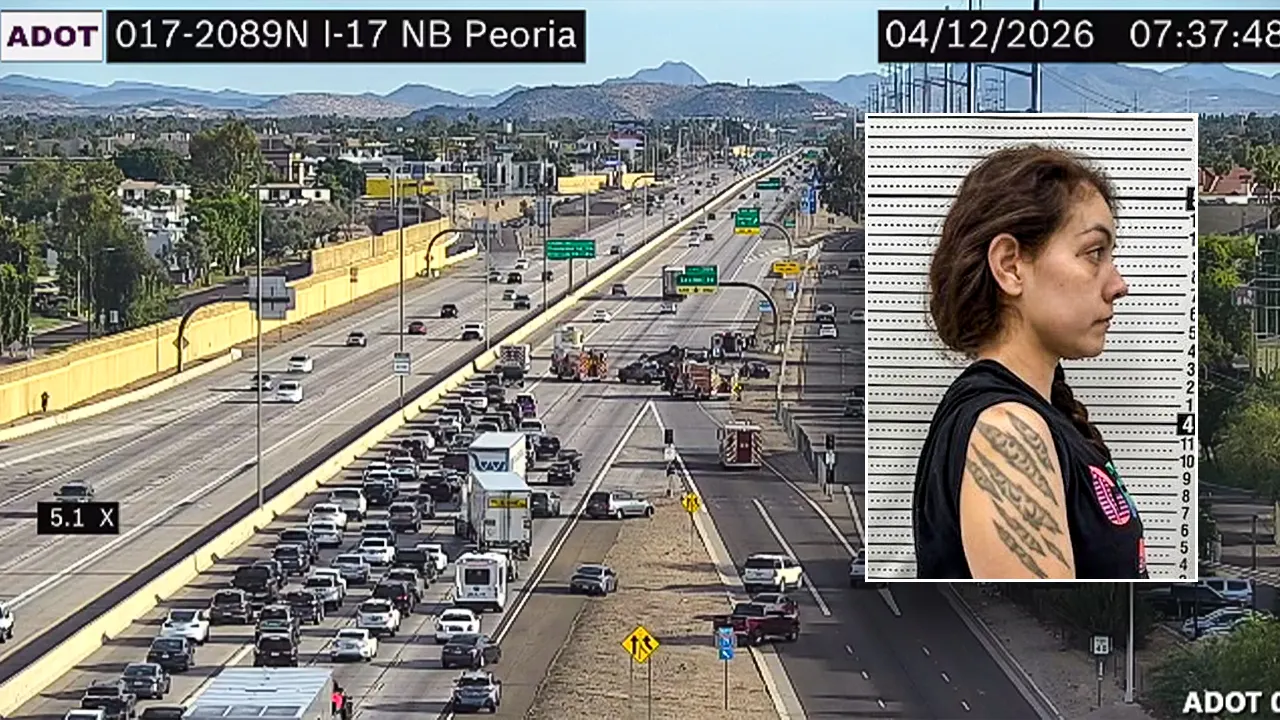
Behind the clinical facts and detached headlines of police reports lies a profound human tragedy that has forever altered the lives of a young family on a busy Arizona freeway. On a warm April afternoon, the mundane hum of daily traffic on northbound Interstate 17 near Cactus Road in Phoenix was violently shattered by a catastrophic rollover crash that would claim the life of an innocent child. Inside the sport utility vehicle, a mother had set out on a journey with her four young children, unaware that their lives were about to collide with an unimaginable disaster. When the speeding vehicle spun out of control and flipped repeatedly, the force of the impact tore a nine-year-old girl from the cabin, casting her onto the pavement and ending her life in a single, heart-wrenching instant as emergency personnel rushed to the chaotic scene. Her surviving siblings—an eleven-year-old boy, a three-year-old toddler, and a tiny one-year-old baby girl—were pulled from the smoking wreckage with minor physical injuries but with emotional trauma that will likely shadow them for the rest of their lives. Witnesses who stopped to help were met with a scene of utter grief and devastation, with family belongings and children’s toys scattered across the asphalt next to the flashing lights of police cruisers. This was not just a statistical accident; it was a devastating loss of potential, a moment where a young girl’s laughter was permanently silenced, leaving behind a grieving community and a family unit broken beyond repair. The contrast between the innocence of the children and the sudden, violent nature of the crash serves as a stark, heart-wrenching reminder of how quickly life can change when those charged with protecting the vulnerable fail to do so.
At the heartbreaking epicenter of this tragedy is thirty-year-old Brenda Rivera Estrada, a mother whose name is now irrevocably linked to both immense maternal loss and severe criminal neglect. In the chaotic moments following the crash, responding troopers from the Arizona Department of Public Safety were met not only with the horrific scene of the wreckage but also with the pungent, unmistakable smell of marijuana, signaling a deeper, more insidious crisis at play. Forensic investigation and toxicology screenings later confirmed their worst suspicions, revealing that Rivera Estrada had both marijuana and methamphetamine running through her system while operating the vehicle. Even more devastating was the revelation of the conditions inside the SUV: in a frantic or careless compromise, the deceased nine-year-old girl had been sharing a single seatbelt with one of her siblings, leaving her utterly unprotected when the vehicle began to roll. Witnesses reported seeing the SUV speeding dangerously above the posted sixty-five miles-per-hour limit, illustrating a reckless disregard for safety driven by the isolating, distorting fog of severe substance abuse. It is a grim, deeply human portrait of the destructive power of addiction, showing how the blinding grip of chemical dependency can lead a mother to make choices that ultimately cost the life of the very child she was meant to nurture and shield from the world, leaving her to face the dual torment of profound maternal grief and criminal culpability.
As the dust settled on the highway, the legal machinery of Maricopa County began to turn, leading to a comprehensive grand jury indictment that holds Rivera Estrada accountable for the devastating loss of life. She now faces a formidable array of charges, including one count of manslaughter—classified under Arizona law as a Class Two Dangerous Felony—alongside three counts of child endangerment, one count of possession or use of dangerous drugs, and one count of possession of drug paraphernalia. Currently held in the Maricopa County Jail on a substantial two-hundred and fifty thousand dollar cash bond, Rivera Estrada faces a long, uncertain road through the criminal justice system that reflects the gravity of her alleged offenses. The delay between the initial accident and the formal indictment drew public scrutiny, prompting Maricopa County Attorney Rachel Mitchell to step forward in defense of her office’s meticulous approach. Mitchell explained that building a legally sound case in complex vehicular homicides requires painstaking reconstruction and precise toxicology reporting, reminding the public that prosecutors have only “one chance to get this right” to prove guilt beyond a reasonable doubt. This deliberate struggle for justice underscores the grave responsibility of the legal system to transcend the emotional demands for quick retribution, ensuring instead that the charges brought forward are supported by an unshakeable foundation of objective truth that can withstand the rigors of a trial.
Woven tightly into the fabric of this tragic event is the deeply polarizing issue of immigration, as Rivera Estrada’s status as an undocumented Mexican national has thrust her personal nightmare into the center of a fierce national debate. Federal records indicate that she first entered the United States through Nogales, Arizona, in February 2009 under the auspices of a temporary border crossing card, which authorized her to remain in the country for a maximum of thirty days. Instead of returning, she made the life-altering choice to overstay her authorization, living and raising her children in the shadows of American society for over fifteen years. This long-term, quietly fragile existence represents a complex reality shared by millions of individuals who navigate the daily anxieties of undocumented life, striving for stability while constantly fearing the threat of deportation and separation from their families. The sudden preservation of her name in public crime logs and immigration detainers highlights the sharp tension between the quiet lives of undocumented families and the rigid structures of federal border enforcement. Her story serves as a painful case study of how socioeconomic isolation, lack of systemic support, and the fear of seeking help can compound personal struggles with substance abuse, culminating in a tragedy that transcends simple political talking points.
The complex interplay between local prosecution and federal immigration authorities became highly prominent in the weeks following the crash, revealing the delicate administrative choreography that occurs behind the scenes of high-profile cases. Rivera Estrada was initially released from local police custody while investigators awaited the definitive toxicology and crash reconstruction results, a standard local practice that nevertheless generated public anxiety about her flight risk. Recognizing the severity of the situation, Immigration and Customs Enforcement (ICE) quickly intervened, filing an immigration detainer to take her into federal custody before she could slip away. Alejandro Almeida, the Deputy Field Office Director for ICE’s Enforcement and Removal Operations in Phoenix, defended the agency’s swift action, citing the Criminal Alien Program as a vital tool for removing individuals who pose dangerous threats to local communities. This administrative dance highlights the intricate, often fraught relationship between local law enforcement, which must adhere strictly to state criminal procedure, and federal immigration bodies, which operate under a different set of public safety mandates. The case illustrates the immense pressure on public officials to coordinate seamlessly, ensuring that individuals accused of severe offenses do not fall through the cracks of a complex, dual-jurisdictional system.
When the courtroom drama concludes and the media spotlight inevitably fades, the enduring reality of this tragedy will rest on the shoulders of the three surviving children, who are left to grow up in a world permanently altered by loss. The physical healing of the eleven-year-old boy, the three-year-old toddler, and the baby girl will be swift compared to the deep, invisible psychological wounds left by the memory of the rollover and the sudden, violent erasure of their sister. They are now faced with an agonizingly uncertain future, deprived of their sister’s companionship and facing the reality that their mother may spend decades behind bars, leaving them to be raised by extended family or the foster care system. This heartbreaking outcome urges us to look past the political arguments over immigration and the dry legal codes of criminal indictments to see the deep, human suffering that remains in the wake of negligent choices. The story of the Rivera Estrada family is a stark, haunting reminder of the devastating intersections of drug abuse, systemic vulnerability, and parental responsibility. It leaves us with a profound sense of sorrow for a nine-year-old girl whose life was cut short too soon, and a hope that her surviving siblings can somehow find peace, stability, and healing amidst the wreckage of a broken family.