


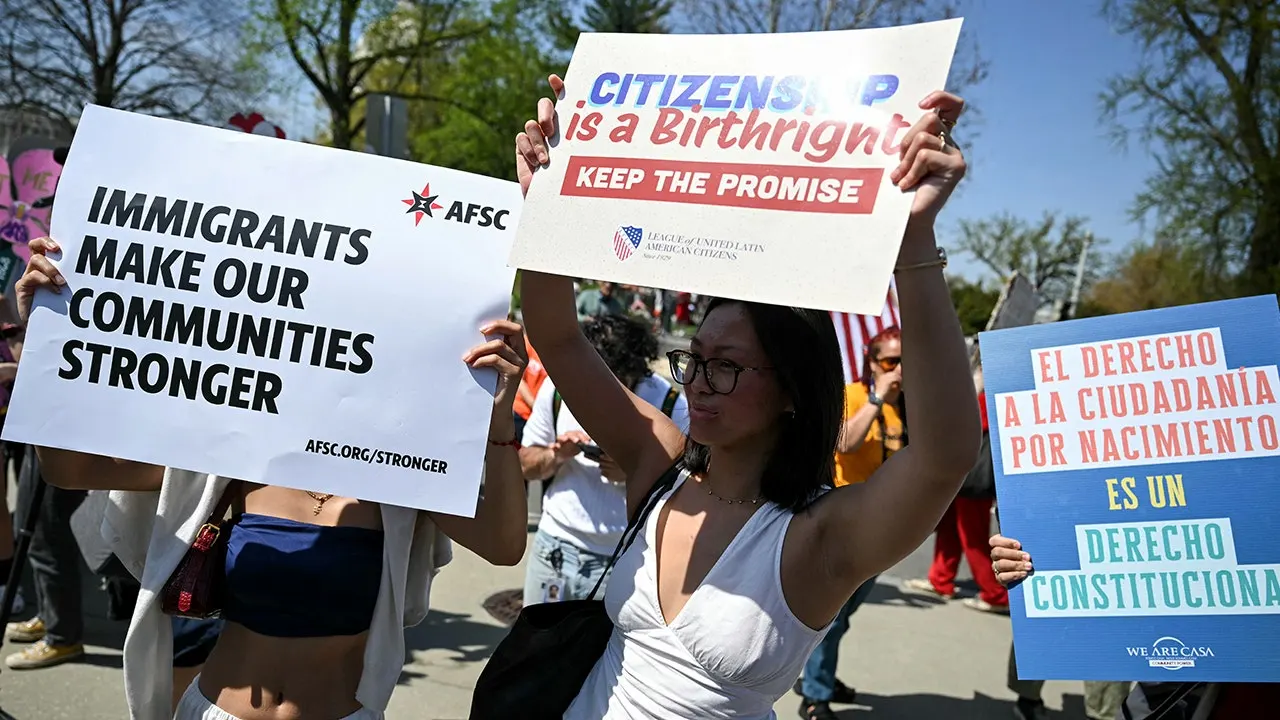
The national identity of the United States has long been anchor-mapped by the promise of birthright citizenship, a constitutional guarantee deeply rooted in the post-Civil War era to ensure that those born on American soil are granted the full, undiluted rights of citizenship. Yet, when the Supreme Court issued a monumental 6-3 ruling affirming this legal foundation, it acted as a lightning rod, igniting a fierce ideological battleground across the American political landscape. To the frustration of conservative activists, the majority opinion was bolstered not just by the court’s liberal wing, but by Chief Justice John Roberts and Associate Justices Amy Coney Barrett and Brett Kavanaugh—a development that many on the right viewed as a profound betrayal of originalist principles. Critics argue that this decision effectively sanctifies a legal pathway for the children of foreign nationals residing unlawfully in the country, thereby diluting the intrinsic value of American citizenship and encouraging unlawful immigration. In a swift counter-offensive, the Oversight Project, a prominent government watchdog group, released its highly aggressive, multi-layered “Keeping Families Together Plan” to Fox News Digital, aiming to bypass the court’s decision by dismantling the systemic mechanisms that allow undocumented families to establish permanent roots in the United States.
At the epicenter of this controversial blueprint is Mike Howell, an attorney and the resolute president of the Oversight Project, who frames the current immigration reality not just as a policy disagreement, but as a demographic crisis. Utilizing exceptionally provocative language, Howell warns that the undocumented community has harnessed what he calls “weapons of mass reproduction,” transforming birthright citizenship into a powerful tool for establishing permanent residency. His “Keeping Families Together Plan” deliberately co-opts humanitarian rhetoric, arguing that the most effective way to maintain family unity is not through legalization, but through the systematic, uncompromising deportation of parents alongside their children. Howell advocates shifting federal enforcement resources away from politically hostile “sanctuary cities”—where local authorities frequently clash with federal agents—and redirecting them toward comprehensive worksite enforcement in America’s agricultural and industrial centers. The underlying mathematics of this strategy is deliberately stark: by targeted enforcement at farms and factories, the state forces undocumented parents into a agonizing moral dilemma where they must choose between taking their American-born children back to their home nations or abandoning them to the domestic foster care system. By turning birthright citizenship into a preventative barrier rather than a legal shield, the plan seeks to fundamentally alter the cost-benefit analysis for any foreign national considering crossing the border to build a family.
To make this deterrent strategy truly preventative, the Oversight Project’s proposal ventures far beyond traditional workplace raids, pushing the boundaries of federal authority directly into domestic medical facilities and the lucrative, global underworld of birth tourism. Howell envisions a highly visible enforcement landscape where Immigration and Customs Enforcement (ICE) personnel are stationed outside and within targeted maternity wards to identify, monitor, and deter pregnant foreign nationals from using American medical infrastructure to secure automatic citizenship for their newborns. This initiative places a sharp focus on dismantling the highly organized, deeply profitable birth-tourism networks that cater extensively to wealthy foreign elites, particularly those originating from China. Navigating the delicate geopolitical and economic dependencies between Washington and Beijing, Howell argues that it is time for the United States to play an unyielding game of economic “hardball” to defend its sovereignty. He does not spare his own political allies from criticism, openly lambasting former President Donald Trump’s historic tolerance of wealthy Chinese students enrolled in American academic institutions, a practice Howell claims merely props up a failing university system at the expense of national security. Pointing to highly publicized reports of wealthy Chinese businessmen leveraging California’s permissive surrogacy laws to effectively purchase American citizenship through paid surrogates, Howell questions how any self-respecting sovereign nation could tolerate such an explicit commercialization of its national identity.
Despite the fierce populist rhetoric surrounding Trump’s campaign promises of unprecedented “mass deportations,” Howell candidly acknowledges a profound gulf between political theater and the logistical realities on the ground, noting that a truly comprehensive deportation apparatus has yet to materialize. He attributes this inertia to a powerful coalition of corporate special interests—particularly in the agricultural and manufacturing sectors—who lobby aggressively behind closed doors to protect their low-wage immigrant workforces from federal disruption, alongside the political fallout from high-profile law enforcement incidents that often give administration officials “cold feet.” In response to the Oversight Project’s criticisms, the White House has scrambled to reassure its conservative base, with spokesperson Abigail Jackson reaffirming that the president remains completely committed to safeguarding the foundational value of natural-born citizenship. In the wake of the Supreme Court’s ruling, the administration has urged Congress to immediately draft corrective legislation, while simultaneously promising that the Department of Justice will dramatically escalate its investigations into organized birth-tourism syndicates. This administrative push and pull highlights the intense friction within the executive branch, which finds itself caught between the demands of a highly energized restrictionist constituency and the complex, slow-moving machinery of the federal bureaucracy.
Perhaps the most legally creative and highly ironic component of the Oversight Project’s strategy is its proposal to weaponize the judicial legacy of Chief Justice John Roberts against his own jurisprudence. Howell’s plan takes a calculated, intellectually sharp jab at Roberts by invoking his famous 2012 swing-vote decision in NFIB v. Sebelius, where the Chief Justice narrowly salvaged the constitutionality of ObamaCare by reinterpreting the law’s individual mandate penalty not as an unconstitutional regulatory command, but as a legally permissible “tax.” By using Roberts’ own expansive legal definitions as an administrative roadmap, the Oversight Project suggests that conservative lawmakers can utilize the budget reconciliation process—a powerful legislative tool that bypasses the Senate filibuster and requires only a simple majority—to levy astronomical financial penalties on birth tourists, classifying these fees strictly as a “tax.” Under this legal framework, such a measure would theoretically survive constitutional scrutiny by relying on the very legal precedents established by Roberts to appease the political left a decade ago. Furthermore, the plan calls on the Department of Homeland Security to take the unilateral step of suspending all travel visas for countries heavily implicated in birth-tourism operations, demonstrating a willingness to leverage every available administrative and fiscal tool to disrupt the flow of foreign nationals seeking American citizenship through birth.
As this fierce debate over the future of American citizenship intensifies, proponents of the plan acknowledge that their uncompromising proposals will inevitably provoke severe cultural and political blowback, particularly from suburban moderates and the mainstream media, yet they insist that the administration must forge ahead disregarding the social friction. In Congress, conservative lawmakers like Representative Andy Ogles and Senators Eric Schmitt and Rand Paul have already introduced bold legislative proposals for a constitutional amendment to permanently end birthright citizenship, though political analysts widely agree that such measures face nearly insurmountable hurdles in a deeply partisan legislature. Meanwhile, the Department of Homeland Security is not waiting for constitutional reforms, actively distancing itself from the Supreme Court’s decision while showcasing a barrage of aggressive enforcement statistics to demonstrate their commitment to border security. According to a DHS spokesperson, the agency has overseen the departure of over three million illegal immigrants during the current administration—including an estimated 2.2 million self-deportations and nearly one million formal removals—sending an uncompromising message that those who enter the country illegally will be pursued, detained, and removed. This dual campaign of legislative maneuvering, administrative pressure, and relentless grassroots advocacy underscores a nation locked in a profound ideological struggle, where the very definitions of family, law, sovereignty, and what it truly means to belong to the American republic are being radically contested and rewritten.