


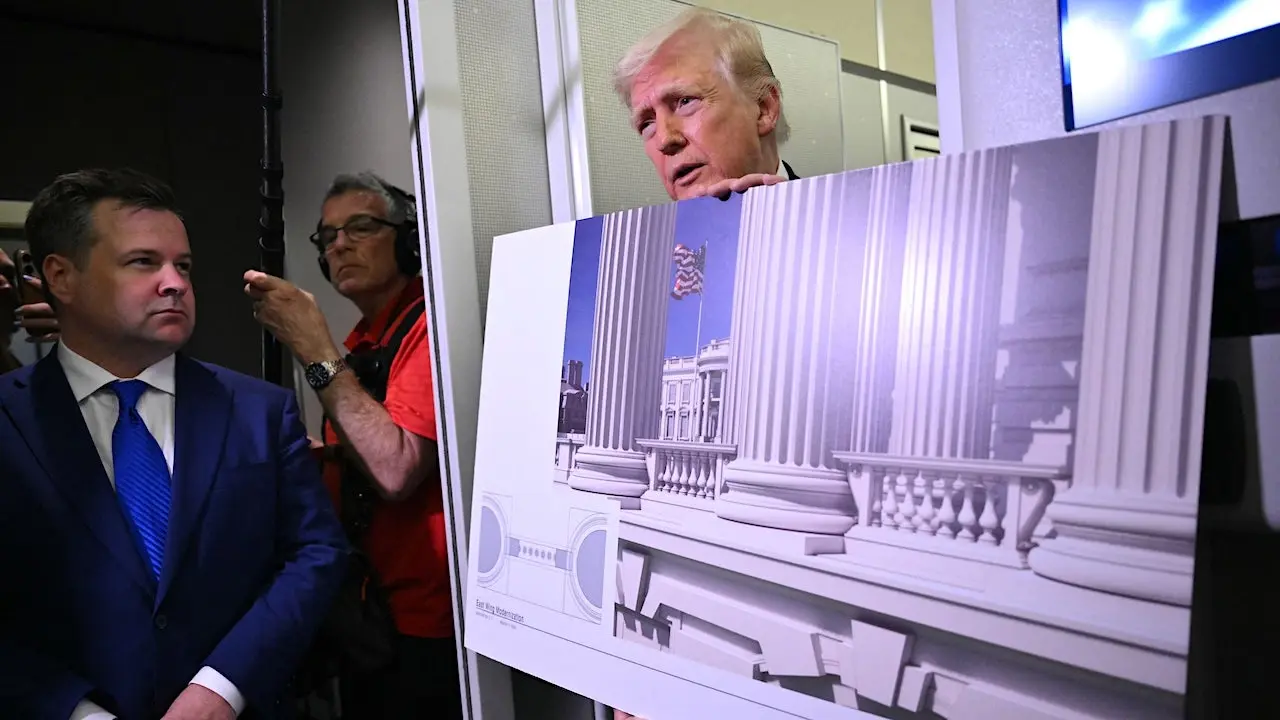
In the grand tapestry of American politics, where every stone in the White House seems to hold whispers of history, the drama surrounding President Donald Trump’s ambitious ballroom renovation project unfolds like a modern epic. Picture this: a bustling crowd of journalists and onlookers gathered outside the iconic residence, cameras flashing against the backdrop of cherry blossoms or stark winter winds, all because a man who once stormed onto the national stage with promises of making America great again decided to spruce up his home office. The $400 million project, privately funded by Trump’s donors, aimed to transform the outdated East Wing—built way back in Theodore Roosevelt’s time in 1902 and expanded during World War II—into a sprawling 90,000-square-foot ballroom, complete with underground bunkers, medical facilities, and top-notch security to fend off threats like drones, missiles, or even biohazards. It was supposed to be Trump’s legacy etched into the White House itself, a symbol of power and resilience. But, as with so many tales in politics, things got complicated when history buffs and preservationists stepped in, waving laws and injunctions like flags in a protest. In December, right after demolition kicked off, the National Trust for Historic Preservation (NTHP) filed a lawsuit, arguing that Trump overstepped his authority by razing a cherished part of our collective heritage without congressional approval. They painted it as more than just bricks and mortar; it was about honoring the White House as a living museum, a place where generations of presidents, from Lincoln to Obama, had walked, plotted, and dreamed. Imagine the frustration for Trump supporters, who see this as bureaucratic overreach on a patriot’s pride, versus the preservationists, who view it as safeguarding icons that connect us to our past. The project, with its blend of opulence and necessity, now hangs in the balance, a reminder that even the most powerful among us must navigate the maze of courts and public opinion.
Diving deeper into the lawsuit, it’s worth understanding the human element here—the passion fueling both sides. On one hand, you have the Trump team, quick to highlight how previous presidents like Obama renovated the White House without Congress micromanaging every nail and paintbrush. Trump himself has quipped that it’s “too late” to stop it now, framing it as a long-overdue upgrade in a space that was, in his words, a “disaster.” He shared renderings of a grand, open ballroom, envisioning it as a venue for state dinners, rallies, and events that could boost morale and prestige, all paid for by private donations from major corporations. The idea is seductive: why should taxpayers foot the bill for a president’s fancy digs when loaded supporters are eager to invest? Yet, critics like Senator Elizabeth Warren have launched inquiries, alleging “bribery in plain sight,” where donors might gain undue influence through their generosity. Picture the outrage from everyday Americans who wonder if this is democracy at work or just another way for the elite to game the system. The NTHP, led by CEO Carol Quillen, wasn’t out for headlines; they genuinely worried about losing a piece of architectural history that represented eras of American resilience. Quillen spoke eloquently about stewardship, urging broad consultation with the public, as if the White House belonged to all of us. This clash isn’t just legal—it’s emotional, pitting progress against preservation, innovation against tradition, in a way that makes you root for one side or the other, depending on your faith in the American dream.
The court battles added layers of suspense, like a cliffhanger in a political thriller. Back in March, U.S. District Judge Richard Leon slapped an injunction to halt the construction, concerned it violated federal laws on presidential renovations without congressional nods. But in a twist, the judge paused his own order for an appeal, allowing work to continue temporarily. What kept things moving? Security. The White House argued passionately that stopping the project would leave the building—and the president and his family—vulnerable, with the site “open and exposed” to threats. They poured in evidence of fortified bunkers below ground, designed to withstand attacks, and insisted that waiting too long risked national security. Leon, reviewing confidential materials, carved out an exception for safety-related work, but he wanted clarity on whether the ballroom itself was essential to those defenses. It humanizes the stakes: think of the Secret Service agents worriedly scanning skies for drones, or staffers imagining worst-case scenarios. For Trump, this was personal—his home, his legacy, potentially at risk. Opponents saw it as a stalling tactic, a way to bulldoze through objections. The appeals court’s involvement amplified the drama, turning a renovation into a battleground for executive power versus oversight, reminding us that even in the Oval Office, no one is immune to accountability.
As the case escalated, the U.S. Court of Appeals for the D.C. Circuit weighed in with a March ruling that allowed construction to proceed until April 17, buying time for Trump to appeal to the Supreme Court. The three-judge panel—Millett, Rao, and Garcia—urged Judge Leon to revisit his injunction, probing whether it truly clashed with security needs. The Trump administration claimed the ballroom and bunkers were intertwined, unlike what they initially suggested, making it hard to halt one without jeopardizing the other. Government lawyers painted vivid pictures of ongoing vulnerabilities, where a pause could “imperil the president and others.” This wasn’t just paperwork; it was about real people—the family upstairs, the devoted aides, the visitors dreaming of history. Trump pushed back hard against critics like Michelle Obama, who called the old arrangement a “disaster,” defending his vision as a necessary evolution. Public funds covered the underground security, blending taxpayer dollars with private whims—a nuance that fueled debates about fairness. Rao’s dissent stood out, invoking a law that lets presidents improve the White House, arguing security outweighed “generalized aesthetic harms.” It humanized the judges too: Rao, Trump’s pick, fiercely protective; the others balancing perspectives. For the public, this became a referendum on Trump’s era, where bold moves met fierce resistance, making you wonder if the White House would ever be just a home again.
Looking beyond the headlines, the project raised broader questions about power, privilege, and history in America. Trump’s donors, many from big corporations, stirred whispers of influence-peddling, with accusations of quid pro quo amidst Warren’s inquiry revealing corporate ties. The NTHP’s plea for public input echoed a call for democracy, where ordinary citizens could voice opinions on such grand plans. Imagine town halls buzzing with debates: Is this renovation wasteful extravagance, or a savvy blend of security and spectacle? For supporters, it symbolized Trump’s outsider edge, turning a stuffy mansion into a modern fortress. For detractors, it epitomized excess, a marble reminder of inequality in an era of political division. The appeals panel’s uncertainty about temporary measures highlighted the messiness of balancing security with heritage. As construction edged forward, anticipation built—what would the final ballroom look like? A luxurious hall for deals and dances, or a fortified bunker for uncertain times? It’s stories like this that make history feel alive, pulsating with human ambitions, fears, and the eternal tug-of-war between progress and preservation.
In the end, this saga isn’t just about a ballroom; it’s a mirror reflecting America’s soul, where presidents dream big but face the checks and balances stitched into our founding fabric. The April 17 deadline approached like a ticking clock, with appeals pending, leaving us to ponder what happens next—will Trump get his grand space, or will history prevail? Humanizing it, think of the workers on the site, swinging hammers under watchful eyes, or the families praying for security in turbulent days. Trump’s project, funded partly by wealthy benefactors, challenges us to ask: Who’s really paying for leadership? As the courts deliberate, voices from all corners chime in—Fox News ads promising audio listening, Reuters facts, AP details—all weaving a narrative that’s as American as apple pie and as contentious as a family feud. Through it all, the White House endures, not just a building, but a living legacy, reminding us that in politics, every renovation carries the weight of our shared humanity. And if you’re tuning in, just know: listening to stories like this brings them to life, one audio byte at a time.