


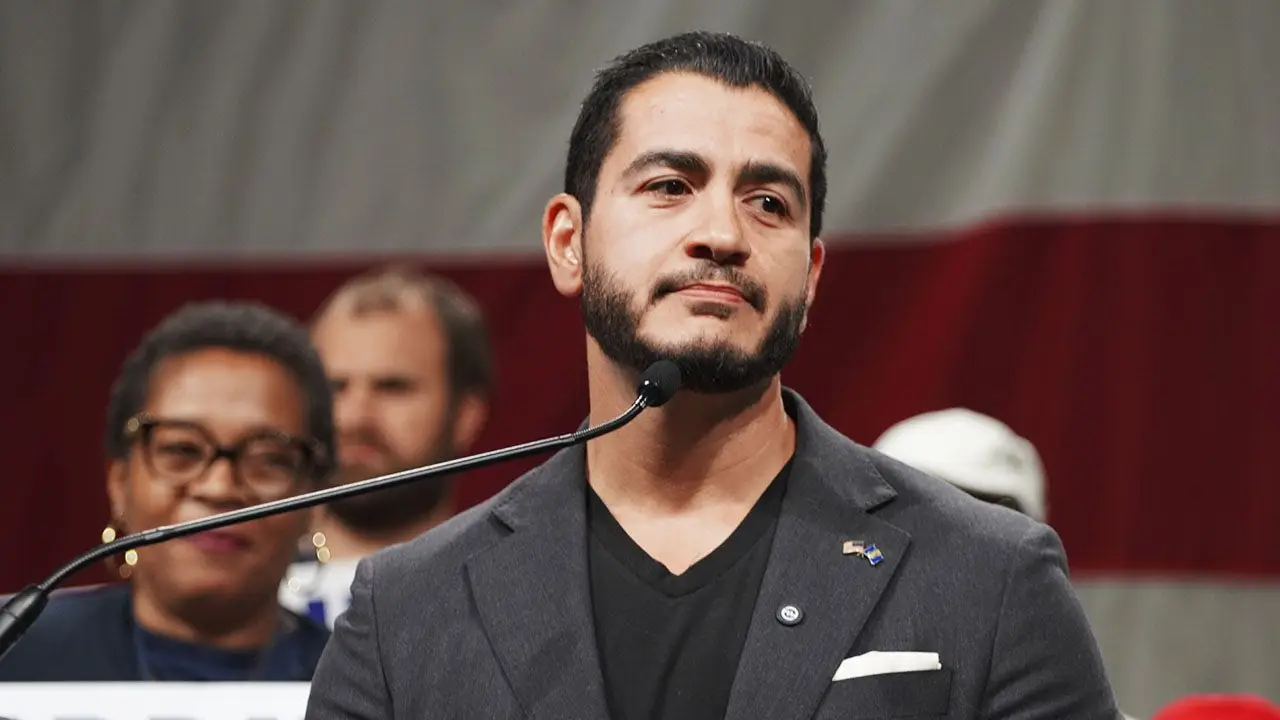
In the heart of the American Midwest, where the Great Lakes shape both the weather and the weary pragmatism of its people, a fierce political battle is unfolding that feels far more like a cold war than a simple election. In Michigan, a state perpetually teetering on the edge of economic hope and industrial decline, the Democratic nominee for the U.S. Senate, Abdul El-Sayed, is facing a barrage of attacks that aim to unravel his credibility and paint him as a radical outsider. Opposite him stands Mike Rogers, the Republican nominee, a former FBI agent and congressman whose messaging is steeped in national security and traditional values. Yet, amidst the torrent of attack ads about inflation, rising grocery bills, and border security, a strange and deeply human story has resurfaced—a story that takes us back nearly two decades to a dusty lecture hall at the University of Michigan, where a young, brilliant medical student named Abdul, then the vice president of the Muslim Students Association, found himself at the center of a protest that would become a permanent scar on his political record. This is not merely a tale of political mudslinging; it is a profound examination of faith, fear, and the fractured way we perceive the “other” in a post-9/11 world.
The scene in 2007 is almost cinematic in its tension. The University of Michigan, an institution known for its liberal activism and intellectual rigor, had invited three men to speak: Walid Shoebat, Zachariah Annani, and Kamal Saleem. These men claimed to be former terrorists, having once belonged to the Palestine Liberation Organization or the Muslim Brotherhood, before experiencing dramatic conversions to evangelical Christianity. Their stories were visceral and terrifying—tales of bomb-making, hatred for the West, and a final, redemptive embrace of Jesus Christ. To the event organizers, these men were essential witnesses, offering a first-hand account of the dangers of Islamic extremism and the redemptive power of faith. However, to a significant portion of the student body, particularly the Arab and Muslim students on campus, these speakers represented something far more sinister. The Arab-American community, which had long scrutinized these figures, alleged that their biographies were fabrications, elaborate fictions designed to profit from Islamophobia. They questioned why, if these men were truly self-confessed terrorists, they had never been arrested or deported. In a climate of palpable fear, the lecture hall became a crucible. As the speakers began their presentation, a group of students clad in yellow shirts stood up in unison, walking out in a coordinated display of defiance. The walkout was a statement against what they perceived as a generalization of an entire religion—a message that being Muslim meant being inherently violent. Watching this unfold, Abdul El-Sayed was not a passive observer; he was a leader, a galvanizing force. According to the Michigan Daily, the campus newspaper that chronicled the event, El-Sayed later expressed his approval and motivation, stating, “We’ve done something good today, and we need to keep that going in the future.”
To understand El-Sayed’s actions, one must first understand the man himself—the human being behind the political attacks. Born to immigrant parents of Egyptian descent, El-Sayed is a Rhodes Scholar, an epidemiologist, and a physician who served as Detroit’s Health Director, fighting to provide clean water and health equity to a city ravaged by disinvestment. His journey through elite American institutions was a constant navigation of dual identities: the brilliant scientist and the young Muslim man. In 2007, just six years after the horrific attacks of September 11, the atmosphere for Muslims in America was charged with suspicion. Every mosque, every student association, and every traditional garb was under a microscope. For El-Sayed, the protest wasn’t simply about political disagreement; it was about the safety and dignity of his community. When he heard these “ex-terrorists” speak, he saw not just personal testimonies, but weapons of mass propaganda. He saw his parents, his friends, and his entire heritage being reduced to a caricature of violence. The walkout was a visceral, organic reaction to feeling delegitimized in the very halls where he had been taught to pursue truth. In the years since, his campaign has clarified his stance, with spokesperson Cole Wozniak stating that El-Sayed “unequivocally denounced terrorism.” Wozniak further explained that the speakers were “widely condemned by experts, including in national security, for spreading misinformation and fabricating their backstories.” This defense reveals a crucial nuance: El-Sayed wasn’t protesting against the idea of redemption or the rejection of extremism; he was protesting against a fraudulent narrative that was being used as a political tool to demonize his community.
Yet, the controversy surrounding this protest does not exist in a vacuum. It is inextricably linked to the organization El-Sayed was leading at the time: the Muslim Students Association (MSA). Over the decades, the MSA has been a sanctuary for thousands of Muslim college students across America—a place to pray, to find community, and to navigate the complexities of faith in a secular environment. However, shadowy allegations have long trailed the organization, linking its foundational roots to the Muslim Brotherhood, a transnational Islamist organization that the White House recently asked the State and Treasury Departments to consider designating as a foreign terrorist organization. In the early 1960s, the Muslim Brotherhood reportedly established a presence in the United States, utilizing student unions as a conduit for its influence, particularly through the MSA. Lara Burns, a senior research fellow at George Washington University’s program on extremism, testified before the Senate Judiciary Committee last month, reinforcing this historical connection. She noted that the Brotherhood’s members “functioned primarily through student unions on college campuses, most particularly through the MSA.” To critics, this linkage is a smoking gun—evidence that El-Sayed was, at the very least, marinating in an ecosystem of radical thought. However, to humanize this, one must consider the perspective of the average student who joins the MSA. For many, it is simply a social club, a place to get halal food, and a network of support. The vast majority of its members are not extremists; they are curious kids, struggling with their identity in a country that often views them with suspicion. The challenge lies in the fact that guilt by association is a powerful tool in modern politics, and El-Sayed, as vice president, now resides in that crosshairs.
The political battlefield today has transformed this 2007 campus skirmish into a weaponized artifact. In the race for the Senate, Mike Rogers is using El-Sayed’s history to paint a picture of a candidate who is soft on terrorism and hostile to American values. Rogers, a former FBI agent, represents the staunchest form of national security conservatism, and every detail of El-Sayed’s past is now filtered through that lens. Meanwhile, the geopolitical landscape has shifted dramatically since 2007. The barbaric attacks of October 7, 2023, by Hamas on Israel, and the subsequent war, have reignited a global debate about Islamism and its manifestations. President Donald Trump’s administration has specifically sought to designate the Lebanese, Jordanian, and Egyptian chapters of the Muslim Brotherhood as foreign terrorist organizations and specially designated global terrorists, citing their connections to Hamas. This executive order reverberates like a thunderclap through the current campaign. El-Sayed’s team, however, is fighting fire with fire, attempting to pivot the narrative away from a two-decade-old protest and toward the immediate, tangible pain of Michigan voters. “Mike Rogers and his allies are pushing lies because they don’t want to talk about the record-high prices Michiganders are paying for gas and groceries because of Trump’s illegal war in Iran,” Wozniak said—a clever deflection that seeks to frame the conversation around economic survival rather than ideological purity. For the average Michigander, standing in a grocery store aisle watching prices skyrocket, the memory of a 2007 college protest feels distant and abstract, a luxury of a highly engaged political class.
As we reflect on this unfolding drama, the story transcends the binary of liberal versus conservative. It becomes a story about the fragility of memory, the weight of labels, and the difficulty of discerning a person’s soul from a snippet of their past. Abdul El-Sayed is not a two-dimensional villain, nor is he a perfect saint. He is a human being who, in 2007, felt a moral imperative to defend his community against what he viewed as a vicious lie, even if that defense inadvertently aligned him with organizations that harbor darker elements. The speakers he protested against—Shoebat, Annani, and Saleem—were themselves complicated figures whose stories have been heavily debated and often disputed. The event organizers genuinely believed they were doing good, warning the public of a real and present danger. Everyone in that lecture hall—the speakers, the protesters, the organizers, and the silent students in between—was operating from their own truth, their own trauma, and their own fear. The question for Michigan voters, and for a watching nation, is whether we can hold these competing truths in our minds simultaneously. Can we see El-Sayed as a brilliant doctor who saved lives in Detroit, and also as a young man who once cheered a protest against people who claimed to have once supported the PLO? Can we see Rogers as a vigilant patriot, and also as a partisan operative using the past to score political points? The answer lies not in soundbites, but in the arduous, uncomfortable work of humanizing the stranger, of listening to the frightened heart beneath the flag, and of recognizing that in a democracy, the past is never fully past—it simply waits, in the archives of a campus newspaper, to be resurrected for a different generation, a different election, and a different cause. In the end, this is not just a story about El-Sayed; it is a story about all of us, navigating the tangled web of our own histories, hoping that in the eyes of our neighbors, we are seen as more than the sum of our worst moments.