


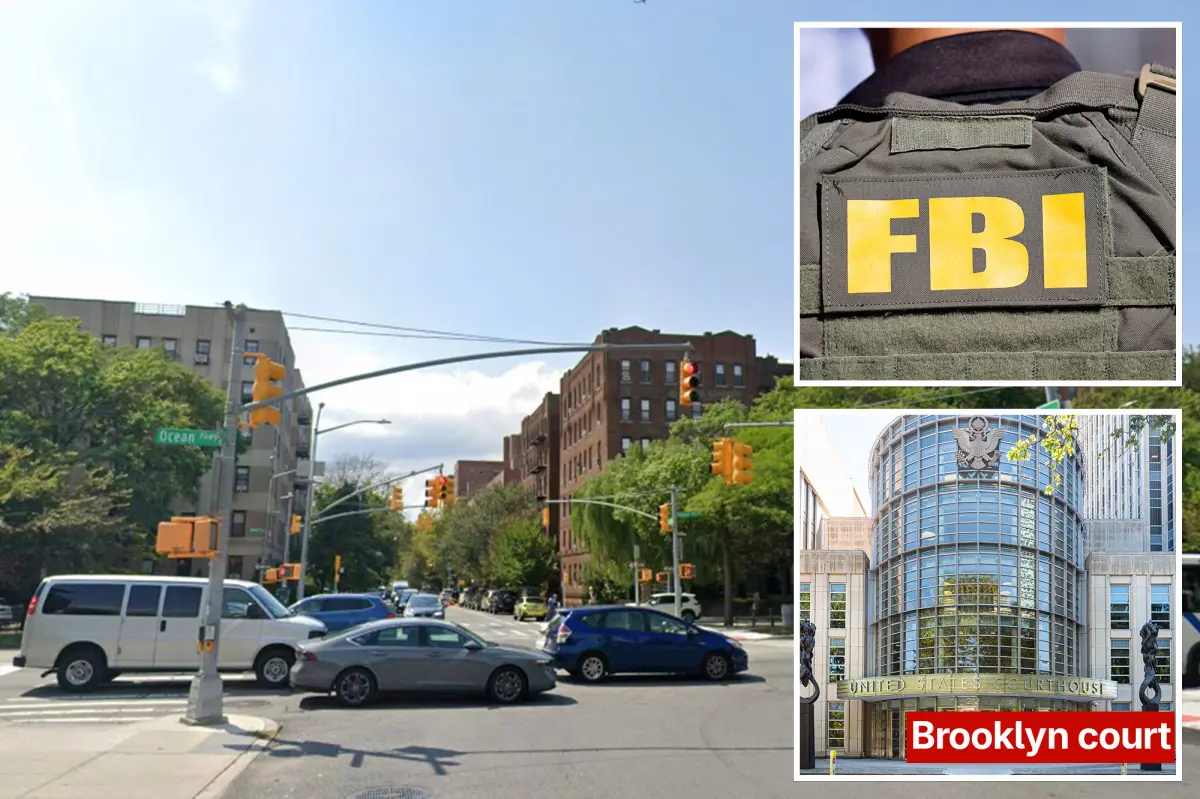
In the pre-dawn stillness of Brooklyn, before the city fully woke, a routine street crossing became the scene of an unforgivable betrayal. Around 6 a.m. on Feb. 3, a man walking near Ocean Parkway and Beverley Road in Kensington likely had no idea that the headlights approaching him belonged to an FBI agent, nor that the car was traveling against traffic, its emergency lights flashing. Andrew Reyes, 30, was behind the wheel of an agency-issued Chevy Impala. He was not responding to a call that would justify such reckless driving—at least none that prosecutors have described. Instead, the indictment alleges, he ran directly into the pedestrian, sending the man to the pavement unconscious. What happened next transformed a terrible accident into a criminal case that has stunned even hardened observers. Rather than dialing 911, rather than kneeling beside the victim, rather than calling out for help, Reyes allegedly dragged the unconscious man from the street, across the sidewalk, and onto a nearby bench. He retrieved the victim’s bag and placed it beside him, as if arranging a quiet scene of rest, and then left. The man lay there, severely injured and completely alone, while the federal agent drove away. For a person sworn to serve, this was not just a hit-and-run; it was a deliberate erasure of responsibility. Reyes joined the FBI in 2023 and was assigned to the New York field office, a position that should have meant protecting the vulnerable. Yet prosecutors say he used his vehicle—and his badge—to flee a moment that demanded the opposite. He was arrested Thursday morning, after being fired amid the investigation, and is expected to appear in Brooklyn federal court. The details of his journey from federal agent to defendant are still unfolding, but the first glimpse is deeply troubling.
The sequence of events described in the indictment is as disturbing as it is precise. Reyes was driving against the flow of traffic on Ocean Parkway, emergency lights blazing. At that hour, with streets relatively empty, the flashing lights might have seemed like a signal of urgency—perhaps an agent rushing to a call. But the lights did not protect the pedestrian crossing the road. The impact threw the man to the ground, knocking him unconscious. A responsible driver would have stopped, called for medical help, and done everything possible to reassure the victim that help was coming. Instead, Reyes allegedly got out and performed a grotesque act of stagecraft. He dragged the man’s limp body from the street to a bench, lifted or guided him onto it, and then went back for the man’s bag, placing it next to him on the bench. The scene, as described, looks almost like a bystander trying to make an injured person comfortable—except that it was an attempt to conceal what had happened. There was no call to 911, no attempt to wake the victim, no waiting for an ambulance. The man was left unconscious, with only his bag for company, on a bench in the cold morning. The Federal Bureau of Investigation, an institution built on the idea of justice, became in that moment the source of a grave injustice. The indictment does not say how long the man remained there before being discovered, only that he was eventually found and survived. For a neighborhood that prides itself on being a quiet, family-oriented corner of Brooklyn, the incident has raised unsettling questions. If an FBI agent can hit a person with a government car and then walk away, what does that say about the systems meant to keep everyone safe? The victim’s injuries are not described in court papers, but surviving a crash of that kind does not mean walking away intact. It can mean months of rehabilitation, nightmares, and a deep sense of violation. The man on that bench was not a name in a police report; he was someone’s family member, someone with a life interrupted by a stranger’s choice.
Brooklyn U.S. Attorney Joe Nocella did not mince words when announcing the indictment. “The defendant’s alleged conduct demonstrated a shocking disregard for human life and his sworn oath to uphold the law,” he said. That sentence captures the dual nature of the betrayal. On one level, this is about a serious injury caused by reckless driving. On another, it is about an FBI agent—someone with the legal authority to arrest, investigate, and enforce federal laws—choosing to leave an innocent person broken on a bench. The oath that Reyes took when he joined the FBI presumably meant something to him at the time. It probably meant something to his colleagues, his supervisors, and the public who trusted him. But in the early morning hours of Feb. 3, that oath collided with the instinct for self-preservation, and self-preservation won. The alleged coverup was not just a lie told later; it was a series of decisions made in the immediate aftermath of the crash. Every step—dragging the victim, placing the bag, driving away—was a choice. Those choices reveal a person who was more concerned with protecting his career than with protecting a fellow human being. The fact that the victim survived does not soften the accusation. It may, in fact, make the agent’s alleged conduct even more troubling: after seeing a man hit by his car, Reyes did not know whether the victim would live or die. He left anyway. He did not wait to find out. He did not call for help. He simply arranged the body in a way that might make it appear as though the man had stumbled onto the bench on his own, and then vanished. Such an act strikes at the most basic social contract—the duty we owe to one another when someone is hurt. When the person who causes the harm is a federal law enforcement officer, the violation feels even more profound. The badge is supposed to be a symbol of safety, not a license to abandon.
The alleged deception did not end at the scene. According to the indictment, Reyes later compounded his crimes by lying to investigators from the U.S. Department of Justice’s Office of the Inspector General. During a May interview, he reportedly claimed that he had never struck anyone while driving his FBI vehicle and that he had not failed to report an accident. Those statements were demonstrably false, prosecutors say, and they form the basis of the false-statements charge. This second layer of wrongdoing is important because it shows a continuing pattern of behavior. A panicked person might make a terrible mistake in the first moments after a crash—perhaps driving away in shock, perhaps convincing themselves that the victim wasn’t seriously hurt. But months later, with time to reflect and the opportunity to tell the truth, Reyes allegedly chose to lie again. That lie was not a momentary lapse; it was a deliberate attempt to obstruct an official investigation. It also suggests that the agent believed he could use his position to escape accountability. After all, he had emergency lights on his car and the backing of a powerful federal agency. Perhaps he thought investigators would believe him over an injured pedestrian. Perhaps he thought his word as an FBI agent would carry more weight than the evidence. The indictment is a reminder that no one is above the law, but it also exposes how easily power can distort judgment. The inspector general’s office exists precisely to investigate allegations of misconduct by federal agents. That Reyes allegedly lied to those watchdogs is not merely a technicality; it undermines the entire system of internal accountability. When an agent lies about using his vehicle in a crash, he makes it harder for the public to trust that the FBI will police its own. The May interview was an opportunity for Reyes to come clean, to admit that he had made a terrible mistake and to accept the consequences. Instead, according to the indictment, he doubled down. He may have hoped that the crash would go unnoticed, that the victim would not remember what happened, or that the emergency lights would confuse the issue. But the truth has a way of surfacing, and now he faces a federal prosecution.
Reyes now faces serious legal consequences. He was arrested Thursday morning, after being fired from the FBI, and was scheduled to make his initial appearance in Brooklyn federal court that afternoon. The indictment charges him with two counts: willfully depriving an individual of his constitutional rights while acting under color of law, and making false statements. If convicted, he could be sentenced to up to 10 years in prison. The first charge is particularly significant because it frames the alleged conduct not as a mere accident but as an abuse of government authority. “Under color of law” means Reyes was using the power of his federal position when he struck the victim and left him; the charge says he violated the victim’s constitutional right to be free from such arbitrary and dangerous actions by someone wielding official power. It is a charge often associated with police misconduct, and it carries a heavy moral weight. For a man who joined the FBI in 2023 and was assigned to the New York field office, this is a stunning fall from grace. At 30, he was at the beginning of a career that could have led to years of public service. Instead, he faces the prospect of becoming a federal prisoner. The court appearance on Thursday was likely brief—arraignment, perhaps bail arguments, a scheduling of future hearings—but the shadow of the charges will follow him for years, regardless of the outcome. No attorney was immediately identified for Reyes, and it is unclear how he will plead. But the case will be closely watched, not only because of the defendant’s former profession but because of the questions it raises about accountability within federal law enforcement. The FBI has not commented on the specifics, but the fact that Reyes was fired before his arrest suggests that the bureau did not wait for a conviction to distance itself from his alleged conduct. That firing is a small measure of institutional accountability, but it does little to ease the suffering of the victim. The man who was hit may spend a lifetime dealing with the consequences of those few seconds on Ocean Parkway. He may have medical bills, chronic pain, and a haunting memory of being left alone in the dark. And while a conviction of Reyes would not erase any of that, it would at least affirm that the system recognizes the wrong.
This case is ultimately about more than one agent’s alleged crimes. It is about what happens when the people entrusted with enforcing the law become the ones who break it. It is about the quiet vulnerability of a pedestrian crossing a street at dawn, and the profound responsibility that comes with driving a vehicle—especially a government vehicle with flashing lights. Emergency lights are meant to save lives, to signal that an official is on the way to help. In this story, they became a tool that allegedly allowed an FBI agent to drive against traffic without consequence, and then to abandon the person he had hurt. The image of that unconscious man on a bench, with his bag placed beside him, is a metaphor for a broader failure of care. It suggests a willingness to treat another human being as an inconvenience, a problem to be managed rather than a person to be helped. If the allegations are true, Reyes failed not only as an agent but as a human being. He had the chance to do the right thing at every step—after the crash, when he got out of the car; after he dragged the victim to the bench; after he had weeks to think about what he had done; and during the May interview, when he could have confessed. Instead, according to prosecutors, he chose self-protection every time. Now the courts will decide whether that pattern of choice constitutes a crime. But no verdict can fully restore what was lost: the victim’s sense of safety, the public’s confidence in the FBI, and the moral integrity of a young man who once wore the badge. As Brooklyn moves forward, the hope is that justice will be more than a punishment—that it will be a reminder that every person, no matter how powerful, is bound by the same duty to care for others. And that in the end, the measure of a society is not how it treats the famous or the fallen, but how it treats the unconscious stranger on a bench, left alone in the early morning.