







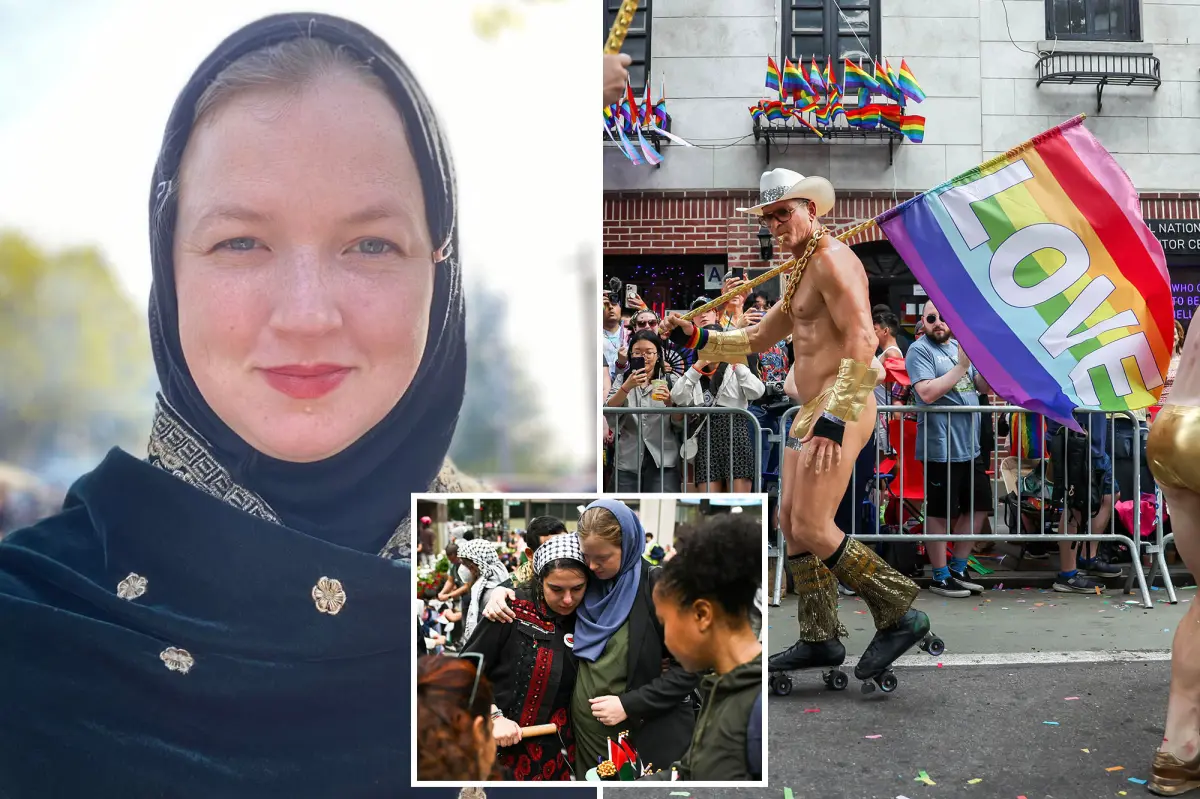
The delicate balancing act of modern progressive politics has been laid bare in Washington state, where a Democratic congressional candidate recently made a candid, yet controversial, admission. Melissa Chaudhry, a 34-year-old running for a second time in Washington’s 9th congressional district, confessed to a local Seattle newspaper that she deliberately avoided featuring LGBTQ+ rights on her campaign website. Her reasoning? She feared that openly championing these issues would alienate and upset her Muslim constituents. This calculation has sparked a fierce debate over political pragmatism, allyship, and the competing priorities within a diverse voter base, highlighting the friction that can arise when a candidate attempts to navigate overlapping cultural and religious sensibilities.
Chaudhry’s connection to the Islamic community is both personal and public; she wears a hijab and took the surname of her husband, a Muslim Army veteran. However, her hesitation to display LGBTQ+ advocacy on her platform stands in stark contrast to the actual demographics of her district. The Seattle metropolitan area, which comprises a significant portion of her constituency, is home to one of the largest LGBTQ+ populations in the United States, with approximately 17% of adults identifying as such. Conversely, the local Muslim population is estimated at just around 2%. Despite this vast demographic disparity, Chaudhry defended her omission by stating she wanted to be “careful about her Muslim constituents,” noting that “a lot of Muslims do not feel that way, unfortunately,” regarding LGBTQ+ acceptance.
This tension is reflected in broader national data on faith and social issues. According to a 2025 Pew Research Center report, only 41% of American Muslims believe homosexuality should be accepted by society, compared to 57% of Christian respondents and 82% of Jewish respondents. By prioritizing the traditional views of a small segment of her electorate over the deeply held values of a significantly larger and historically marginalized local demographic, Chaudhry found herself at the center of a political firestorm. For many progressive voters, her silence on these issues was seen not as sensitive cultural diplomacy, but as a disappointing compromise on fundamental human rights.
The backlash from the local LGBTQ+ community was swift and uncompromising, quickly forcing Chaudhry into damage-control mode. Andrew Ashiofu, the chair of the Washington Stonewall Democrats, publicly rebuked the candidate on social media, asserting that LGBTQ+ rights are foundational and non-negotiable for anyone seeking Democratic endorsement. In a lengthy response, Chaudhry attempted to reassure voters of her personal allyship, writing from the “bottom of her heart” that queer constituents and their rights would always be safe under her leadership. To prove her commitment, she pointed to her personal life, sharing that she supportive of her sister, who is in a committed same-sex relationship, and maintains close friendships within the LGBTQ+ community.
However, these personal assurances did little to appease her critics, who viewed her defense as a standard, deflective political trope. Ashiofu declined to engage further with her explanation, comparing her defense of having queer family and friends to the well-worn, dismissive phrase used by individuals defending themselves against accusations of racism. For advcoates, systemic political representation cannot be replaced by private goodwill; they argue that if a candidate is too intimidated to advocate for marginalized groups on a campaign website, they cannot be trusted to fight for them under the intense pressure of legislative halls in Washington, D.C.
Ultimately, Chaudhry’s campaign dilemma illustrates the complex and sometimes contradictory nature of building a broad progressive coalition. In trying to foster an inclusive environment that respected the religious conservatism of one minority group, she inadvertently marginalized another group that forms a cornerstone of her party’s base. As she continues her bid for Congress, the controversy serves as a stark reminder that in modern representation, silence on core human rights issues is rarely viewed as neutral. For candidates running in highly diverse districts, the challenge remains how to honor the faith traditions of some constituents without compromising on the visible advocacy and protections demanded by others.