



Perfect Storm: Inside the Geological and Structural Failures Behind Venezuela’s Deadly Doublet Earthquake
The Catalyst of Catastrophe: How a Rare Seismic Doublet Shattered Venezuela’s Coastline
On June 24, a devastating geological event redefined our understanding of seismic vulnerability along the Caribbean plate boundary. While any major tectonic shift poses a severe threat to human life, the residents of Caracas and nearby coastal cities like La Guaira, Caraballeda, and Catia La Mar found themselves caught in a terrifying convergence of worst-case scenarios. The disaster was not triggered by a single isolated rupture, but rather by a rare and violent phenomenon known to seismologists as an earthquake “doublet.” Two massive quakes shattered the region in rapid succession, separated by a mere 39 seconds. The first, a formidable magnitude 7.2 shockwave, destabilized geological formations and weakened buildings, only to be followed moments later by an even more destructive magnitude 7.5 convulsion. This relentless pairing subjected the built environment to a prolonged, chaotic swaying that few structures were engineered to survive. According to official figures released by the Venezuelan government, this double-strike claimed more than 2,200 lives, completely leveled over 400 major buildings, and left hundreds of other high-rises structurally compromised, transforming vibrant coastal communities into fields of concrete dust and twisted rebar.
              SEISMIC ENERGY ACCUMULATION

[ Boconó Fault ] ---> (Trigger Event: Mag 7.2)
                             │
                             ▼ (39 Seconds Elapsed)
[ San Sebastián Fault ] ---> (Main Shock: Mag 7.5)
                             │
                             ▼ (Directivity Effect)
================== EASTWARD PROPAGATION ==================>
[ Caraballeda ] ────> [ La Guaira ] ────> [ Caracas Capital ]
The Path of Destruction: Why the Eastward Rupture Travelelled Toward Population Centers
The sheer lethality of the June 24 disaster was dictated heavily by the direction in which the earth unzipped. As the initial tectonic stress fractured the Boconó fault—a historical geological seam infamous for producing a catastrophic earthquake in the 19th century—seismic waves radiated outward in all directions. However, the energy traveling eastward encountered a critical threshold on the adjacent San Sebastián fault, a major tectonic boundary primed for failure. When this second, larger fault ruptured, the tear did not propagate harmlessly out to sea or toward the sparsely populated west. Instead, it tore violently eastward for more than 100 miles, aiming directly at the high-density urban corridor of the Caracas metropolitan area. Geophysicists from the United States Geological Survey (USGS), including Dr. William Barnhart, pointed out that the region’s fate hung on a coin flip of plate tectonics. Had the rupture propagated westward, the energy would have dissipated into less populated areas, sparing thousands. Instead, the fault line extended its destructive reach all the way to the capital, ensuring that the ground beneath Venezuela’s most densely populated valleys shook with maximum intensity.
   STRIKE-SLIP FAULT MECHANISM (SAN SEBASTIÁN FAULT)

             [ North of Fault Line ] -> SLIPS EAST
   =========================================================
   ------------------ SAN SEBASTIÁN FAULT ------------------
   =========================================================
             [ South of Fault Line ] -> SLIPS WEST
Ground Shift and Tectonic Displacement: The Truncated Runway at Simón Bolívar International Airport
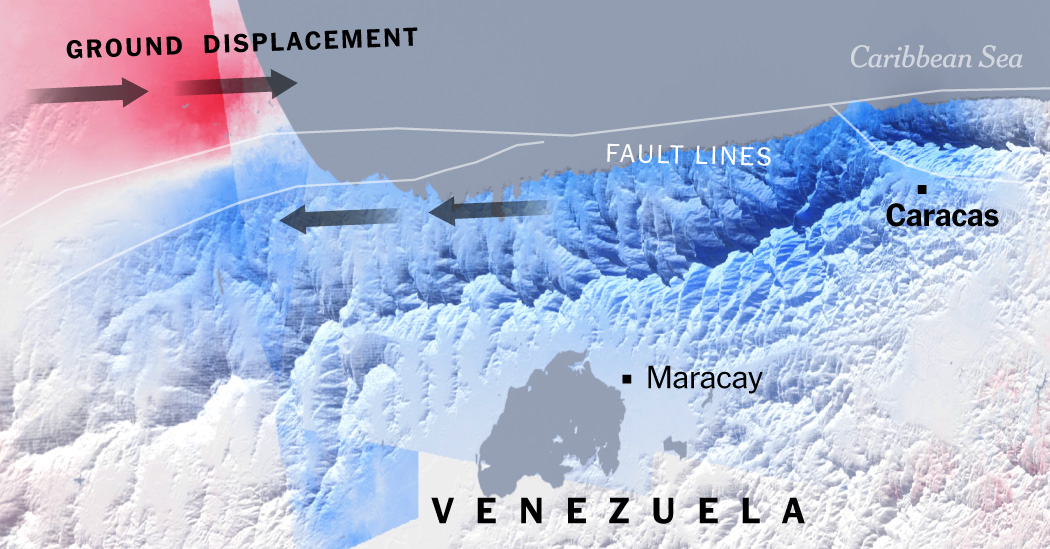
To comprehend the sheer physical force of the disaster, scientists have turned to advanced satellite imagery, comparing the topography of the coast before and after the event. The data revealed a massive lateral ground displacement. The San Sebastián fault is classified as a right-lateral strike-slip fault, a tectonic boundary where two blocks of the Earth’s crust slide horizontally past one another. During the second earthquake, the land mass north of the fault line lurched eastward, while the continental shelf to the south shifted violently to the west. In coastal communities like La Guaira, where the fault line runs just offshore or directly beneath city streets, the ground shifted by up to 1.5 feet. This horizontal tearing was vividly illustrated at Simón Bolívar International Airport. Satellite analysis showed that the northern half of the airport’s runway infrastructure was physically displaced to the east, while the southern side was dragged in the opposite direction. While Dr. Barnhart noted that the rupture did not quite breach the surface of the earth to create a visible surface cliff, the deep-seated crustal shear was powerful enough to tear through foundations and rupture underground utility networks across the entire state of La Guaira.
          AIRPORT GROUND DISPLACEMENT GRAPHIC

               [ North of Fault: Runway Shifted East ]
           ┌───────────────────────┐ ───>
           │===| runway north |====│
    =======└───────────────────────┘======= [Fault Line Boundary]
           ┌───────────────────────┐ <───
           │===| runway south |====│
               [ South of Fault: Runway Shifted West ]
The Physics of Directivity and Deep-Seated Shallow Ruptures
The extreme violence of the ground movement was further amplified by a classic wave-physics phenomenon known as “seismic directivity.” As the physical rupture moved eastward along the San Sebastián fault, it traveled at a speed close to that of the seismic shear waves themselves. This caused the shockwaves to bunch up and pile on top of one another, much like the sound waves in front of a supersonic jet or the bow shock waves pushed ahead of a speeding ship. This directivity effect focused and amplified the energy, delivering a concentrated punch of high-frequency shaking to the cities in its path. Compounding this, the earthquakes were exceptionally shallow, nucleating a mere six miles beneath the surface of the earth. According to Dr. Vitor Silva, head of risk engineering for the Global Earthquake Model Foundation, this is “almost as shallow as it gets” for events of this magnitude. Because there was very little rock column standing between the source of the energy release and the foundations of the cities above, there was minimal geological damping. The raw, unfiltered kinetic energy of the rupture translated directly into violent surface acceleration, leaving the built environment little chance to absorb the shock.
            THE SEISMIC "DIRECTIVITY" EFFECT

     Rupture Front ---> ---> ---> ---> [Accumulated Wave Energy]
    (Source moves at wave speed)       =======
                                               ====> [Caracas]
                                               /====> (Ampliified
     Velocity Vector -> -> -> -> -> -> =======/       Destruction)
The Silent Killer: Soft Sedimentary Soils and the Resonant Wave Effect
In urban development, flat ground is naturally favored for housing, transportation, and commerce. However, flat coastal planes and deep mountain valleys are often comprised of loose, water-saturated sedimentary soil—remnants of ancient river beds, lakes, and oceans. In Venezuela, this geological reality became a silent accomplice to the earthquake’s destruction. When seismic waves travel through hard, crystalline bedrock, they move quickly and with relatively low amplitudes. However, the moment those waves hit the soft, unconsolidated alluvial soils of coastal Caraballeda and Playa Grande, they slow down and balloon in height, drastically amplifying the shaking at the surface. In Caraballeda along the coastline, where at least 152 multi-story buildings collapsed or were severely damaged, the structures had been anchored in soft coastal plains. The geology of the area acted as a natural amplifier, filtering the seismic energy into specific frequencies that matched the natural swaying frequency of the local high-rises. When these frequencies synchronized, a phenomenon known as resonance occurred, causing buildings to rock with increasing violence until their structural columns sheared, bringing thousands of tons of concrete crashing down.
          SOIL AMPLIFICATION EFFECT ON WAVES

 [ Deep Bedrock ]                      [ Soft Sediment / Coast ]
(Fast, Low Amplitude)                 (Slow, Highly Amplified Waves)
   _    _    _                         ___        ___        ___
 _/ _/ _/ _/───────────────────────/   ______/   ______/
Building Codes vs. Reality: Examining Venezuela’s Structural Failures
In the aftermath of the disaster, attention has inexorably shifted from the natural forces of the earth to the human-made structures that failed to withstand them. On paper, Venezuela boasts some of the most rigorous, modern seismic building codes in South America, developed after lessons learned from historic earthquakes in the region. The tragic reality, however, is that these codes are only as effective as their enforcement. Aerial drone footage and engineering field surveys conducted in damaged neighborhoods like Playa Grande—where over 246 structures were destroyed directly over the fault pathway—reveal a stark disparity in construction quality. Many multi-story apartment buildings suffered from “soft-story” collapse, where ground floors designed for open parking spaces or commercial storefronts lacked the shear walls and lateral reinforcement to support the heavy residential levels above. In other ruins, forensic engineers noted a distinct lack of steel rebar reinforcement within supporting columns, suggesting that historical economic pressures or corner-cutting had compromised structural integrity. As rescue efforts transition into long-term reconstruction, the disaster stands as a stark warning to rapidly developing nations worldwide: building codes must be actively enforced, because when the earth eventually moves, the geologic record forgets nothing, and the soil spares no compromised structure.
                      SOFT-STORY COLLAPSE

     ┌────────────────────────────────────────┐
     │          Residential Floor 2           │
     ├────────────────────────────────────────┤  <-- Intact upper mass
     │          Residential Floor 1           │
     └───────────┬────────────────┬───────────┘
     ===========/ ==============/ ============   <-- Sheared Columns
                 [ Ground Floor Parking/Lobby ]      (Soft-Story Failure)