




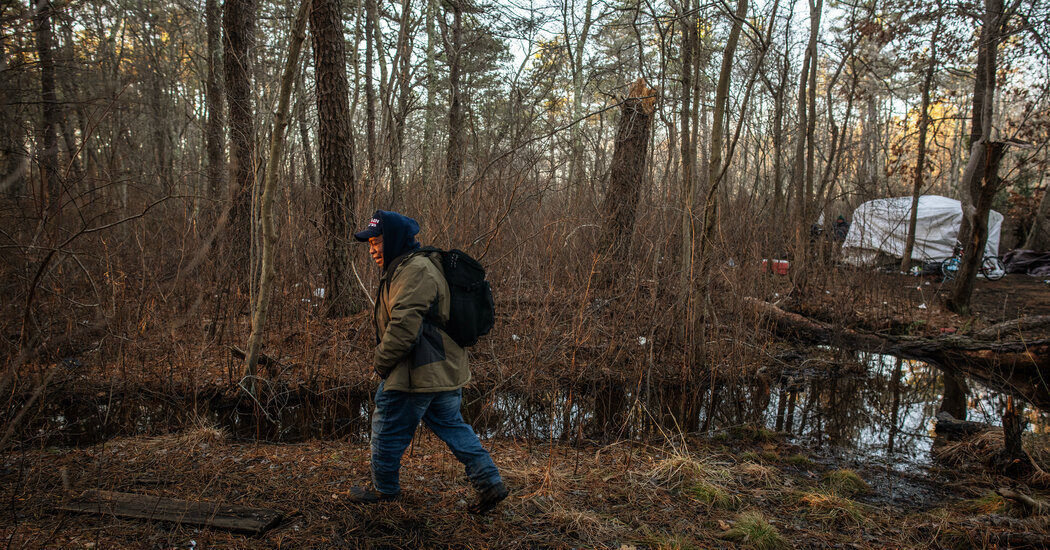
Winter in the Hamptons is marked by an extraordinary display of protective care, a season where the wealthy residents of Long Island’s most elite coastal enclaves spend fortunes to shield their investments from the brutal elements. Along the manicured avenues of these prestigious communities, the towering, decorative evergreen hedges that frame multimillion-dollar estates are wrapped with obsessive precision. Teams of workers unspool heavy bolts of burlap, pulling the rough fabric taut against the foliage and stitching it together by hand with oversized, specialized needles purchased from local hardware stores. This elaborate ritual, often called “hedge couture,” is designed to prevent the winter frost from rupturing the delicate cellular walls of the plants, ensuring that when spring returns, the landscape remains as pristine and flawless as the fortunes of those who live behind them. Yet, less than a dozen miles from these swaddled, pampered gardens, a far more precarious struggle for survival unfolds in the freezing dark of the surrounding pine forests. In these woods, hidden away from the prying eyes of summer vacationers, the very men who spend their autumns stitching protective blankets around wealthy patrons’ plants are left to face the deadly winter cold with little more than plastic tarps and discarded blankets. It was in one of these makeshift, freezing encampments, on a bitterly cold Thursday in February, that sixty-one-year-old Francisco Camey stepped out of the shelter he shared with his younger brother, Gilberto, and simply disappeared into a freezing wind that howled off Peconic Bay. The temperature that night plummeted into the low twenties, with gusts making the air feel like zero degrees Fahrenheit. Inside their enclosure—a fragile sanctuary constructed of ropes, plastic sheeting, and white tarps strung between dry pine trees—Gilberto woke up in the dead of the night to a sudden, icy draft. He called out into the darkness, hoping his brother had returned from the local store, but his voice was met only by the whispering wind and the terrifying, silent reality of the creeping frost.
When dawn finally broke over the snowy landscape of Riverhead, Gilberto set out to follow his brother’s faint tracks, his sneakers sinking deep into the fresh powder as he walked. The trail he followed cut through a silent forest of towering pines and skeletal, leafless oaks—a hidden wilderness of makeshift camps populated by dozens of undocumented migrant laborers, mostly from Guatemala, who have become the invisible backbone of the Hamptons’ luxury economy. Gilberto trudged through the cold, his hoodie pulled tight against his face, eventually emerging onto a quiet two-lane highway that led toward a local public park. There, just past a frozen water fountain and adjacent to a snow-covered Little League baseball field, he spotted a flash of bright blue against the stark white ground. Francisco was lying on his back in a deep bank of snow, his thick white hair submerged in the powder, wearing nothing but a blue Champion sweatshirt to shield him from the freezing night. His hands were clenched tightly against his chest in a final, instinctive effort to preserve the last fading embers of his body heat. For Gilberto, the sight was a paralyzing, soul-crushing shock that made him feel as though his own life was slipping away in the cold. This tragedy exposed the brutal, unyielding geography of inequality that defines the Hamptons, where the migrant laborers who paint, build, and landscape these legendary estates are completely priced out of the very paradise they maintain. The lucky ones are able to secure a “cuarto”—a single, cramped room in a house packed with other workers—for which they pay upwards of $800 to $1,000 a month. But in the winter, when the landscaping work completely dries up and the wealthy property owners retreat to their city apartments, even these rooms become an impossible luxury, forcing dozens of vulnerable workers to seek refuge in the freezing woods.
The journey that brought the Camey brothers to the woods of Long Island began decades ago in the central highlands of Guatemala, in a town called San Raymundo. Born into a massive family of thirteen children to a poor sharecropper, Francisco grew up working the soil, helping his father harvest corn from a young age, carrying heavy baskets of cobs on his back, and cutting his hands on the rough husks. Because they farmed land owned by wealthy landlords, the harvest was always split in half, leaving the family in a cycle of perpetual poverty. Driven by the hope of lifting their family out of desperation, the brothers made the agonizing decision to leave their homeland, paying thousands of dollars to smugglers to guide them across the United States border. Manuel was the first to arrive in 2001, followed closely by Gilberto, Francisco, and later, Rafael. They joined a massive, unprecedented wave of Latino immigrants who transformed the demographics of the East End, with the Latino population in the region growing eightfold between 1980 and 2000. Today, Guatemalan and other Latino migrants make up more than a quarter of the year-round population, performing the essential, grueling labor that keeps the region’s multimillion-dollar real estate empire functioning. Yet, as their numbers grew, so did a quiet, persistent backlash from local residents. The optimistic days of gathering outside the Southampton 7-Eleven at five in the morning to wait for landscaping trucks were quickly met with “No Loitering” signs, targeted immigration raids, and fierce political opposition to indoor hiring halls. Rising property values transformed the Hamptons into an ultra-luxury market where the average home price soared past millions of dollars, while the affordable basements and shared rooms where the workers lived were systematically targeted by local zoning officials, pushing the most vulnerable of these essential workers deeper into the shadows.
For Francisco, the relentless economic pressure, combined with the profound isolation of living far from his homeland, eventually took a devastating toll. While his brother Manuel found stable, year-round work in a restaurant kitchen, Francisco relied entirely on seasonal landscaping gigs, sending whatever money he could back to his aging mother in Guatemala. But as the cost of renting a simple room ballooned to heights that rivaled rents in major metropolitan areas, Francisco found himself unable to make ends meet when winter arrived. To numb the piercing cold of the New York winters and the deep psychological ache of his isolation, he turned to alcohol, relying on the cheapest beer he could find to blunt his reality. The downward spiral intensified dramatically after his mother passed away in 2013; consumed by grief and a sense of deep personal shame, Francisco stopped answering calls from his family, actively avoiding his brothers Manuel and Rafael even as they searched for him. Six years ago, when the financial math of surviving in the Hamptons ceased to add up for Gilberto as well, he joined Francisco in the woods, refusing to abandon his struggling older brother. Working side-by-side during the summer, Gilberto tried his best to shield Francisco, using his own earnings to buy groceries and cooking hot meals of beans and omelets over an open fire pit outside their plastic-lined tent. On that fateful February morning, Francisco had left their camp with the simple intention of buying beer, leaving behind a perimeter of empty beer cans around their tent—a tragic testament to the quiet, desperate coping mechanism that ultimately bound him to the forest floor.
Though the Suffolk County medical examiner officially attributed Francisco’s death to “chronic alcoholism” due to his high blood alcohol level, prominent forensic pathologists who reviewed the case at the request of journalists reached a far more damning conclusion. Experts like Dr. Michael Baden, the former chief medical examiner of New York City, pointed out that while Francisco had a significant amount of alcohol in his system, he would not have died had he been indoors or in a warm shelter, defining the true cause of death as hypothermia. The physical state in which Francisco’s body was found—partially undressed in the snow—points directly to a cruel biological phenomenon known as “paradoxical undressing.” In the final, catastrophic stages of freezing to death, the body’s natural defense mechanisms fail; the brain’s thermostat malfunctions, and instead of constricting blood vessels to keep warmth at the core, the body suddenly dilates them, sending a rush of warm blood to the skin. This creates a terrifying, deceptive sensation of burning up, causing the freezing individual to strip off their clothes in their final, disoriented moments before succumbing to the cold. This physiological horror is compounded by a systemic lack of resources for the region’s homeless population. There is no permanent year-round shelter in the Hamptons, and the temporary winter shelters operated by nonprofits like Maureen’s Haven have faced hostile zoning lawsuits from local municipalities. The daily reality for these workers remains perilously grim; only weeks before Francisco’s death, another Guatemalan laborer arrived at a temporary shelter with feet so severely blacked by frostbite that doctors were forced to amputate parts of both feet, illustrating the horrific bodily toll of a community that refuses to house its workforce.
Francisco was finally laid to rest in an airy, brightly lit church in Riverhead, a sanctuary that regularly serves as a gathering place for the area’s massive Guatemalan migrant community. At the front of the church, on a small table adorned with a cloth embroidered with blue angels, sat the only photograph his family could find of him: a blurry, out-of-focus snapshot of Francisco sitting on a plastic tarp, quietly eating a tamale against a backdrop of golden Hamptons beach grass. The funeral exposed the deep, painful fissures within the family, with his brothers Manuel and Rafael sitting on one side of the aisle, clean-cut and relatively secure in their rented rooms, while Gilberto sat isolated on the other, looking decades older than his years due to his time in the woods. His brothers viewed Francisco’s tragic fate through a lens of personal shame and failure, blaming his “vices” rather than the predatory economic systems that had cast him aside. After the service, as the mourners gathered at a local Guatemalan deli, the walls around them were plastered with classified ads for rooms to rent, explicitly stating a preference for “men who don’t have vices”—a stark reminder of how narrow the margins of survival are in this coastal paradise. Thanks to the tireless efforts of local advocates like Marit Molin of Hamptons Community Outreach, Gilberto was eventually able to secure a $900-a-month room of his own, taking his first steps out of the forest in many years. Yet, even in the safety of a warm room, he finds himself unable to sleep, haunted by the memory of his brother’s frozen face and the agonizing reality that in an empire of unimaginable wealth, millions of dollars are spent to delicately wrap and protect ornamental bushes from the winter frost, while the human beings who nurture them are left to freeze and die in the shadows.