



1.
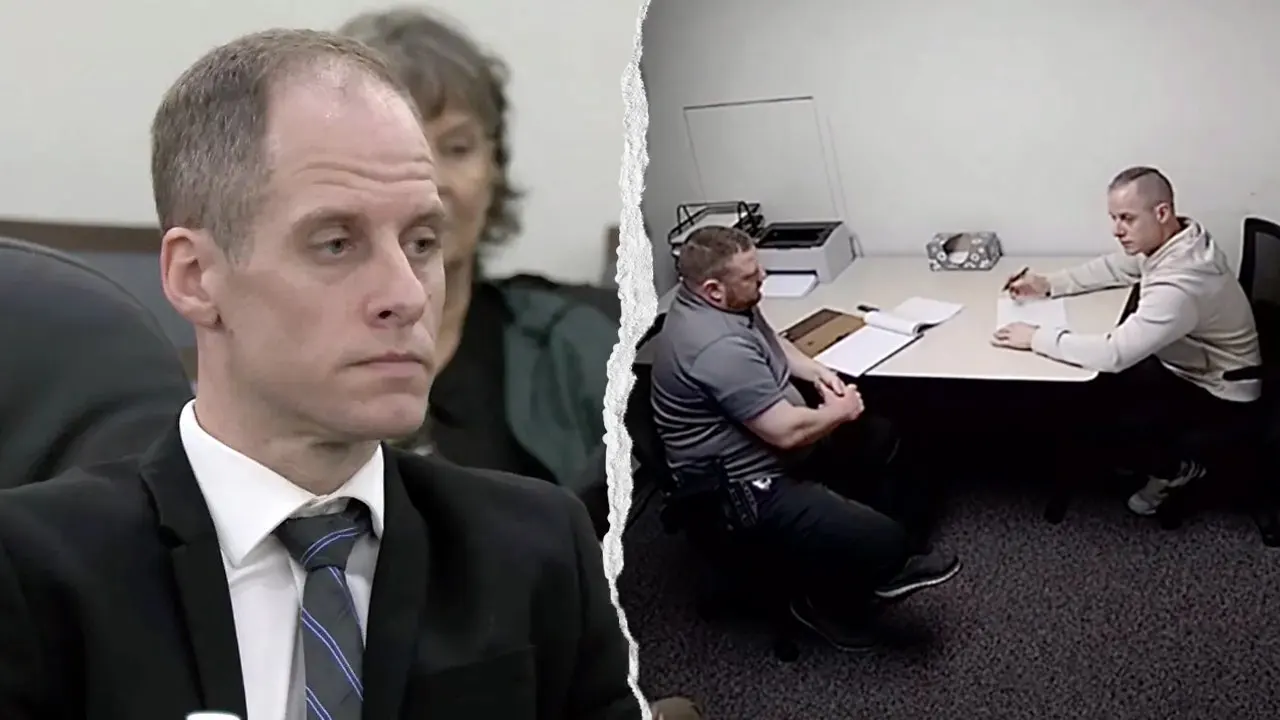
In a small Ohio courtroom, the voice that once charmed television audiences sounded steady, almost rehearsed, as Caleb Flynn answered questions about the worst night of his life. A former American Idol contestant, Flynn had once stood in the bright lights singing for judges and dreaming of a music career. But on Monday, he sat at the center of a far darker story. His trial for the murder of his wife, Ashley Flynn, entered its second week, and jurors were still glued to a recorded police interview that prosecutors hope will unravel the mystery of what happened inside the couple’s Tipp City home on February 16. Ashley, a 34-year-old mother of two, was found dead in the master bedroom with a gunshot wound to the back of her head. Prosecutors say her death was not the result of a random intruder, as Flynn reportedly implied, but a calculated execution staged to look like a burglary gone wrong. They believe Flynn shot his wife while their two young daughters—ages 10 and 12—slept in another room, then engineered a scene to deflect suspicion. Flynn has pleaded not guilty to aggravated murder and related charges, and his defense team has maintained his innocence throughout. As the courtroom listened to his voice fill the space, there was a heaviness in the air: the unmistakable weight of a childhood dream giving way to a family tragedy, a marriage shattered by secrets, and two girls who lost their mother in the most violent way imaginable.
2.
The recording played for jurors offered a chilling glimpse into Flynn’s own account of that night. He told investigators that on the day before the shooting, a strange man appeared at the family’s front door—a man with long hair who gave Ashley what Flynn described as a “weird” sales pitch involving an American flag. Flynn claimed the man drove up in a car, sat outside for a moment, then walked to the porch while Ashley and the girls were in the living room. “My daughter can confirm,” Flynn said, seemingly eager to steer investigators toward an intruder narrative. He described the man as awkward, with no visible work uniform or company logo, and said Ashley eventually closed the door after the man indicated he might return later. The story felt deliberately detailed, almost as if Flynn was trying to plant a seed of doubt before detectives even began searching for evidence. He then walked them through his own movements that night, painting a picture of a tired father asleep on the couch with the family dogs beside him. He told police that one of the dogs began shaking and scratching, waking him. He said he got up to check on his daughters, tucked his youngest back into bed, and lay down beside her. Then, he said, the sound of gunshots ripped through the house—loud, back-to-back, unmistakable. “The shots woke you up?” an investigator asked. “Yes, sir,” Flynn replied. But his story didn’t fully align with what investigators later found. Detective Sgt. Mike Morgan testified that Flynn said he froze for four to six seconds before running to the master bedroom, where he found Ashley dead. Those few seconds, prosecutors would argue, were not the paralysis of a terrified husband but the pause of a man making sure his performance was complete.
3.
Perhaps the most damning testimony came from the woman who was not supposed to be part of the story: Alleigha Botner, Flynn’s former mistress. For nearly two days, jurors listened as Botner described a passionate, secret affair that spanned roughly a year and a half and produced more than 107,000 text messages. Her voice, at times trembling and at other times blunt, pulled back the curtain on a relationship filled with intensity, jealousy, and disturbing declarations. Botner testified that Flynn repeatedly spoke about wanting his wife dead, and in one message she read aloud, he allegedly wrote that he had stayed up until 4 a.m., “literally thinking of ways to kill her and not go to jail.” Those words hung in the courtroom like smoke. The affair, Botner said, was not just an emotional escape for Flynn but a fixation that consumed him. She testified that shortly after midnight on February 16, Flynn sent her a message saying, “It’s happening,” followed by “February 16th—day I’ll never forget.” Botner responded, “You’re about to be free.” Flynn replied, “I choose you.” The exchange was not the language of a man merely planning a divorce, prosecutors argued. It was the language of a man preparing to do something irreversible. Botner herself admitted that she understood his plan for that day to mean he intended to finally leave Ashley and begin a new life—not to kill her. But the words were chilling, and they shifted the emotional energy of the trial from a complicated marriage to something darker, more premeditated.
4.
Still, Flynn’s defense attorneys worked diligently to reframe the mountain of messages and the affair itself. During cross-examination, they reminded jurors that Botner’s own messages were filled with emotionally charged language, dramatic threats, and expressive declarations. The affair was messy, obsessive, and chaotic on both sides, they argued. Longing and heartbreak, anger and tenderness—these were the raw materials of a relationship conducted in secret, not necessarily a blueprint for murder. The defense also pointed to a puzzling lack of physical evidence. Investigators have never recovered the firearm they believe was used to kill Ashley, despite extensive searches of the property, nearby waterways, and other areas. No eyewitnesses placed Flynn at the scene of the shooting, and forensic testimony showed that no gunshot residue was found on his hands or clothing. In a case that prosecutors have painted as cold and calculated, those missing pieces matter. The defense has used them to argue that reasonable doubt remains, asking jurors to consider whether Flynn—a reality television personality, a husband, a father—could really have committed such a brutal act in a home filled with his sleeping children. The absence of a weapon and the absence of forensic proof make the case less straightforward than it might seem, and the defense is determined to exploit every gap. In a trial where the prosecution’s narrative depends largely on messages and motive, the physical absence of murder paraphernalia gives the jury room to pause.
5.
Amid all the legal maneuvering and evidence, the two people most affected by this tragedy remain largely silent: Ashley and Caleb Flynn’s daughters. The girls were inside the house when their mother was killed, and prosecutors have considered calling them to testify. If they do, the court has ruled, their testimony will be heard by audio only—a way to protect them from the trauma of facing their father in a crowded courtroom while recalling the night their world collapsed. The thought of their voices, young and trembling, being played for jurors is heartbreaking to consider. They lost their mother in the dark hours of a winter night, and now they may be asked to help send their father to prison. The trial has also dragged family members into an uncomfortable spotlight. Reports have surfaced of an eerie Google search made by Ashley’s father after he learned of her murder, a detail that has added another unsettling layer to the case. It remains unclear exactly what that search involved, but its mention by authorities suggests that even those closest to Ashley are not insulated from suspicion or scrutiny. The extended family, friends, and the small Tipp City community have watched the proceedings unfold with sorrow and disbelief. A mother who was known for her smile and devotion to her children has been reduced to exhibits, text messages, and crime scene photos. The courtroom, with its wooden benches and hushed conversations, feels less like a place of justice and more like the epicenter of a shared wound that will take a long time to heal.
6.
As the second week of trial unfolds, prosecutors are inching closer to resting their case. Additional witnesses are expected to take the stand, and the courtroom remains uncertain whether the couple’s daughters will be among them. The decision, made in real time, weighs heavily on everyone involved. Flynn’s attorneys have declined to comment while the trial is ongoing, and his face has given little away during the proceedings. But the story, in all its brutal complexity, is now fully in the hands of a jury that will have to decide not just whether the evidence proves guilt beyond a reasonable doubt, but whether a man who once sang for millions is capable of ending the life of the woman he promised to cherish. For Ashley’s family, this trial is not about spectacle or true crime entertainment. It is about a daughter, a sister, and a mother who deserved a different ending. It is about two children who will grow up with a fractured history, forced to reconcile the love they feel for their father with the accusation that he destroyed their family. The courtroom will keep listening to interviews, keep reading messages, keep weighing the testimony of mistresses and detectives. And somewhere beyond the walls of the courthouse, life goes on—but for those left behind, it will never be the same. Justice, whatever form it takes, will not bring Ashley back. But it may finally give her family the chance to begin the long, painful task of healing.