




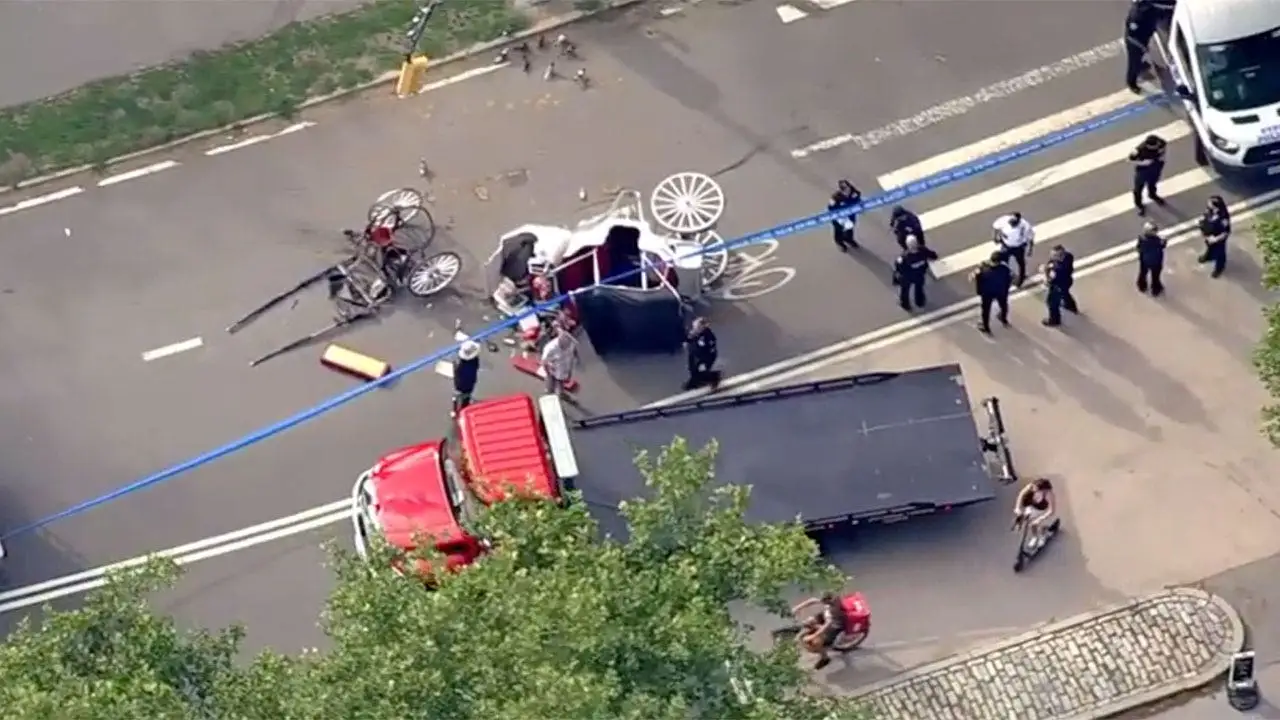
Central Park is often romanticized as the leafy, tranquil heart of Manhattan, an iconic sanctuary of green where millions of visitors flock each year to escape the unrelenting pace of the concrete jungle. For eighteen-year-old Romanch Mahajan and his family, who had traveled thousands of miles from their home in India to experience the legendary wonders of New York City, a leisurely horse-drawn carriage ride through these winding, sun-dappled paths was supposed to be a highlight of their dream vacation—a quiet, joyful moment of bonding, laughter, and lasting memories. Instead, this picturesque setting dissolved into a scene of unspeakable horror last Wednesday afternoon when the carriage ride violently and unexpectedly derailed. Without warning, the horse became severely spooked by an unknown trigger, bolts of panic driving the animal to charge wildly down West Drive in a blind, terrified frenzy. The runaway carriage eventually collided with another carriage before violently overturning in a chaotic crash of splintering wood, heavy metal, and shattered glass. In a devastating testament to the profound strength of familial love amidst sudden terror, Romanch’s father later shared the heartbreaking detail that his young son spent his final moments selflessly trying to shield and rescue his mother, who had been violently thrown from the carriage during the impact. This ultimate act of bravery and sacrifice has cast a deep, somber shadow over the bustling metropolis, turning a vibrant young tourist’s dream vacation into an enduring tragedy that has deeply shaken New Yorkers and people worldwide. The heartbreaking image of a young man, standing on the very cusp of adulthood, sacrificing his own safety to protect his mother in a foreign city has struck a raw, deeply empathetic nerve, forcing a collective pause in a city that rarely slows down, and inviting everyone to contemplate the fragile boundary between a beautiful afternoon of exploration and an unimaginable, sudden loss.
In the immediate and painful wake of this heartbreaking loss, the local community is coming together not only to grieve but to honor the memory of a young life cut far too short. Local advocates, elected officials, and deeply moved citizens will gather for a solemn, candlelit vigil on Monday evening at the Cherry Hill Fountain, a location situated near where the tragic incident occurred. Organized by the advocacy group New Yorkers for Clean, Livable, and Safe Streets (NYCLASS), the gathering is designed to offer a space of quiet reflection, solidarity, and shared sorrow for the grieving Mahajan family during their darkest hour. In a poignant, highly symbolic gesture to ensure that Romanch’s sacrifice is never forgotten, NYCLASS announced that a critical piece of city legislation aimed at reforming the carriage industry, previously known as “Ryder’s Law,” will be officially renamed “Romanch’s Law” in memory of the fallen teenager. This transition from a name representing an animal victim to one honoring a human life underscores the profound intersection of human safety and animal welfare that lies at the core of this tragedy. By renaming the bill, advocates hope to keep Romanch’s name alive not just as a symbol of heartbreak, but as a direct catalyst for systemic change that prevents other families from ever having to endure the same excruciating pain. The vigil at the fountain, typically a place of scenic beauty and joy, will serve as a stark, emotional reminder of the human cost of outdated practices in a modern, crowded city, bringing together diverse voices united in their grief and their demand for a safer future.
To fully understand the legislative journey of the newly renamed “Romanch’s Law,” one must look back to the origins of the original bill, which was initially introduced to address the deep-seated controversies surrounding New York City’s horse-drawn carriage industry. The legislation was first proposed in 2022 by former Council Member Bob Holden following a highly publicized and deeply disturbing incident where an aging carriage horse named Ryder collapsed on a hot concrete street in Hell’s Kitchen, sparking widespread public outrage before eventually passing away. The distressing footage of Ryder’s collapse went viral online, exposing the physical toll that navigating busy, paved city streets, toxic exhaust fumes, and roaring traffic takes on these sensitive animals. Following the recent tragedy of Romanch Mahajan, Council Member Chris Marte swiftly renewed the call for the bill’s passage, arguing that the status quo is no longer tenable for either the animals or the millions of pedestrians who visit the park each year. Standing in solidarity, Council Speaker Julie Menin announced that the City Council would officially hold a public hearing for the bill this coming July, signaling a pivotal moment for local governance and animal rights. Menin emphasized that the council is prepared to hear from all stakeholders, including animal welfare advocates, carriage operators, tourists, and safety experts, in order to review critical safety measures and animal welfare standards. For many, this upcoming hearing represents more than just a legislative debate; it is a long-overdue moral reckoning on whether horse-drawn carriages have a sustainable place in the twenty-first-century landscape of New York City.
On the other side of this emotionally charged issue are the carriage operators and the labor unions that represent them, who find themselves navigating a complex landscape of public grief, intense scrutiny, and professional survival. Alexander Kemp, the administrative vice president of Transport Workers Union (TWU) Local 100, expressed the union’s heartfelt condolences to the Mahajan family, stating that words cannot fully capture the sheer, devastating enormity of this tragedy. Acknowledging the urgent need for a response, Kemp and union leaders held a press conference to announce that they are taking immediate, proactive steps to address safety concerns within the industry, recognizing that public trust has been severely shaken. The union is currently developing new, rigorous safety training protocols designed with direct feedback from experienced carriage operators, which will be rolled out to approximately 200 carriage owners and drivers across the city. These new protocols aim to enhance driver education, improve horse handling under high-stress urban conditions, and establish stricter guidelines for identifying potentially hazardous situations before they escalate. For the drivers, many of whom are working-class immigrants who view their profession as a historic trade passed down through generations, the push to ban the carriages entirely threatens their livelihoods and their way of life. The union’s efforts to implement rapid safety reforms represent an attempt to find a middle ground—demonstrating a commitment to public and animal safety while fighting to preserve a long-standing New York tradition and protect the economic security of their members.
The tragic death of Romanch Mahajan has reignited a fierce, long-simmering debate that has divided New York City for decades over the ethics, safety, and cultural value of horse-drawn carriages. On one side, animal rights organizations and advocates have long argued that forcing horses to navigate asphalt streets, congested traffic, and unpredictable city noises is inherently inhumane and dangerous, pointing to numerous past accidents as proof that horses and modern city environments are fundamentally incompatible. They argue that Central Park, while greener than the rest of Manhattan, is still a bustling urban environment filled with bikers, pedestrians, pedicabs, and emergency vehicles that can easily scare a high-strung prey animal. Conversely, proponents of the carriage industry view the horses as beloved, well-cared-for animals and defend the practice as an iconic, romantic tradition that dates back to the nineteenth century, drawing millions of tourists from all over the world and contributing to the unique nostalgia of New York City. They argue that with proper regulation, veterinary care, and driver training, the carriages can safely coexist with modern city life. However, this latest tragedy has shifted the conversation from a purely animal welfare debate to an undeniable public safety crisis, as the loss of a human life has fundamentally altered the stakes. The debate is no longer just about the treatment of the horses, but about the city’s responsibility to protect its citizens and visitors from preventable harm in its most famous public park.
As New York City prepares for the upcoming July hearings on “Romanch’s Law,” the political momentum for a permanent solution seems stronger than ever before, fueled by a collective desire to ensure that Romanch Mahajan’s tragic death is the last of its kind. Mayor Zohran Mamdani has stepped forward to express his commitment to working closely with the City Council, animal welfare advocates, and the carriage industry itself to transition away from horse-drawn carriages in Central Park. Crucially, the Mayor has emphasized the necessity of a “just transition,” a concept that aims to phase out the carriages while simultaneously protecting the workers’ livelihoods, perhaps by introducing electric carriages or retraining drivers for alternative tourism-related jobs. This compassionate, multi-faceted approach acknowledges both the human tragedy of Romanch’s death and the economic reality of the working-class carriage drivers, seeking a path forward that honors the deceased without leaving vulnerable workers behind. As the city reflects on the brave young man from India who died trying to save his mother, there is a growing, palpable sense that New York is ready to embrace a more compassionate and modern era of tourism. Ultimately, the transformation of Ryder’s Law into Romanch’s Law symbolizes a profound shift in the city’s consciousness—one where public safety, animal welfare, and labor rights are no longer viewed as conflicting interests, but as interconnected pillars of a modern, humane metropolis.