




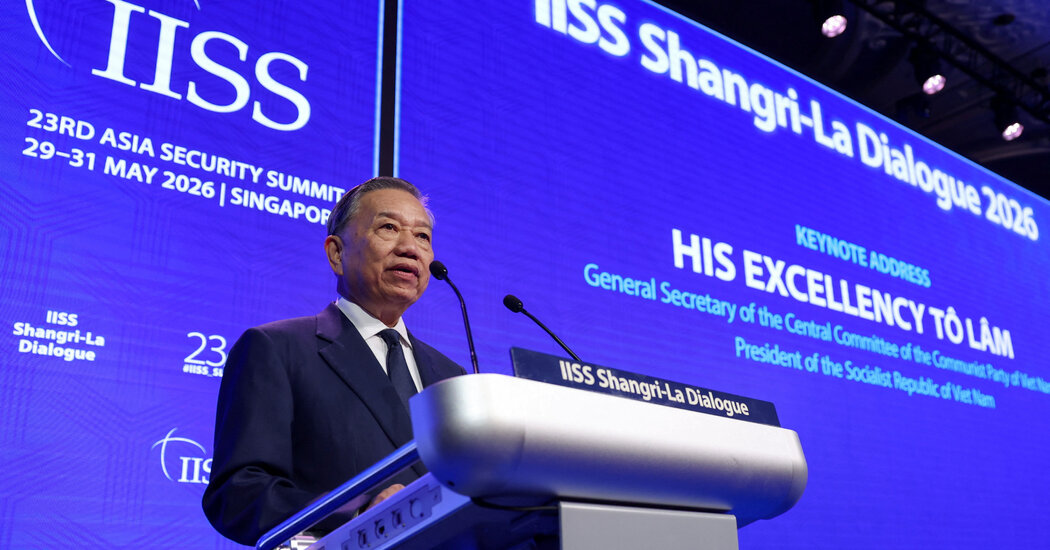
A Vision Beyond Bullets: To Lam’s Bold Economic Blueprint for Regional Peace at the Shangri-La Dialogue
In an era defined by sharpening geopolitical rivalries and a dangerous return to zero-sum militarism, To Lam, Vietnam’s newly minted and arguably most powerful leader in decades, chose the prominent stage of Singapore’s Shangri-La Dialogue to deliver a sobering message to Asia’s security establishment. Addressing a packed hall of defense ministers, military commanders, and global intelligence chiefs, Mr. Lam—who recently solidified his control over the domestic political apparatus by assuming the dual mantles of Chief of the Communist Party and State President—argued that the traditional pathways to national security are no longer sufficient in a highly integrated world. Rather than offering the customary diplomatic platitudes, he launched into a sophisticated critique of a global disorder increasingly dominated by unchecked competition, warning that a paradigm of “might makes right” is actively undermining international stability. The core of his thesis was both pragmatic and challenging: true, enduring peace cannot be forged through the barrel of a gun or a spiraling arms race, but must instead be built upon a foundation of shared and highly resilient economic development. By framing security through the lens of economic sustainability, Mr. Lam sought to elevate Vietnam’s international standing, presenting his nation not as a passive battleground for superpower competition, but as an active, globally minded architect of contemporary regional diplomacy that prioritizes strategic trust, inclusive trade, and the preservation of international law over raw physical coercion.
The Interconnected Imperative: How Global Disruptions Echo in Southeast Asian Waters
                        GLOBAL MARITIME COMMERCE
                                   │
            ┌──────────────────────┴──────────────────────┐
            ▼                                             ▼
   STrait of hormuz                             South China Sea
(Geopolitical Choke Point) (1/3 of Global Shipping)
│ │
▼ ▼
Disrupts Energy & Trade Threatened by Militarization
│ │
└──────────────────────┬──────────────────────┘
▼
AFFECTS VIETNAM’S ECONOMIC STABILITY
To illustrate the vulnerability of the modern international system, Mr. Lam drew a direct line between seemingly distant global conflicts and the everyday economic realities of nations in Southeast Asia. He pointed directly to the ongoing instability in the Middle East, specifically highlighting how escalating conflicts near the Strait of Hormuz have sent shockwaves across global energy markets, recalibrated international shipping routes, and inflicted significant socio-economic damage on countries thousands of miles away from the front lines. The underlying warning was clear: in an era of integrated global supply chains, no region—no matter how peaceful on the surface—is immune to the cascading failures triggered by localized military aggression. This systemic frailty is felt acutely in Hanoi’s own backyard, the South China Sea, a vital maritime corridor through which roughly one-third of all global trade flows. Without mentioning China by name, the Vietnamese leader spoke directly to the deep anxieties felt across Southeast Asia regarding Beijing’s rapid construction of militarized artificial islands just beyond Vietnam’s exclusive economic zone, a provocative expansion of power that Hanoi has countered with its own defensive outpost development. In a world where trade, finance, data, technology, and energy are increasingly weaponized as instruments of political coercion, Mr. Lam cautioned that the erosion of respect for established rules-based orders is rapidly giving rise to an anarchic theater where “the big fish swallow the small fish,” a trend that threatens to turn the engine of global economic growth into a vulnerable choke point.
Striving for Wealth by 2045: Inside Vietnam’s “Era of National Rise”
To appreciate the urgency behind Mr. Lam’s diplomatic push, one must understand the ambitious domestic timeline driving Hanoi’s statecraft, particularly what the leadership has declared as Vietnam’s “era of national rise.” Vietnam has set a high-stakes goal to transition from a middle-income manufacturing hub into a wealthy, high-income nation by the year 2045—a milestone that requires sustained, near-double-digit economic growth over the next two decades. This ambitious domestic transformation, however, is entirely contingent on maintaining a stable, predictable, and peaceful external environment that is insulated from erratic geopolitical shocks. Mr. Lam made this connection explicit during his speech, declaring that security is not merely the absence of war, but the preservation of a dynamic “development foundation with high resilience to shocks.” He asserted that when international cooperation succeeds in providing real safety, sustainable livelihoods, and tangible improvements in the living standards of ordinary citizens, nations naturally develop a mutual interest in preserving peace, thereby cultivating the deep-seated strategic trust needed to prevent armed conflict. For Vietnam, economic growth is not just a policy goal; it is the ultimate national defense strategy, an shield designed to protect sovereignty by embedding the country so deeply within the architecture of global commerce that any disruption to its stability would carry unacceptable costs for the rest of the world.
The High-Wire Balancing Act: Navigating the Giant Shadows of Washington and Beijing
At the heart of Vietnam’s foreign policy challenges lies an incredibly complex balancing act between two rival superpowers, China and the United States, a dynamic that Mr. Lam must navigate with absolute precision to safeguard his nation’s rapid development. On one side of this geopolitical equation sits China, Vietnam’s immediate neighbor to the north, its largest trading partner, and an indispensable source of raw materials, machinery, and increasingly, high-tech foreign direct investment. On the other side is the United States, the primary consumer market for the high-value exports—ranging from smartphones to semiconductors—that have fueled Vietnam’s rise as an alternative global manufacturing powerhouse. While Vietnam has capitalized handsomely on the ongoing “China plus one” strategy as multi-national corporations relocate manufacturing facilities to shelter their exports from punitive American tariffs, this newfound prominence brings immense strategic risk. Hanoi’s position remains deeply precarious; any sudden escalation in the trade war, or any direct military miscalculation in the South China Sea, could easily derail Vietnam’s export-driven economy. While To Lam has worked diligently to maintain balanced relations—culminating in highly publicized agreements signed with Chinese President Xi Jinping in Beijing—maintaining equilibrium with Washington has proven highly complex, particularly given the shifting political tides in the United States and Vietnam’s ongoing, unmet requests for direct high-level engagements with leadership.
                ┌─────────────────────────┐
                │  VIETNAM'S BALANCING ACT │
                └────────────┬────────────┘
     ┌───────────────────────┴───────────────────────┐
     ▼                                               ▼
┌─────────────────┐ ┌─────────────────┐
│ CHINA │ │ UNITED STATES │
├─────────────────┤ ├─────────────────┤
│ • Northern Neighbor │ • Primary Export│
│ • Largest Trade Partner │ Market │
│ • Key Industrial Input │ • Essential for │
│ Source & Investor │ GDP Growth │
│ • Security Challenge │ • Key Security │
│ (South China Sea) │ Partner │
└─────────────────┘ └─────────────────┘
A Diverse Coalition: Vietnam’s Pragmatic Pivot to Middle Powers and US Defense Cooperation
To mitigate the dangers of being caught in the crossfire of the Sino-American superpower rivalry, Vietnam under To Lam has actively diversified its international partnerships, building a robust network of security and economic alliances with prominent middle powers throughout the Indo-Pacific. Rather than relying on a single security umbrella, Hanoi has systematically deepened its bilateral relations with countries like Japan, South Korea, India, and Australia—nations that share Vietnam’s deep-seated interest in preserving a multi-polar, rules-based maritime order and preventing any single hegemon from dominating the region. Simultaneously, Vietnam is carefully expanding its defense cooperation with the West, a shift illustrated by its quiet procurement of advanced American military hardware, including C-130 transport aircraft, to bolster its search-and-rescue and maritime surveillance capabilities. This measured security relationship remains under close observation in Washington, where visiting delegations, such as the one led by Representative Gregory Meeks of New York, continue to evaluate the potential for further military sales to Hanoi. This multi-layered diplomatic strategy demonstrates that Vietnam’s “bamboo diplomacy”—characterized by flexibility, resilience, and a lack of formal military alliances—is not a policy of passive isolationism, but a highly proactive, modern doctrine of defensive consolidation designed to build asymmetrical leverage through diverse relationships.
The Emergent Power: Vietnam as a Proactive Architect of the Future Asian Order
Ultimately, To Lam’s high-profile appearance at the Shangri-La Dialogue signals a fundamental evolution in how Vietnam views its role on the global stage, transitioning from a reactive post-war nation playing catch-up to a self-assured, pragmatic middle power determined to help shape the rules of the international system. As analysts like Huong Le Thu of the International Crisis Group have noted, Vietnam has earned its place in a “league” of increasingly assertive regional nations that refuse to sit on the sidelines while Washington and Beijing carve the world into exclusive spheres of influence. By stepping into the spotlight at Asia’s premier security summit, Mr. Lam sent a definitive signal that Vietnam intends to play an active, leading role in defining the terms of regional security, demonstrating that the preservation of sovereignty in the twenty-first century requires active diplomacy, economic resilience, and a commitment to international law. As the country moves boldly toward its 2045 milestone, its leadership understands that true national security cannot be separated from global prosperity. By championing a vision where economic development serves as the foundation for strategic trust, Vietnam under To Lam is offering the international community a compelling, alternative path forward—one where mutual economic dependence, rather than military dominance, dictates the terms of peace in the Indo-Pacific.