

Para 1:
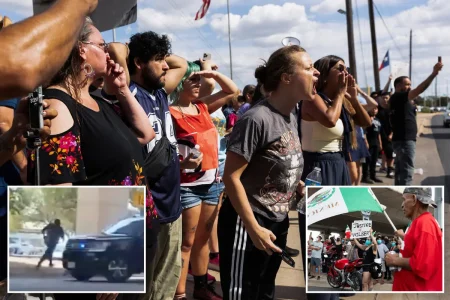
There are moments in life that split the world into before and after—sudden, violent instants that change everything for the people who survive them and for the communities that must live with the memory. The shooting of Wilber Rafael Garces Perez is one of those moments. A federal immigration officer, sworn to enforce the law, stood to the side of Garces Perez’s car. In that position, according to a video analysis, the officer apparently fired through the rear passenger window. The words are clinical, forensic, precise—”video analysis,” “apparently fired,” “rear passenger window”—but they describe an event that was anything but tidy. They describe the final seconds of a human life, a life that was carrying groceries, perhaps, or driving home from a long shift, or simply traveling through a place where he might have expected a minor traffic stop, not a bullet. The video evidence does not show everything. It cannot show the fear in the car, the confusion, the split-second decisions, or the panic that may have led to a tragic misunderstanding. It cannot show what was in the officer’s mind, or what words were exchanged, if any. What it can show is the geometry of violence: where the officer stood, where the Shot allegedly came from, and where the bullet found its way through glass and into a body. And yet, despite this cold geometry, the events surrounding the shooting remain murky, tangled in contradictions and unanswered questions. The video gives us a partial picture, not the whole story-studded with blanks that only an impartial investigation can fill stolen, and every blank is a wound for the family left behind.
Para 2:
The video analysis itself is a careful study of space and motion, a kind of forensic choreography that tries to reconstruct what happened from the mute clues left behind. It places the federal immigration officer not directly in front of the vehicle, not behind it, but standing to the side—off the car’s centerline, near the rear passenger area. From that angle, the path of the bullet seems to line up with the rear window, passing through glass that would have shattered into a spiderweb of cracks at the moment of discharge. Ballistics and sight lines suggest that the officer fired at a particular moment, in a particular direction, but the analysis cannot say why. It cannot say whether the car was moving backward or forward, whether the officer believed he was in danger, whether he felt the driver was attempting to flee, whether he saw a weapon or a movement that his own body interpreted as a threat. The video is a collection of frames, not a mind reader. It can show that the officer was standing aside, with a clear line of fire through the passenger window, but it cannot reveal the context that made that shot seem necessary—or, depending on one’s perspective, inexcusable. The murkiness is not just a legal problem; it is a human one. Every unanswered question becomes fertile ground for fear and anger. For the officer’s defenders, the video might suggest that he was trying to avoid the car’s path trick or any collision, that he placed himself in a more dangerous spot to take a defensive angle that turned lethal. For critics, the video suggests something far more unsettling: a federal agent who had time to move to the side, to position himself, and then fired into a car with someone inside, perhaps without warning, perhaps without cause. Both interpretations are possible. Neither is proven. The video frames quietly hold their secrets, and the truth waits for investigators to assemble a fuller mosaic of evidence, witness testimony, forensic reports, and maybe body camera footage.
Para 3:
This incident sits at the intersection of immigration enforcement and the use of deadly force, two areas that carry enormous weight and generate enormous controversy. Federal immigration officers are not local police, but they carry guns and badges, and they have the authority to make arrests and, under certain circumstances, to use lethal force. Their primary mission is to enforce immigration law, to identify and remove people who are in the country without authorization所需要的. But in the field, the line between administrative enforcement and criminal justice can blur. A routine encounter can escalate in seconds, especially when fear is high on both sides. Immigrants, many of whom live in the shadows, may panic when confronted by an officer, not because they are dangerous, but because they are terrified of being separated from their families, deported, or placed in a system they do not understand. That terror is a real presence in any interaction. The officer, meanwhile, is trained to assess threats quickly, and the car itself—a heavy machine that can move, accelerate, and crush—can be perceived as a lethal weapon. When a car is involved, the use of deadly force becomes a life-or-death calculus. The officer on that day, according to the video, did not stand in front of the car, where he would have been vulnerable to being run over. He stood to the side, where he was safer from the vehicle but where his line of fire crossed through the passenger compartment. That choice is telling. It suggests that someone was thinking about safety—perhaps his own, perhaps others. But it also produced a dead man. The protocols for deadly force in federal immigration enforcement are supposed to guide these decisions, but protocols are not magic spells. They cannot erase fear, confusion, or adrenaline. They cannot bring back a life.
Para 4:
Behind the forensic language, behind the video analysis and the legal arguments, is a human being—Wilber Rafael Garces Perez. He was not just a name in a news article or a number in a case file. He was somebody’s child, somebody’s partner, somebody’s beloved friend. He probably had dreams that had nothing to do with immigration policy: a quiet retirement, a better job, a child’s graduation, a family gathering with music and laughter. He may have come to this country looking for work, like millions of others, to support people he loved, to build a life that was safer and freer than the one he left behind. He was part of a community, a neighborhood, a network of people who knew him by his smile and his voicecars. And now, because of a single moment that ended in a single gunshot, all of those threads have been severed. The grief of his family is not a theoretical concept. It is the agony of waking up every morning to an empty space in the bed, to a chair at the table with no one in it, to a phone that will never ring with his voice again. It is the pain of explaining to children, if there are children, that someone they loved is not coming home. It is the slow, exhausting march through the rituals of death: the funeral preparations, the paperwork, the questions, the waiting for answers that may never come. And for the immigrant community, his death is a symbol of their own vulnerability. It is a reminder that the law, which is meant to protect, can also take away. That a routine encounter with an armed officer can end in tragedy. That even if you have done nothing wrong, even if you are just driving a car on an ordinary day, you are not safe. That fear is not just an emotion; it is a condition of life for many who live under the shadow of deportation.
Para 5:
The legal and investigative questions that swirl around this shooting are as heavy as the personal ones. Did the officer follow protocol? Did he give a verbal command before firing? Was there a reasonable belief that deadly force was necessary to protect the officer or others? Was the car actually moving in a threatening way at the moment of the shot, or was it stopped, or even moving away? The video analysis can narrow the orbit of possibilities, but it cannot answer the central question. Witnesses may contradict each other. Physical evidence can be ambiguous. The officer’s own account will matter greatly, but his memory, like all human memories, may be distorted by the stress of the event. There is also the question of accountability. When a federal officer uses deadly force, what agency investigates? What standards apply? Will the officer face an administrative review, a criminal investigation, or neither? And what happens to Garces Perez’s family? They may seek answers through tort claims or civil lawsuits, but the legal system is slow and unforgiving, and no amount of money can undo what happened. The murkiness of the events is not just a failure of observation; it is a failure of the system to provide transparency. In a democracy, the state’s power to kill must be scrutinized with care, especially when the dead person is an immigrant, whose voice is often marginalized and whose loved ones may be reluctant to speak with authorities because of immigration status. Transparency is not a luxury; it is a necessary condition for justice. Without it, the rumble of rumors replaces the clarity of truth, and the public cannot know whether this shooting was a lawful act of self-defense or a tragic, avoidable error.
Para 6:
In the end, the story of Wilber Rafael Garces Perez is not just about a video, a bullet, or a window. It is about the broader human cost of an immigration system that criminalizes people who are often simply trying to live. It is about the fear that saturates daily life for undocumented immigrants and their families—a fear that is now underlined with blood. It is about the burden carried by law enforcement officers who are asked to enforce complicated, ever-changing policies in communities where they are seen as hostile intruders. The shooting leaves no winners. The officer who fired the shot will carry the weight of that moment forever; no justification, no legal clearance, can remove the memory of taking a life. The agency will face questions about training, tactics, and the wisdom of sending armed federal officers to conduct immigration enforcement in public spaces. And the community, already traumatized, will have to find a way to grieve and to demand answers without losing hope. The video analysis gives us a glimpse, but not the whole story. That story deserves to be told—with care, with honesty, with humility, and with an unwavering commitment to the truth. The murky events may eventually become clear through rigorous investigation, or they may remain forever clouded in doubt. Whatever the outcome, one thing is certain: Wilber Rafael Garces Perez deserved to live. He deserved to go home that daychers. He deserved a life that was not ended by a bullet through a rear passenger window. The rest—the analysis, the explanations, the justifications—can never change that simple fact. We owe it to him, and to all the families who have lost loved ones in similar circumstances, to seek the truth and to build a reality where such tragedies become increasingly rare. That is the only memorial that matters.