





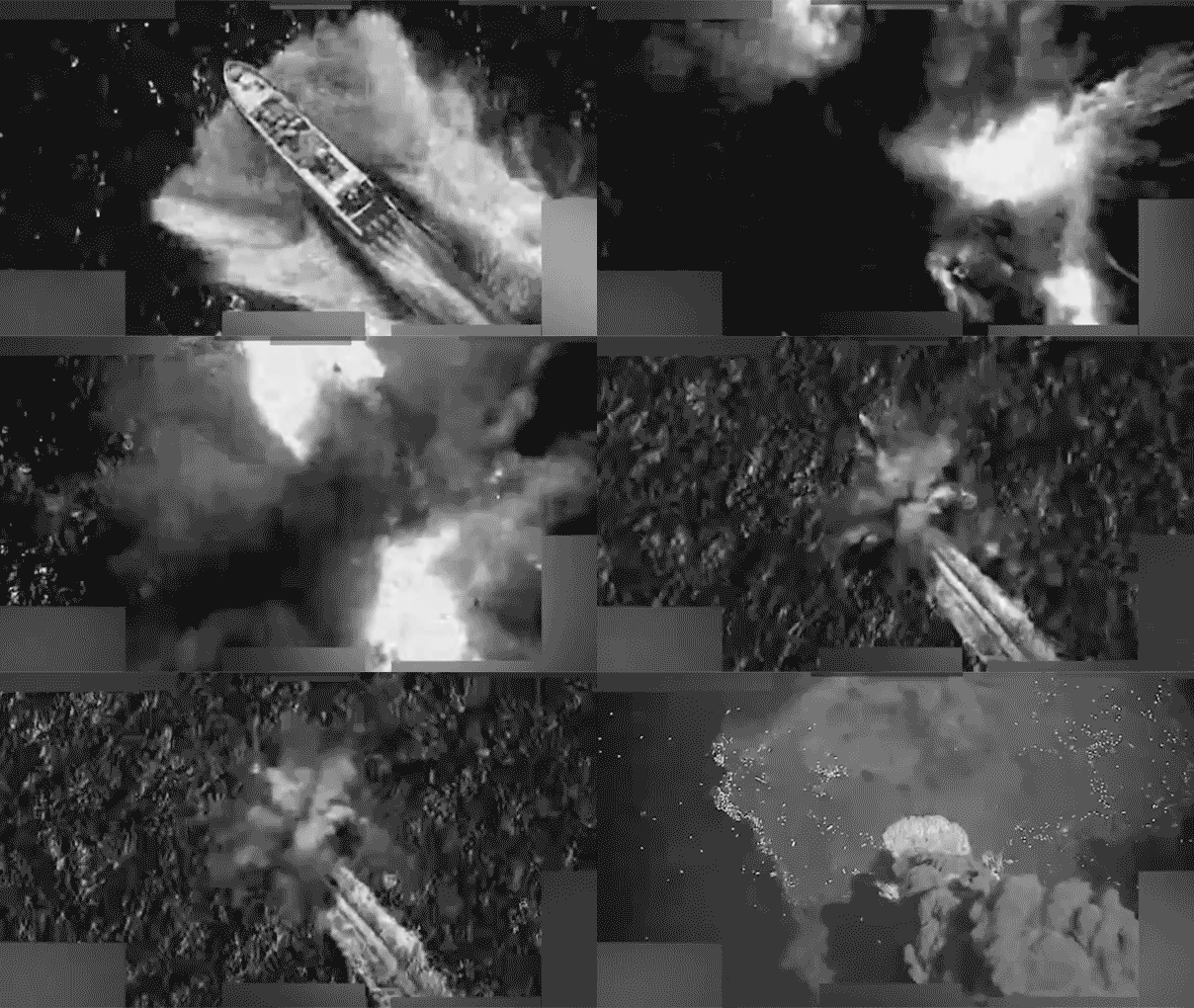
Under the vast, indifferent canopy of the Eastern Pacific sky, where the ocean stretches into a seamless horizon of deep, rolling blue, a sudden and violent flash of fire recently shattered the silence of the open sea. It was here that a United States military operation, orchestrated under the direct command of General Francis L. Donovan of the U.S. Southern Command (SOUTHCOM), conducted a deadly kinetic strike on a small vessel navigating known drug-trafficking corridors. Operating under the banner of Joint Task Force Southern Spear, high-tech military assets targeted the boat, which intelligence officials asserted was operated by Designated Terrorist Organizations. In a matter of moments, the high-speed pursuit ended in a catastrophic explosion, reducing the craft to a plume of smoke and a scattering of charred debris on the water’s surface. According to military reports, three individuals—whom the command swiftly classified as “narco-terrorists”—were killed in the strike, their lives extinguished in an instant of overwhelming military force, while no American personnel suffered any harm. The brief video footage subsequently released by SOUTHCOM captured this terrifying sequence of events: a small boat cutting desperately through the waves, a sudden, blinding eruption of flames, and then nothing but quiet, smoking wreckage floating on the swelling tide, leaving behind a haunting silence and no mention of any survivors.
To the military strategists monitoring screens in air-conditioned command centers thousands of miles away, these three men were categorized merely as hostile targets, cogs in a massive, illicit global enterprise that fuels addiction and violence across the Western Hemisphere. Yet, beneath the sterile and clinical language of “kinetic strikes” and “narco-terrorism,” there lies a raw, deeply human tragedy that is too often obscured by the smoke of battle. These three unnamed men, whose scorched remains were left to the depths of the Pacific Ocean, were human beings with families, histories, and personal motivations that will now never be understood or recorded. The labeling of suspects as “narco-terrorists” serves a dual purpose: it legitimizes the use of maximum, military-grade violence on the high seas, but it also strips these individuals of their humanity and their right to due process long before they ever reach a courtroom. By transforming a law enforcement challenge into an active military theater, the distinction between a criminal suspect and an enemy combatant becomes dangerously blurred, leaving families in remote coastal villages to wonder why their sons, fathers, or brothers vanished into the ocean, their fates sealed by an unseen strike from above without a trial, an arrest, or even a public confirmation of their identities.
This lethal engagement is far from an isolated incident; rather, it represents the continuation of a relentless and highly aggressive maritime campaign launched during the Trump administration designed to dismantle transnational cartels through sheer, overwhelming force. According to compiled reports, the death toll from these unilateral U.S. military strikes in the Eastern Pacific has climbed to at least 211 individuals since September, highlighting a dramatic and controversial shift in how the drug war is being prosecuted. Just days prior to this strike, SOUTHCOM carried out another operation in the same region that resulted in the death of one suspected trafficker, though two others managed to survive the harrowing ordeal. Furthermore, the administration recently celebrated a high-profile success when a swift and lethal kinetic strike neutralized Héctor Rusthenford Guerrero Flores, widely known as “Niño Guerrero,” the notorious leader of the violent Venezuelan gang Tren de Aragua, for whose capture the U.S. Department of State had previously offered a $5 million reward. This escalating rate of lethal engagements highlights a strategy that increasingly favors total elimination over apprehension, raising the stakes of maritime interdiction to a level of absolute, life-or-death finality for anyone caught navigating these contested tropical waters.
This uncompromising strategy has, however, ignited a fierce and necessary debate among legal scholars, human rights advocates, and concerned lawmakers, who argue that the campaign may be overstepping the boundaries of international law and traditional military authorization. While the White House and the Department of Defense assert they possess an “iron-clad” legal case to strike designated narco-terrorist groups, critics point out a troubling lack of public evidence and judicial oversight. The military routinely releases dramatic, low-resolution thermal videos of exploding boats to the public, yet they rarely provide proof of the actual contraband carried on board, nor do they release the identities of those killed to prove they were indeed high-level terrorists rather than coerced, low-level smugglers. Human rights organizations are deeply concerned that using lethal military force against civilian vessels in international waters—outside of a declared warzone and without the imminent threat of armed violence against U.S. forces—violates fundamental principles of human rights, sovereignty, and maritime law. They warn that bypassing the judicial system to execute suspects on the open ocean sets a perilous global precedent, eroding the foundational belief that even those accused of the most serious crimes are entitled to a fair trial rather than instant execution by remote control.
To truly humanize this complex crisis, one must also look at the desperate socio-economic realities of the Eastern Pacific corridor, where poverty and systemic neglect drive desperate individuals into the arms of ruthless cartel networks. Many of the low-level couriers who pilot these fragile pangas, semi-submersibles, and speedboats through treacherous waters are impoverished fishermen from coastal communities in Central and South America, where legitimate economic opportunities are virtually nonexistent. For these men, the promise of a payout from a drug syndicate represents a rare, albeit highly dangerous, chance to feed their families, pay off medical debts, or escape crushing local poverty. The cartels ruthlessly exploit this desperation, employing coercive tactics and threat of violence to force vulnerable locals into becoming the disposable front-line infantry of the drug trade. When the U.S. military unleashes high-explosive ordnance on these small transport vessels, it is often these impoverished, easily replaceable couriers who pay the ultimate price, while the wealthy, powerful cartel bosses who orchestrate the shipments remain safely insulated in their fortified mansions inland, completely untouched by the fire and steel of maritime strikes.
Ultimately, the black smoke rising from the burning wreckage in the Eastern Pacific serves as a sobering reminder of the compounding human cost of an endless, militarized war on drugs. As long as the insatiable demand for illicit narcotics persists in North America and Western Europe, cartels will continue to find a steady supply of desperate, vulnerable people willing to risk their lives on the high seas, regardless of the lethal risks involved. The use of high-tech military assets to incinerate small boats may yield striking videos for press releases and short-term tactical successes, but it does little to address the root causes of addiction, systemic poverty, and transnational crime that drive this tragic cycle. If the ultimate goal of international policy is to foster long-term stability and protect human life, society must look beyond the sterile detachment of military terminology and thermal imaging. Only by examining the profound human tragedies unfolding on these blue highways—and by recognizing the deep-seated economic and social factors that compel men to step aboard these doomed vessels—can we hope to find a path toward a more just, humane, and enduring resolution to the crisis on the high seas.