



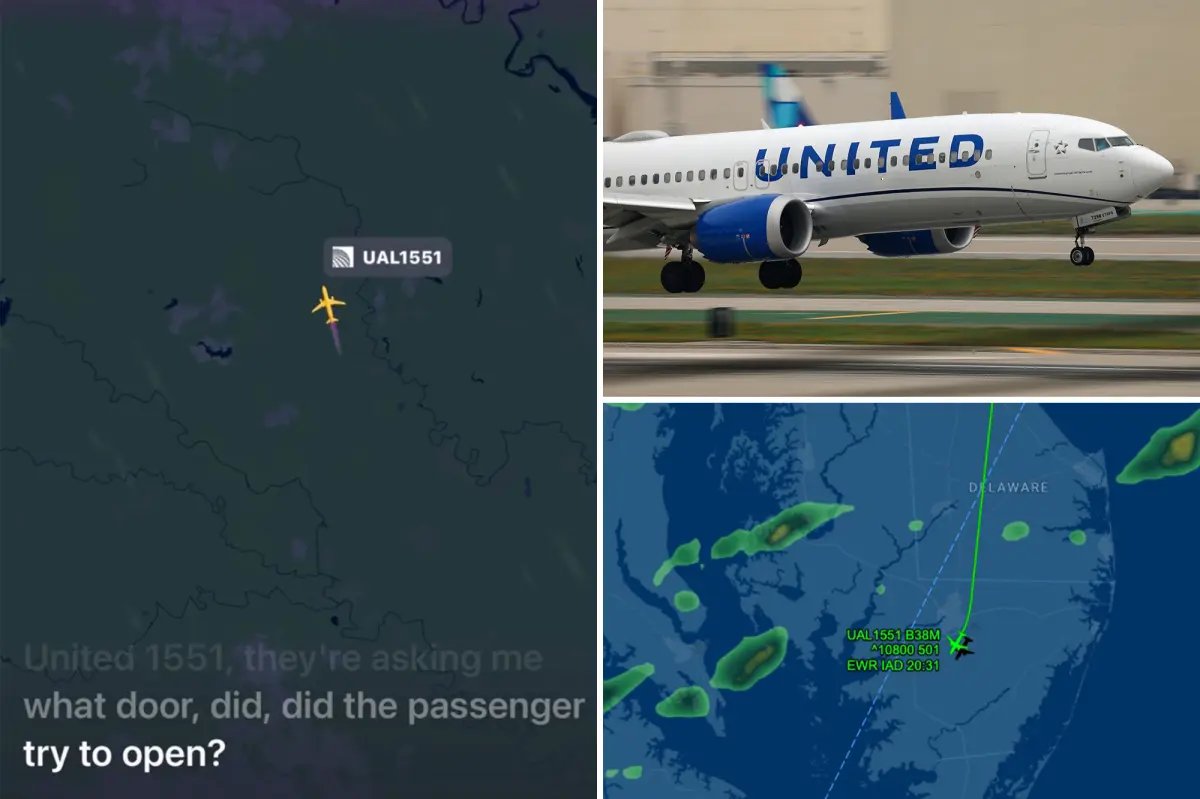
The journey began as so many do, within the brightly lit, humid terminals of Newark Liberty International Airport on a standard Thursday evening. Among the crowds of eager travelers, families heading home, and business professionals, there was a shared anticipation of the journey ahead. For the one hundred and forty-five passengers boarding United Airlines Flight 1551, their destination was Guatemala City—a five-hour flight southward over the eastern seaboard and the Caribbean. The aircraft, a modern Boeing 737 Max 8 operated by a highly trained crew of six, pushed back from the gate and climbed into the night sky, lifting off at exactly 6:46 p.m. As the plane reached its cruising altitude of thirty-six thousand feet, the initial energy of boarding transformed into the familiar, hypnotic rhythm of long-haul travel. The low, white-noise hum of the jet engines filled the cabin while passengers settled into their confined personal spaces, adjusting neck pillows, opening novels, selecting movies from their seatback screens, or closing their eyes in hopes of getting some sleep. It is in these moments, suspended high above the clouds, that an aircraft becomes its own self-contained world, completely isolated from the earth below. This entire environment relies heavily on a tacit social contract, an unspoken understanding among strangers to civilly share a pressurized metal cylinder traveling at hundreds of miles per hour. Yet, this delicate peace is incredibly fragile, and on this particular night, it would be shattered in the most jarring and unexpected way. Less than two hours into the journey, the routine atmosphere inside the cabin vanished, replaced by an escalating sense of dread as a single individual’s erratic and dangerous behavior stripped away the safety and comfort that every passenger had taken for granted, plunging the flight into a state of absolute emergency that would alter their travels. This sudden disruption created an atmosphere of pure, unfiltered panic, forcing everyone to confront the terrifying reality of their high-altitude isolation. Fear was completely palpable, catching in every single throat on board.
The terrifying disruption began when a passenger, experiencing an apparent psychological crisis or exhibiting extreme aggression, actively attempted to open one of the aircraft’s exits designated as Door 2L. To those standing nearby or watching in horror from their nearby seats, this action felt like an immediate threat to their lives, conjuring up nightmare scenarios of sudden cabin decompression and freezing winds. From a technical standpoint, opening a plug-type aircraft door at an altitude of thirty-six thousand feet is physically impossible due to the immense pressure differential between the highly pressurized cabin atmosphere and the thin air of the upper stratosphere; thousands of pounds of force secure the door, rendering human effort completely futile. However, the passengers on board did not have the luxury of mathematical reassurance or engineering knowledge in that panicked moment; they were trapped in a confined space watching an unpredictable individual claw at a vital escape hatch. The situation devolved further from a systemic threat to personal violence when the unruly traveler turned their attention away from the door and launched a physical assault on a fellow passenger who was simply resting in their seat. This sudden act of violence escalated the tension to a breaking point, transforming the quiet cabin of the Boeing 737 Max 8 into a scene of panic and vulnerability. Flight attendants, who are trained as first responders of the skies, were forced to immediately intervene, putting their own safety on the line to de-escalate the situation, restrain the assailant, and shield the other travelers. This harrowing physical and mental ordeal highlights the raw trauma of high-altitude emergencies, where there is simply nowhere to run, forcing ordinary people to confront the volatility of a stranger in a space with no exits. The psychological impact of being locked in a cold metal tube, miles above the ground, with an unpredictable person who has lost all self-control is a unique form of modern terror that surely lingers long after the aircraft wheels finally touch the airport runway.
While chaos unfolded in the passenger cabin, the cabin crew worked frantically to restrain the individual and communicate the danger to the flight deck, which immediately became a command center of intense focus. The pilots, flying a complex Boeing 737 Max 8 at speed, had to balance the technical management of the aircraft with the immediate security threat developing just feet behind them. Recognizing the severity of the passenger’s actions, the captain made the necessary decision to abort the flight to Guatemala City and initiate an emergency descent toward Washington Dulles International Airport in Virginia. This sudden diversion required flawless coordination with air traffic controllers, who scrambled to clear a path through some of the busiest mid-Atlantic airspace. The audio recordings of the radio transmissions between the cockpit of United 1551 and air traffic control paint a vivid picture of the professionalism displayed during the crisis: the controller’s voice cut through the static to verify the unprecedented nature of the cabin threat, asking which door the passenger had attempted to open. The pilot’s response was chillingly direct and composed—verifying that the breach was attempted at thirty-six thousand feet on Door 2L, and confirming that an assault on a fellow traveler had indeed occurred. When the controller inquired about potential injuries, the pilot calmly stated “Not to our knowledge,” reflecting the focused priority of getting the plane safely on the ground before conducting a full damage assessment. This rapid, calculated response by both the pilots and the ground controllers is what prevented a terrifying cabin crisis from descending into a full-scale aviation disaster, emphasizing the critical importance of rigorous emergency training for flight crews worldwide. As the giant passenger jet tilted its nose downward, initiating a rapid but controlled descent, the atmosphere in the cabin remained thick with tension, with passengers clutching their armrests and whispering quiet prayers as they watched the flight path track towards an unexpected landing spot on their individual television screens, desperate for the safety and sanity of the earth.
The Boeing 737 Max 8 touched down safely at Washington Dulles International Airport less than two hours after its initial departure, bringing a temporary end to a harrowing experience. As the plane taxied off the runway, it was met on the tarmac by an array of flashing emergency lights from law enforcement and airport authority vehicles, highlighting the gravity of the crime committed in the sky. Officers boarded the aircraft immediately, physically removing and arresting the disruptive passenger, a sight that finally allowed the remaining one hundred and forty-four passengers and six crew members to exhale in relief. However, the emotional and logistical aftermath of the incident was just beginning. Because of the investigation and the immense strain on the crew, United Airlines had to cancel the flight, which created a host of new challenges for travelers whose travel plans, business meetings, and family reunions were suddenly derailed. The airline was tasked with managing the complex logistics of housing, feeding, and rebooking nearly a hundred and fifty people on short notice. Stranded passengers were provided with overnight hotel accommodations in the Washington metropolitan area and scheduled for a replacement flight the following Friday morning. For these travelers, the night was spent in unfamiliar hotel rooms, processing the stress of a near-disaster and contemplating the fragile certainty of modern travel, where a single person’s erratic actions can cause a massive logistical chain reaction that disrupts lives, costs thousands of dollars, and leaves lasting psychological scars. Many of the passengers, still visibly shaken, huddled in the airport terminal, calling their loved ones to assure them they were safe, while others tried to make sense of the sudden detour that had transformed their evening from a straightforward commute into a stressful ordeal. The physical security of being back on the ground was offset by the lingering anxiety of the event, reminding everyone how easily the comforts of modern travel can be stripped away, leaving passengers to navigate the cold bureaucratic realities of airline hotel vouchers.
This shocking event is unfortunately not an isolated incident, but rather part of a larger, systemic struggle with unruly behavior in modern commercial aviation. Just weeks prior, another dramatic encounter unfolded on a United Airlines flight arriving from the Dominican Republic to Newark, where an individual assaulted a flight attendant and made a desperate attempt to break into the cockpit as the plane was landing. These frequent headlines have forced the Federal Aviation Administration (FAA) to adopt a strict, zero-tolerance policy in an effort to protect passengers and flight crews from physical harm. Disruptive passengers now face severe civil penalties, with fines that can reach up to forty-three thousand, six hundred and fifty-eight dollars per violation, alongside potential bans from airlines and federal criminal prosecutions. To understand the scale of this issue, one must look at the data collected by the FAA over the last several years. The agency recorded a massive surge in unruly passenger reports in 2021, when a record-breaking five thousand, nine hundred and seventy-three incidents were logged as air travel resumed in the wake of the pandemic, marked by intense mask debates and heightened societal tension. While that number has fortunately declined in the years since—dropping to over two thousand reports in 2022, down to one thousand, six hundred and twenty-one last year, and sitting at six hundred and eight reports so far this year—the persistence of these violent outbursts proves that flying remains a highly stressful experience capable of pushing vulnerable individuals over the edge. Industry experts point to a variety of contributing factors, including the anxiety of modern travel, cramped cabin spaces, and a broader societal decline in public decorum. While the steady decrease in reports since the peak of the pandemic offers hope that the crisis in our skies is slowly abating, the sheer severity of this latest incident on Flight 1551 shows that there is still a long way to go in ensuring that flight crews are always kept safe while performing their vital work.
Ultimately, the crisis aboard United Flight 1551 serves as a stark reminder of the fragile social contracts that hold our complex, modern society together. Every time we step inside an airplane, we enter into a state of radical trust, placing our physical safety into the hands of the pilots who fly the aircraft, the mechanics who maintain it, and the absolute strangers who sit in the seats beside us. When an individual violates this trust, they disrupt more than just a flight schedule; they shake our fundamental sense of security in the sky. The bravery of the flight crew and the passengers who assisted during this emergency underscores the resilience of ordinary people when faced with unexpected danger. Their quick thinking and professional execution prevented a volatile situation from escalating into a historic tragedy. As the aviation industry continues to analyze these events, looking for ways to better screen passengers, train crew members, and apply legal punishments, the core challenge remains a cultural one: restoring a sense of mutual respect and patience to the shared experience of travel. In an era where the world is more connected than ever before, the skies must remain a sanctuary of progress and safety, where the remarkable miracle of flight is protected from the chaotic impulses of the ground, and where every traveler can feel secure in the knowledge that they are protected by both technology and the shared humanity of those around them. For the passengers of Flight 1551, their journey to Guatemala was eventually completed, but the memories of that night will undoubtedly remain with them for many years to come. Their story serves as an active testament to the courage of crew members who face these unpredictable challenges head-on, ensuring that safety remains the ultimate industry goal. We must always strive to foster an environment where empathy, kindness, and patience can thrive inside the cabins, allowing us to fly together, and ensuring we treat one another with basic human dignity during every flight.