





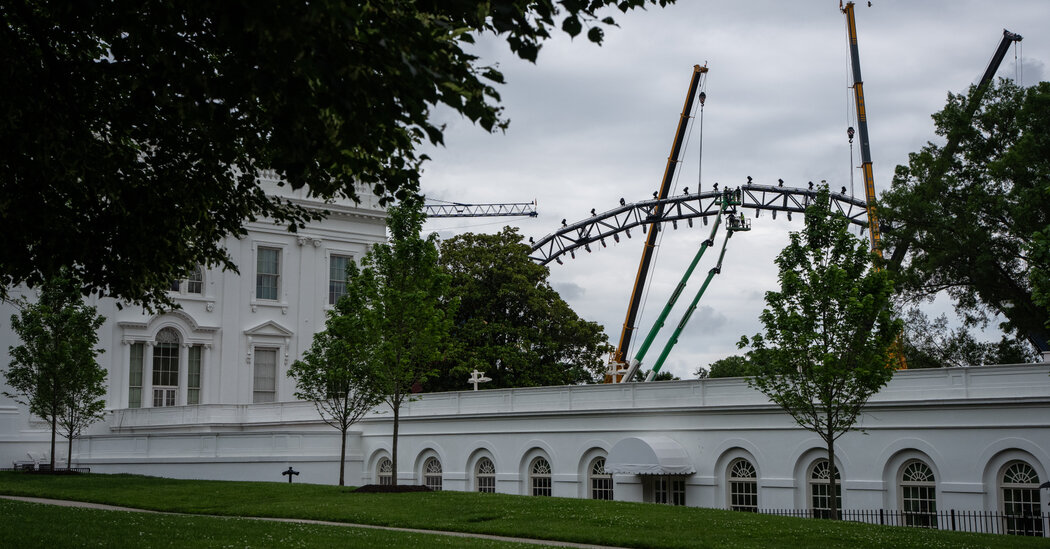
The South Lawn of the White House, typically revered as a manicured, tranquil sanctuary of quiet diplomacy, solemn state visits, and historic walks, is currently echoing with the raw, metallic clamor of heavy industrial construction as crews work around the clock to build a world-first: a fully functional, octagonal mixed martial arts cage erected right on the historic residential grass. This astonishing, almost surreal transformation is captured vividly in the Ultimate Fighting Championship’s newly released architectural renderings, which showcase an imposing, majestic star-spangled arch looming triumphantly over the black canvas cage, flanked by towering temporary grandstands carefully engineered to seat thousands of spectators in the shadow of the executive mansion. Scheduled to take place on June 14—a day that serves the dual, deeply personal significance of being both Flag Day and President Donald J. Trump’s landmark 80th birthday—this high-octane, barrier-breaking sporting spectacle is positioned as a crown jewel in a larger, incredibly ambitious year-long series of national celebrations marking the historic 250th anniversary of the founding of the United States. Far from an isolated promotional stunt, this unprecedented political-athletic cross-pollination represents a broader, highly calculated effort by the administration to completely redefine how America celebrates its historic milestones, consciously blending traditional patriotism with modern, high-intensity pop culture that captivates working-class citizens who feel alienated by traditional high-society galas. Just weeks after the final bell rings and the last punch is thrown on the South Lawn, the administration plans to partition the heart of the nation’s capital once again, constructing a temporary, high-speed IndyCar street circuit designed to send high-powered race cars screaming past the solemn stone monuments in August, further cementing this era as one of magnificent spectacle. This unprecedented synthesis of raw, physical theater and historic presidential grandeur signals a dramatic, permanent departure from the quiet, highly sanitized commemorations of America’s past, transforming the federal city into a living, breathing arena where high-stakes human performance is juxtaposed directly against the background of global democratic authority.
As the physical steel infrastructure begins to rise in the shadow of the executive mansion, the sheer human desperation to secure a seat within this historic pop-up colosseum has reached a fever pitch, creating a ticket frenzy unlike anything modern Washington has ever witnessed. President Trump himself recently marveled at this overwhelming cultural obsession, remarking during a formal address that he has never in his long career in real estate development, television entertainment, or national politics seen people clamor quite so intensely for an invitation, characterizing the upcoming fight night as a uniquely exclusive, historically significant moment. While the temporary outdoor stadium built directly on the White House grounds is carefully engineered to accommodate just over 4,000 highly privileged guests, the planners have made a conscious, deeply populist effort to ensure that the broader public is not shut out from this historic milestone. Just across the street, the sprawling, grassy expanse of the White House Ellipse is scheduled to be transformed into the massive “UFC Freedom 250 Fan Fest,” an open-admission, carnival-like celebration anticipated to draw upwards of 75,000 to 100,000 enthusiastic citizens who will be able to watch the high-stakes bouts projected live on colossal, high-definition outdoor screens completely free of charge. This deliberate bridging of elite exclusivity and mass public celebration is further mirrored in the logistical choosing of local monuments for pre-fight activities; in a striking marriage of neoclassical architecture and raw athletic theater, officials have confirmed that the official pre-fight weigh-ins, where fighters famously lock eyes in intense face-offs, will take place on the steps of the iconic Lincoln Memorial. By positioning these raw, hyper-focused displays of athletic preparation against the solemn, seated statue of Abraham Lincoln, the event’s coordinators are crafting an incredibly potent symbolic image, framing the grit, discipline, and endurance of mixed martial arts as a reflection of the enduring, battle-tested spirit of the American project itself, offering everyday citizens an unforgettable visual experience. Ultimately, this democratic approach ensures that while the elite gather on the secure lawn of the president, the heartbeat of the nation—the working-class families and young sports enthusiasts—gets to share in the monumental birthday party, creating a shared national memory that transcends traditional political boundaries and unites thousands in their love for combat sports.
The journey from a wild, offhand suggestion to a complex federal logistical mobilization is a testament to the unique, rapid-fire decision-making that defines the deep personal relationship between Donald Trump and UFC President Dana White. In a candid and revealing interview with The New Yorker, Dana White walked listeners through the exact moment this historic project was born, stripping away the political calculation to reveal a remarkably human, spontaneous exchange between two old friends enjoying a night out at a sporting event. White recalled sitting cageside with the President when Trump, suddenly captivated by the atmosphere and the approaching milestone of the nation’s Semiquincentennial, leaned over amid the roaring crowd and casually suggested that they should bring the raw energy of an octagonal fight straight to the South Lawn of the White House as a tribute to America’s 250th anniversary. What might have been dismissed as standard, late-night bravado by any other politician was treated by Trump’s staff as an immediate, non-negotiable directive; by the very next Monday morning, White House logistical coordinators were already burning up Dana White’s phone lines, demanding blueprints, technical specifications, and security protocols to turn the President’s casual dream into a concrete reality. This rapid acceleration of government machinery highlights a fascinating operational style, but the human element of this event is perhaps best illustrated by how the highly coveted 4,000 tickets are being distributed among those who helped build the sport and those who serve the nation. Dana White explained that he received a personal allocation of 200 tickets to hand out to close associates, while Ari Emanuel, the high-powered chief executive of TKO Group Holdings, was granted an equal share of 200, but the vast majority of the seats are being held for those who represent the backbone of the country. Trump has reserved 1,000 tickets for his own personal distribution, while the entire remaining bulk of the stadium’s seating capacity is being systematically awarded to active-duty and veteran members of the United States military, transforming what could have been a purely corporate or political elite gathering into a deeply emotional, flag-waving tribute to America’s armed service members who have sacrificed so much for the nation’s freedom. This elegant distribution of tickets perfectly balances the demands of high-powered corporate stakeholders with a deep respect for the military, ensuring that the crowd sitting in the shadow of the Oval Office represents a cross-section of American strength, valor, and loyalty, rather than just the wealthy elite who typically dominate high-profile sporting events in capital cities.
To truly understand the profound human significance of this upcoming South Lawn event, one must look back nearly a quarter of a century to an era when mixed martial arts was a despised, outlawed sport struggling for survival, and trace the deep-seated loyalty that was forged in those dark times between Donald Trump and the UFC leadership. Long before he ever harbored serious ambitions for the presidency, Trump was a polarizing but undeniably shrewd real estate mogul who bucked mainstream trends, recognizing the raw, untapped potential of a discipline that prominent political figures of the era, most notably the late Senator John McCain, had bitterly condemned as little more than barbaric “human cockfighting.” When state athletic commissions across the United States systematically banned the sport, and prestigious arenas refused to host UFC events out of fear of public backlash and moral outrage, it was Donald Trump who stepped forward, opening the doors of his lavish Trump Taj Mahal in Atlantic City and providing a legitimate, high-profile sanctuary for the struggling athletic league to find its footing, rebuild its reputation, and cultivate a passionate fanbase. This crucial lifeline created an unbreakable bond of mutual gratitude; Dana White has never forgotten the man who stood by him when the rest of polite society turned away, translating that enduring loyalty into highly visible political support, including delivering passionate, primetime speeches at successive Republican National Conventions. Furthermore, White’s influential standing within the hyper-masculine, independent media sphere was reportedly a critical factor in facilitating Trump’s high-profile appearances on massive youth-skewing media platforms, most notably convincing the wildly popular podcaster and UFC color commentator Joe Rogan to officially endorse Trump’s presidential bid. The upcoming event at the White House is, in many ways, the ultimate, full-circle culmination of this deeply personal, multi-decade journey, transforming a sport that was once banished to the regulatory and cultural shadows into the literal center of gravity at the nation’s executive residence, where a roaring crowd of thousands will welcome the President not just as a head of state, but as a legendary, founding patron of their beloved sport who believed in their humanity when no one else did. This loyalty has forged a unique cultural alliance between the conservative political movement and the combat sports community, redefining the modern cultural landscape and showing how personal relationships formed in regulatory adversity can eventually reshape the symbolic rituals of the presidency itself on a global scale. For the fighters who once slept on gym floors and fought for raw survival in front of a few hundred people, seeing their sport elevated to the South Lawn of the White House is a moment of profound personal validation, vindicating their years of sacrifice under the grandest spotlight imaginable.
This historic collision of physical combat and the presidency represents a profound, fascinating evolution in the cultural landscape of the United States, illustrating a broader societal shift where the traditional, rigid boundaries dividing political authority, athletic entertainment, and populist spectacle have completely dissolved. For generations, the White House has hosted highly sanitized athletic celebrations, typically consisting of brief, formal photo opportunities on the lawn where championship-winning teams stood politely in suits to receive a commemorative jersey and a handshake from the Commander-in-Chief. By replacing these brief, scripted ceremonies with a live, high-adrenaline, blood-and-sweat combat sports card, the administration is making a definitive statement about the nature of modern leadership and the cultural identity of contemporary America, championing a raw, unapologetic, and highly physical ethos that resonates deeply with a public increasingly weary of polished, focus-grouped political theater. This cultural transformation is not without its critics, who argue that staging a cage fight on the historic, blood-soaked history of the South Lawn compromises the solemnity and dignity traditionally associated with the Executive Mansion, converting a global symbol of democratic stability into a commercialized sporting arena. Yet, for the millions of combat sports enthusiasts and supporters of the president, the event represents an incredibly empowering moment of cultural validation, proving that the gritty, working-class values of resilience, raw individual competition, and physical courage are no longer relegated to the societal fringes, but are now celebrated at the highest levels of American power. This sentiment was echoed clearly by White House spokesman Davis Ingle, who emphasized that the upcoming UFC card would stand alongside the most monumental and historic events in the annals of global sports, describing the President’s decision to host the fight at his official residence as a bold, undeniable testament to a larger patriotic vision designed to honor the complex, fiercely competitive story of America’s 250-year journey with unparalleled energy and national pride, reflecting the deep fighting spirit that has continuously propelled the nation forward. By reframing raw athletic struggle as a core patriotic value, the administration is tapping into a visceral source of national identity, celebrating the idea that America’s success has always been driven by the courage of individuals who are willing to enter the arena, face adversity head-on, and fight for victory, regardless of the challenges they encounter along the way. This shifts the perception of the presidency from an elite, remote office of bureaucratic administration to a dynamic, populist leadership style that actively aligns itself with the passions, pastimes, and everyday pleasures of the American working class, forever blurring the line between classical governance and modern mass media entertainment.
As the summer sun of June 14 draws closer, the logistical ballet required to pull off such an unprecedented event becomes a staggering human achievement in its own right, requiring delicate coordination between Secret Service agents, structural engineers, and sports television production crews to ensure the historic grounds are both secure and broadcast-ready. Groundkeepers who have spent decades carefully tending to the historic flora of the South Lawn must work hand-in-hand with heavy rigging crews, ensuring that the heavy steel structures of the octagon do not permanently scar the delicate landscape while simultaneously establishing a secure, high-capacity venue capable of hosting thousands of spectators under the global spotlight. This delicate dance of preservation and transformation perfectly mirrors the broader, highly ambitious spirit of America’s upcoming Semiquincentennial, reminding the world that the American story has never been static, but has always been defined by a restless, pioneering desire to push boundaries, challenge conventions, and embrace bold, larger-than-life spectacles. When the lights finally illuminate the star-spangled arch over the presidential octagon on that warm June evening, and the first bell rings out across the historic lawn, it will mark the dawn of an entirely new era in the history of the American presidency, where the raw physical courage of fighters and the enduring spirit of a nation collide in a breathtaking display of pure athletic theater. Ultimately, this unforgettable night will stand as a living testament to the powerful, enduring bond between a president and the sport he helped rescue from obscurity, carving out a legendary chapter in the national narrative that will be discussed, debated, and remembered for generations to come as a moment when the ultimate fighting cage became the ultimate stage for the American dream, beautifully demonstrating the endless capacity of the American spirit to surprise, shock, and inspire. To make this event reach its true narrative weight, we must also consider the profound human element of this historic evening: the athletes themselves, standing in the temporary locker rooms situated within the historic corridors of the White House, looking out toward the South Lawn with the realization that their physical performance will be etched forever into the literal fabric of American history. As the final preparations fall into place, the quiet anticipation of the nation’s capital builds toward a crescendo, setting the stage for an unforgettable celebration of athleticism, national pride, and the enduring bond of friendship that brought this spectacular vision to life.