




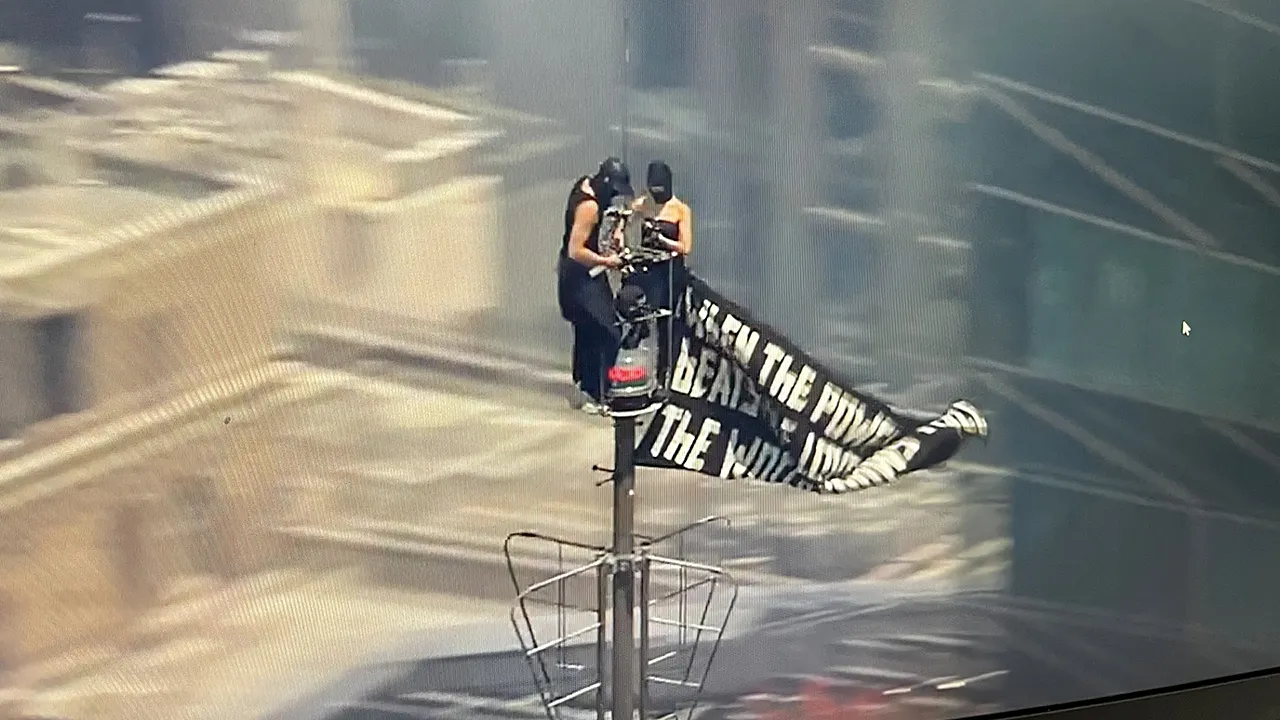
On a seemingly ordinary Wednesday afternoon, beneath the vast, ever-shifting canopy of the New York sky, the relentless, mechanical heartbeat of midtown Manhattan was suddenly and beautifully interrupted by an act of extraordinary audacity and poetic grace. For the millions of souls navigating the concrete canyons of the metropolis, the day had commenced with its typical, predictable rhythm—a chaotic symphony of honking yellow cabs, the low-frequency hum of subterranean subway trains, the sweet aroma of roasted nuts from street-corner carts, and the hurried footsteps of thousands of commuters driven by the demanding, clockwork nature of modern urban life. The Empire State Building, a historic testament to human ambition, economic power, and Art Deco architectural brilliance, stood as it always had: a stoic, silver-grey sentinel anchoring the island and reaching toward the heavens. Yet, as the afternoon progressed and the sun began its gradual, amber descent, casting long and dramatic shadows across the bustling intersections of 34th Street and Fifth Avenue, this familiar, fast-paced reality ground to an unexpected, breathtaking halt. It started with a few pointed fingers, a scattering of raised heads, and a sudden quietness that rippled through the dense crowds at the base of the tower. Slowly, the infectious gravity of curiosity took hold of the pavement; tourists, office workers, shopkeepers, and delivery drivers alike began to slow their strides, their eyes drawn away from the glowing screens of their smartphones and lifted toward the dizzying heights of the building’s upper reaches. High above the safety of the observation decks, clinging to the cold, unforgiving steel and limestone of the skyscraper’s exterior, two fragile human figures could be seen making a perilous ascent, fundamentally transforming one of the world’s most iconic landmarks into a grand, impromptu stage for a deeply philosophical and breathtakingly risky human endeavor. This was not a scene anyone had anticipated on a mid-week workday, yet it instantly captured the collective consciousness of the city that never sleeps.
Scaling the sheer, monolithic facade of a giant like the Empire State Building is a physical and psychological feat that defies the very instincts of human self-preservation, demanding a level of focus, strength, and raw courage that borders on the unfathomable. As these two individuals carefully navigated the vertical labyrinth of steel beams, rivets, and glass, they existed in a realm of terrifying isolation, suspended hundreds of feet above a hard and distant world of asphalt. Every sudden gust of wind filtering through the midtown corridors threatened to compromise their precarious grip, and every downward glance revealed the vast, miniature grid of a city that could easily swallow them whole if they made a single misstep. Yet, watching them from below, it became abundantly clear that this was not a reckless stunt born of mere thrill-seeking or a desperate bid for personal notoriety; rather, it was a deliberate, highly coordinated act of peaceful protest, a physical manifestation of a burning inner conviction that demanded a stage large enough to match its monumental scale. By placing their own bodies in such extreme jeopardy, these climbers stripped away the armor of everyday urban indifference and forced a distracted, weary public to confront the absolute fragility of human existence. The glaring contrast between the rigid, unyielding monument of industrial progress and the soft, breathing, vulnerable flesh of the climbers served as a powerful visual metaphor for the modern human condition—a reminder of how small we are in the grand architecture of our own making, and yet how incredibly far we are willing to go, and how much we are willing to risk, when driven by a message that we believe the world desperately needs to hear. They climbed without ropes or nets, relying only on their hands, feet, and an invisible, unbreakable thread of shared trust.
The true, beating heart of this dramatic climb was revealed when the two individuals, having successfully reached a stable vantage point high upon the structure, carefully unfurled a massive, hand-crafted banner that caught the high-altitude winds and draped itself against the grey facade, bearing the timeless and poignant words: “when the power of love beats the love of power, the world knows peace.” This profound sentiment, famously and historically attributed to the legendary musician and philosopher Jimi Hendrix, carries an extraordinarily heavy weight, especially when hanging above a city that has long been regarded as the global epicenter of financial, cultural, and political power. In a world currently fractured by intensifying geopolitical conflicts, deep-seated socioeconomic divides, and a relentless, often exhausting struggle for global dominance, this message acted as a gentle yet incredibly powerful counter-narrative, urging humanity to reconsider its defining values. By hanging this declaration of peace on a building that constructed its historical identity on being the tallest, the strongest, and the most dominant monument of its era, the climbers created a jarring and beautiful juxtaposition. The banner did not seek to condemn, anger, or divide the populace; instead, it offered a universal, timeless truth that transcends national borders, political affiliations, and religious differences, asking every person who looked up to reflect on the ancient, ongoing struggle between the pursuit of control and the surrender to empathy, suggesting that true strength lies not in our ability to dominate others, but in our capacity to love them. It was a call to self-reflection, unfurled at the very crossroads of the modern world, challenging the mechanics of how we define success and power in our daily lives, transforming a simple piece of fabric into a mirror for humanity’s deepest aspirations.
Down on the crowded pavement of Manhattan, the collective response to this high-altitude demonstration was one of profound humanity and shared quietude, representing a rare moment of genuine stillness in a city known for its restless energy. As the words on the banner slowly became legible to the thousands of onlookers gathering on the streets below, a palpable shift occurred in the atmosphere, transforming a chaotic collection of hurried individual strangers into a singular, deeply reflective community. People who would normally pass one another without a second glance—corporate lawyers in tailored suits, tourists from far-flung corners of the globe, street vendors, and weary commuters—found themselves standing shoulder-to-shoulder, sharing breathless whispers of concern for the climbers’ safety and speaking in hushed, contemplative tones about the meaning of the sign. In an age where public spaces are so often defined by division, digital isolation, and the rapid-fire noise of the modern media landscape, this shared event forced a momentary cease-fire in the daily grind of survival. The collective intake of breath when a climber slipped slightly, the shared sighs of relief when they regained their footing, and the quiet discussions about the state of world affairs that erupted among strangers on the corners of 34th Street highlighted a fundamental truth: that beneath our superficial differences, we are all bound by a shared vulnerability and a deep-seated, universal yearning for a more peaceful, compassionate existence. This was a rare, precious instance where the barriers of urban life dissolved, replaced by a collective empathy that rippled outward from the foot of the tower, warming the chilly autumn air with a sense of shared destiny.
The fragile beauty of this peaceful demonstration was soon met with the rapid, highly organized response of the city’s emergency services, as the New York City Police Department (NYPD) quickly descended upon the scene to manage what was undoubtedly a high-risk security and safety crisis. Sirens wailed and echoed off the glass storefronts of midtown, and within minutes, the perimeter of the Empire State Building was alive with the flashing red and blue lights of patrol cars, emergency vehicles, and utility trucks. Highly trained officers from the NYPD’s elite Emergency Service Unit (ESU)—men and women who routinely put their lives on the line in the city’s most dangerous and unpredictable situations—were tasked with the incredibly delicate and nerve-wracking mission of ascending the building’s interior to safely retrieve the climbers. This operational response introduced a tense, high-stakes dynamic to the scene, as specialized rescue teams had to carefully plan their approach, assessing structural hazards, wind velocities, and the psychological state of the individuals clinging to the open facade. The officers involved in these operations are parents, siblings, and neighbors, carrying the heavy responsibility of ensuring that a peaceful, albeit illegal, protest does not end in an unspeakable tragedy. The interaction between the first responders and the climbers, suspended high above the city, exemplified a complex human dance of duty, safety, and operational precision, highlighting the immense coordination required to keep New York safe while navigating the unpredictable expressions of human passion and belief. In the midst of the flashing lights and crowd control barriered streets, the officers moved with a quiet professionalism, dedicated to preserving human life above all else.
As the afternoon faded into the twilight hours and the climbers were eventually, safely guided back to solid ground by the patient hands of the NYPD, the banner was taken down and the immediate circus of flashing lights and news cameras began to disperse back into the bustling Manhattan night. Yet, though the physical manifestation of the protest was gone and the Empire State Building returned to its familiar illuminated silhouette against the dark sky, the profound impact of the event lingered long after the streets had cleared. This daring act of high-altitude street theater served as a vibrant reminder that even in our intensely regulated, highly commercialized urban spaces, the human spirit still possesses an irrepressible desire to speak, to connect, and to remind the world of its higher calling. The memory of that Wednesday afternoon, when two brave individuals scaled a monument of power to deliver a message of love, will remain etched in the hearts of those who witnessed it firsthand, continuing to inspire conversations in quiet coffee shops, noisy subway cars, and lonely apartment blocks across the five boroughs. In a world that so often feels overwhelmed by the heavy, dark tide of political and social division, this event proved that sometimes it takes a dramatic leap of faith, a terrifying ascent into the sky, and a simple piece of fabric to remind us all that peace is not an impossible dream, but a quiet, loving choice that we must collectively make each and every day. Ultimately, as the city lights twinkled in the darkness, the message left behind was clear: no matter how high we build our structures, we must always ensure our hearts remain grounded in the power of love.