


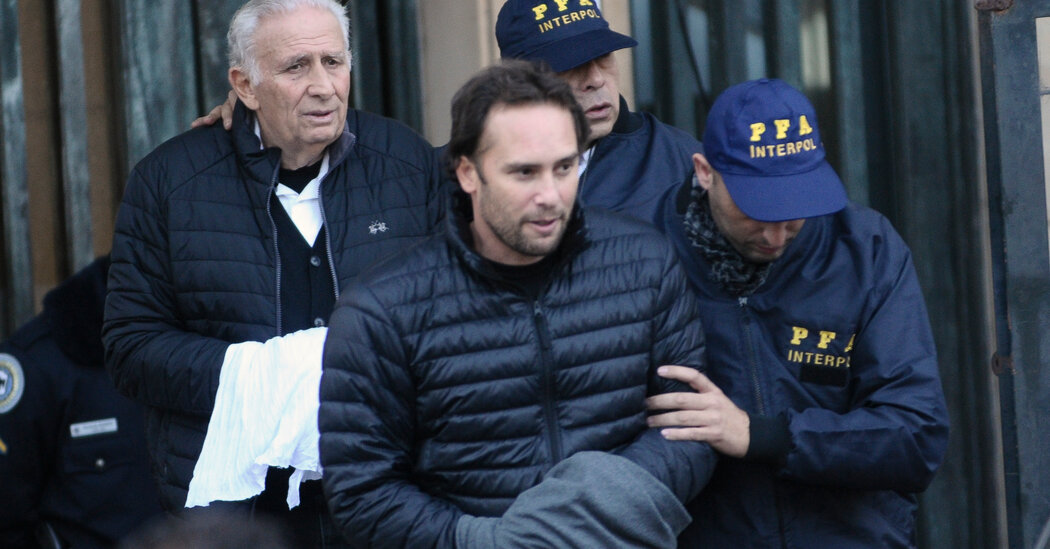
Summarize and humanize this content to 2000 words in 6 paragraphs in EnglishFor more than a decade, a sprawling crackdown on corruption in international soccer from the U.S. Justice Department has rocked the governing body of the world’s most popular sport.Federal prosecutors have won dozens of convictions and recovered millions of dollars in the long-running FIFA case. Yet two of the highest-profile targets, a father and son, Hugo Jinkis and Mariano Jinkis, evaded prosecutors. They were accused of paying bribes to Latin American soccer officials in exchange for lucrative television and marketing rights, but remained frustratingly out of reach because Argentina had blocked their extradition since 2016.It seemed unlikely they would ever appear in an American court, where, if convicted they could face a maximum of years if not decades in prison.But over the weekend, the two voluntarily boarded a commercial flight in Buenos Aires with their wives to New York. And on Monday, Hugo, 81, and Mariano, 51, entered talks to negotiate a possible plea deal with federal prosecutors in Brooklyn.The talks have not been previously reported. They were confirmed to The New York Times by three sources familiar with the case.Their arrival marks a stunning twist in the long-running FIFA case, which has not lacked for drama since bursting into public view with the pre-dawn arrests of multiple officials from FIFA, the governing body of global soccer, in Zurich on May 27, 2015.It also comes weeks before the World Cup is set to begin in the United States, Canada and Mexico, and as international soccer faces lingering questions surrounding corruption. On Monday, it was revealed that a whistle-blower had filed a complaint with FIFA claiming that two officials within Conmebol, the confederation that governs South American soccer, had personally taken more than $5 million in restitution funds collected from defendants convicted in the U.S. criminal case and meant to be used to develop the sport.For the prosecutors, the Jinkises’ appearance offers a potential victory in a case that has lately been undermined by appeals and the Trump administration. Those setbacks have threatened to reverse years of work rooting out pervasive corruption that reached the highest levels of the world’s most popular sport, including bribes to voters determining the site of the World Cup.Since the administration submitted its dismissal request, four other convicted defendants in the case have asked that their charges be dropped as well.Next week — on the 11th anniversary to the day of the raids in Zurich — Judge Pamela K. Chen of the Eastern District of New York will hear arguments about whether to dismiss the indictments against Mr. López and Full Play. That has prompted concerns that the ambitious case, long a source of pride in the Brooklyn office, could be completely unwound.It is not clear why the Jinkises agreed to come to New York now, nearly 11 years since being charged, or why prosecutors appear poised to strike a deal favorable to them. But their arrival runs counter to the larger direction of a case that had, by all measures, been winding down. If the fugitives agree to plead guilty, it would net prosecutors their first convictions since the 2023 trial.Over the years, federal prosecutors have secured more than 30 convictions and hundreds of millions of dollars in the probe, but until now, they have been unable to confront the Jinkises, whom they claim were central players in a long-running scheme to use bribes to acquire rights to tournaments including the Copa América, one of the world’s most prominent and popular sporting events.Two sources with knowledge of the Jinkises’ thinking said that they would not accept any deal that included jail time and were willing to remain in New York as long as needed to reach a resolution.A U.S.-based lawyer for the men, Carlos Ortiz, declined to comment. A spokesman for the U.S. attorney for the Eastern District of New York declined to comment.In late 2023, Judge Chen, citing two new Supreme Court rulings that she interpreted as limiting the reach of the wire fraud statute, vacated the convictions of both Mr. López and Full Play. Last July, the Second Circuit Court of Appeals overturned her decision, reinstating the convictions.Both Mr. López and Full Play appealed to the Supreme Court and were awaiting word on whether it would accept the case when, in early December, Mr. Sauer wrote to the high court, seeking to drop the indictment against both defendants.In his filing, Mr. Sauer said that dropping the indictments was “in the interests of justice” but did not offer more details. Mr. Lopez has argued that he never committed a crime and that the recent Supreme Court rulings justify dropping the indictment.David Sarratt, a lawyer for Mr. Lopez, said the case against his client “should never have been brought.”“He looks forward to putting it behind him soon,” Mr. Sarratt added.Joseph Nocella Jr., the U.S. attorney for the Eastern District of New York, wrote in a March filing that the outcome of Mr. Lopez’s and Full Play’s cases should not have any bearing on the remaining defendants, whose convictions should stand.FIFA, which was named a victim in the case, has received and distributed more than $201 million in restitution, much of which went to regional confederations overseeing soccer around the world, or to national soccer federations directly affected by the corrupt acts.It stated in a letter to the court last week that “any effort to claw back funds from the Government would face significant impediments,” suggesting that FIFA would resist any attempts by defendants to recover funds. FIFA has said it expects to bring in at least $11 billion in revenue from the 2026 World Cup.Immediately before the solicitor general’s December filing, Brooklyn federal prosecutors had been preparing to receive the Jinkises for a plea negotiation that would include a request that they agree to drop Full Play’s appeal, according to four individuals with knowledge of the case.Hours before boarding an airplane bound for New York on Dec. 7, the Jinkises received word that the negotiations were off, according to two lawyers for the men in Argentina. Two days later, Mr. Sauer filed his request for dismissal with the Supreme Court.Although prosecutors have reached voluntary plea agreements with most of the defendants in the case, the Jinkises have proven elusive. They were initially placed under house arrest in Argentina in 2015, but a federal judge in Buenos Aires denied a U.S. extradition request in October 2016.Since then, they have been free within their home country. But they have avoided visiting other countries, where they risk being detained because U.S. prosecutors filed a Red Notice, which functions like an international arrest warrant.That travel limitation has been a source of significant irritation for the Jinkises, the two sources familiar with the Jinkises said. The men own property in Uruguay and were accustomed to international travel. In the past, they have said they would agree to pay substantial fines to get out of their predicament but were unwilling to serve time in prison.The Jinkises have significant resources, including millions of dollars held in accounts controlled by Full Play, that could potentially be forfeited to the government as part of a deal. They also can offer prosecutors the opportunity to convict two defendants who otherwise would be permanently untouchable, even as legal challenges threaten to throw the entire case into chaos.
Twist in FIFA Corruption Case: 2 Fugitives Emerge, Seeking a Plea Deal
Keep Reading