




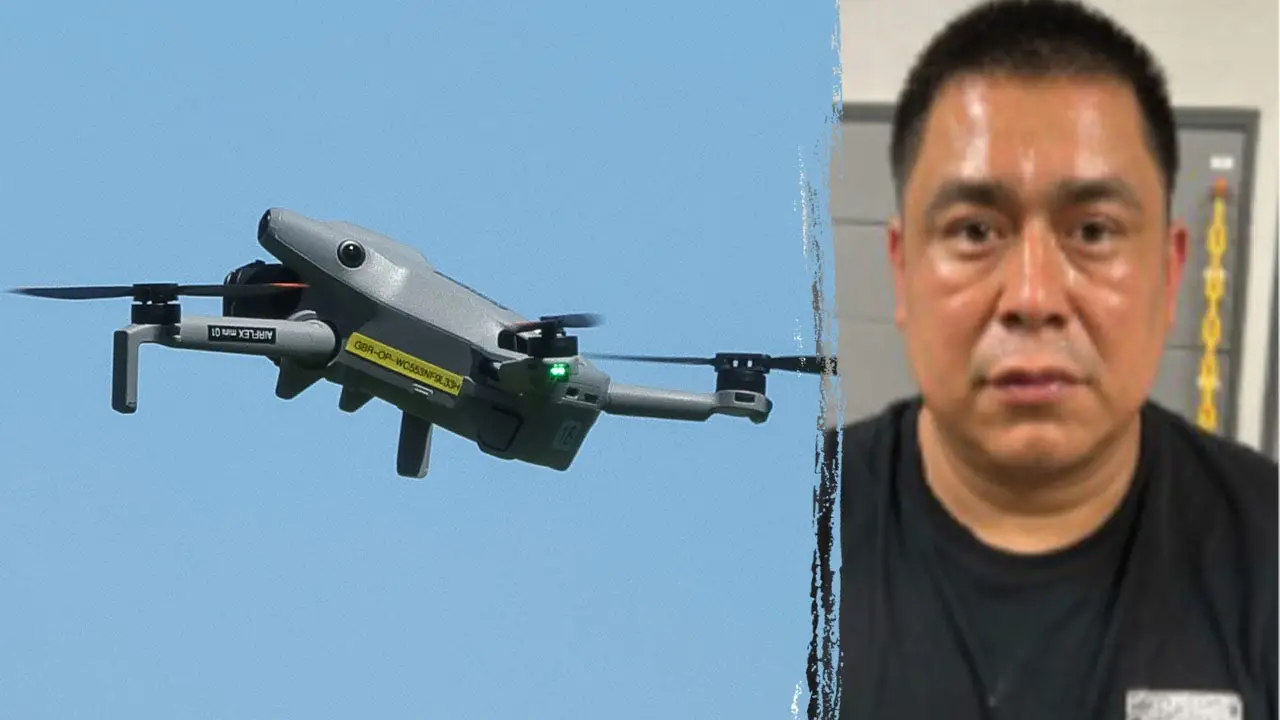
The vibrant pulse of Atlanta’s Centennial Olympic Park was alive with the infectious spirit of global soccer coordination on June 12, as thousands of enthusiastic fans gathered to celebrate the upcoming 2026 FIFA soccer tournament. Under the bright summer sky, the FIFA Fan Festival offered a joyous preview of the unity, athletic passion, and cultural exchange that the World Cup promises to bring to North America. However, high above the cheering crowds and colorful jerseys, a small, unmanned drone suddenly materialized in the sky, humming through the warm air and cutting through the celebratory atmosphere. Operating from a nearby, unassuming parking lot, thirty-seven-year-old Lorenzo Rojas-Martinez stood holding a remote controller, completely absorbed in capturing aerial video footage of the sprawling festival below. What seemed to him like an innocent attempt to document a historic celebration was, in reality, a serious breach of federal security, triggering immediate alarm bells among the heavy law enforcement presence stationed throughout the high-profile venue.
The low-pitched buzz of the rogue quadcopter did not go unnoticed by federal agents, who are operating on high alert to secure major public venues ahead of the massive international tournament. FBI agents monitoring the area quickly traced the drone’s signal and physical flight path back to the adjacent parking lot, where they confronted Rojas-Martinez as he guided the device through the restricted skies. When the agents approached him and asked for official identification, the situation quickly escalated from a routine airspace violation to a complex federal immigration case. Unable to provide lawful identification, Rojas-Martinez was taken into custody on the spot, where investigators quickly discovered that he was residing in the United States without legal authorization. The very next day, his custody was formally transferred to U.S. Immigration and Customs Enforcement (ICE), transforming a local security incident into a prominent example of the intersection between homeland security, immigration enforcement, and high-tech public safety.
Behind the arresting headlines lies the layered, decades-long story of Lorenzo Rojas-Martinez, a Mexican citizen whose life has been defined by repeated crossings of the United States’ southern border and a recurrent struggle with the law. His journey began more than a quarter-century ago when he first crossed illegally into Texas as a teenager in 1999, seeking a life in the shadows of the American dream. Over the next fourteen years, he carved out a precarious existence in the country until his first formal deportation in 2013, only to sneak back across the border and face a second deportation in 2019. Beyond his immigration violations, federal authorities revealed a long and troubled criminal history that spans several states, including convictions for drug trafficking, receiving stolen property, contributing to the delinquency of a minor, and driving under the influence. This extensive history painted a picture of an individual constantly operating on the margins of society, whose latest encounter with federal law enforcement was brought about not by a typical criminal enterprise, but by a modern consumer gadget flown in the wrong place at the wrong time.
The incident highlights the massive, multi-layered security apparatus being erected by federal agencies as America prepares to co-host the highly anticipated 2026 FIFA World Cup, where the skies have become as crucial to defend as the ground. In an era where commercial drones are cheap, highly accessible, and capable of carrying sophisticated payloads or capturing sensitive footage, the Federal Aviation Administration (FAA) has taken unprecedented steps to establish strict “No Drone Zones” over stadiums and surrounding fan events. During tournament match days, all unauthorized aircraft operations—most notably recreational and commercial drones—are strictly prohibited within a three-nautical-mile radius and up to 3,000 feet above ground level around designated World Cup stadiums. Security experts like Kash Patel have publicly voiced serious apprehensions regarding the potential for espionage, crowd disruptions, or coordinated drone attacks during these global events, prompting the FAA to threaten violative operators with devastating penalties, including confiscation of their aircraft, federal criminal charges, and crushing fines reaching up to $100,000.
This high-profile arrest has quickly become a focal point in the raging national debate surrounding border security, sanctuary city policies, and the federal government’s approach to undocumented immigrants with criminal backgrounds. Acting Assistant Homeland Security Secretary Lauren Bis seized on the arrest to deliver a stern warning, explicitly labeling Rojas-Martinez as a dangerous criminal illegal alien who chose to brazenly threaten the safety of the public at a major international festival. Bis emphasized that the current administration would remain entirely uncompromising in its mission to protect American citizens from individuals who repeatedly violate the nation’s borders and laws, using this specific case to validate calls for more aggressive deportation strategies and closer coordination between local police and federal immigration authorities. Her strong words underscore how a single drone flight in Atlanta has been amplified into a symbol of a broader political battle over national sovereignty, public safety, and the rule of law.
Ultimately, the story of Lorenzo Rojas-Martinez serves as a striking modern parable, reflecting a world where cutting-edge technology and ancient human struggles collide in unexpected ways. Rojas-Martinez now faces serious federal charges in court, specifically for operating an unregistered aircraft in a temporary flight restricted zone and for illegal reentry by a previously removed alien—charges that carry the prospect of significant federal prison time before he faces yet another deportation back to Mexico. As Atlanta and the rest of the nation continue their march toward hosting the world’s greatest sporting spectacle, this incident stands as a sober reminder of the unseen digital and physical borders that safeguard our public spaces. It humanizes the complex reality of immigration in America, showing how a man who spent twenty-five years slipping quietly across international borders was finally brought down by a tiny camera floating silently in the Georgia sky.