



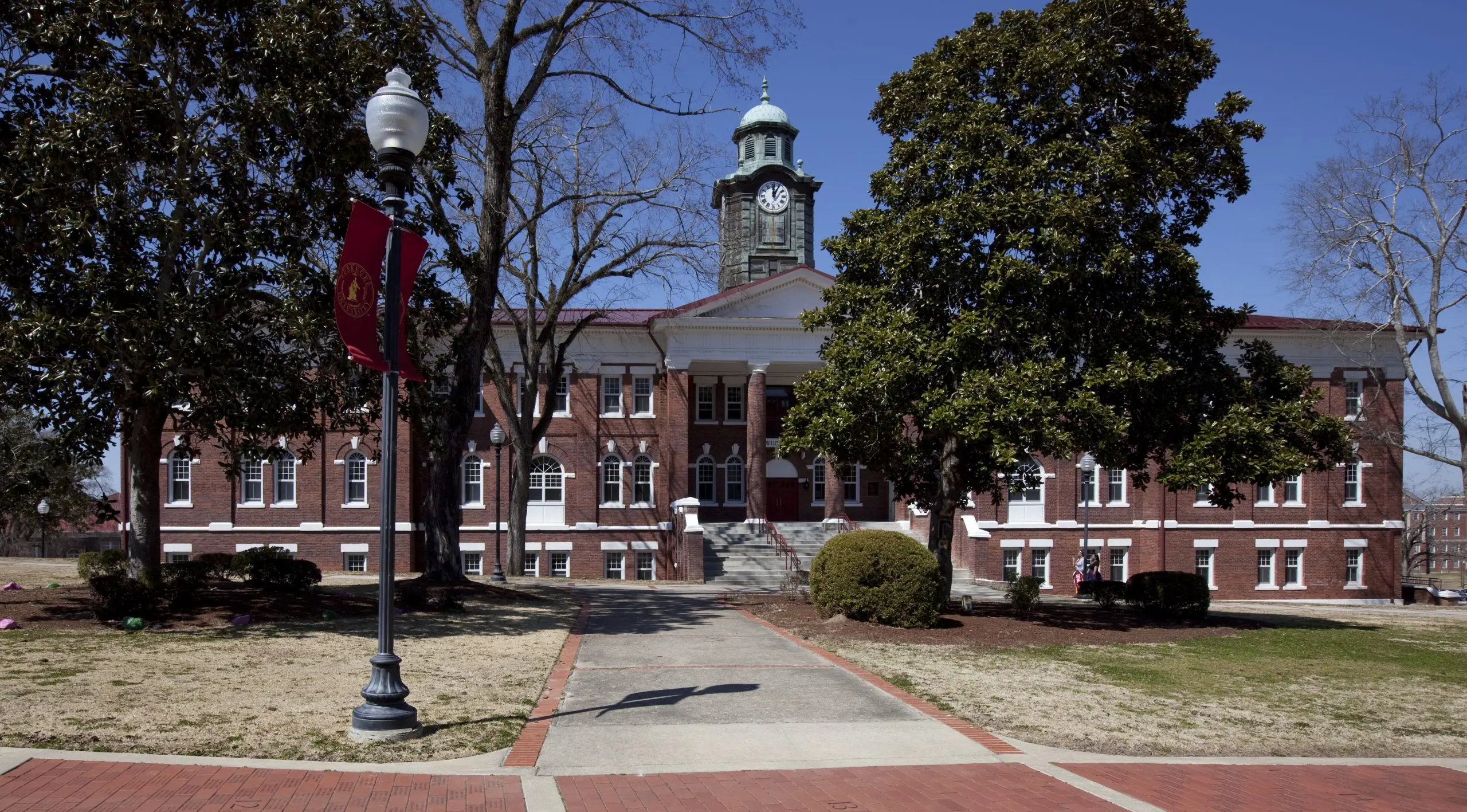
Paragraph 1Dr. Mark Brown, the president of Tuskegee University and a retired Air Force major general, is not backing down from the conversation his campus has sparked. He knows that when a historically Black university reinstates a strict dress code, people are going to talk. They’ll say it’s about control. They’ll say it’s about respectability politics. They’ll say it’s asking students to hide who they are in order to fit into a white corporate mold. Brown hears all of that, and he respectfully disagrees. For him, the dress code at Tuskegee is not about telling young Black people how to look for the sake of appearances. It’s about preparing them for a world that will judge them before they even open their mouths. “If you raise the bar, students will reach it,” Brown said in an interview, with the calm confidence of someone who has led troops and now leads scholars. “Why don’t we raise the bar? That’s what I think we ought to do. We’re unapologetic about that part.” He remembers walking around campus on the first two days of class and feeling a quiet sense of pride. Students showed up in suits, in professional dress, in clothes that signaled seriousness and purpose. “I had a wonderful time riding around and walking around the campus on the first and the second day of class,” he said. “The bar was raised and it was being reached.” That image—of a university president strolling across campus, watching young people meet a standard he set for them—is the image Brown wants people to hold onto. He knows that lowering expectations is easier. Letting things slide is easier. But he believes that a university that doesn’t ask more of its students is failing them. “The same is true as if you lower the bar, or if you go past the mistake and fail to address it: That becomes the standard,” he said. “We are a university of standards. I believe all of higher education should be a university of standards.”
Paragraph 2
The policy itself, as Brown is quick to point out, is not brand new. Tuskegee has long had expectations around dress and conduct. What changed is the emphasis. Before students arrived on campus, they received a memo that made the rules unmistakably clear: business suits and appropriate shoes for business-like meetings, professional dress in classrooms, and no non-religious head coverings—which includes durags and bonnets, items that have deep cultural resonance for many Black students. The reaction was swift. Critics, including the Foundation for Individual Rights in Education, or FIRE, argued that the university was trampling on free expression. “Tuskegee can’t promise students broad freedom of expression while enforcing a sweeping dress code that regulates ordinary, non-disruptive expression,” said Haley Gluhanich, a senior program counsel at FIRE. “Preparing students for professional life is a legitimate goal, but it does not hinge on requirements about what adults wear to class or lunch.” Brown hears that argument, and he doesn’t dismiss it entirely. He just thinks it misses the point. He believes the dress code has to be understood as part of a much larger project—one that includes punctuality, attendance, internships, professional certifications, interview preparation, and workplace readiness. “The focus is how do I make you a professional in whatever space you want to go in?” he said. That’s the question that drives him. It’s not about stripping students of their identity. It’s about giving them the tools to navigate spaces where first impressions matter. “It’s not the world we wish you were going into, it’s the world you’re going to go into,” he said. “It’s not the way that we wish an employer would perceive you. It’s the way the employer will perceive you.” That distinction—between the ideal world and the real one—is at the heart of Brown’s philosophy. He isn’t trying to make Tuskegee students look like someone else. He’s trying to make sure they are never underestimated because of how they show up. In his eyes, a business suit is not a uniform of submission. It’s a tool of empowerment.
Paragraph 3
One of the most common criticisms of dress codes like Tuskegee’s is that they place an unfair burden on students who are already struggling financially. Buying a suit, dress shoes, and professional attire is not cheap, and many students are paying their own way through school. Brown does not pretend this concern doesn’t exist. He addresses it head-on, with the same directness he brings to everything else. About 70% of Tuskegee students are Pell Grant eligible, meaning they come from families with significant financial need. Brown knows that if the dress code is going to work, the university has to make it possible for everyone to meet it, not just the students who can afford a new wardrobe. That’s why Tuskegee has the Golden Tigers Community Closet, a resource available to students who need help obtaining professional clothing. “If a student needs help with that, we’re going to help them,” Brown said. “That’s not going to be the barrier between compliance and getting ready. We’re going to remove that barrier.” This is not just a feel-good promise. The university is also planning to bring in professionals several times during the school year to teach students the details of business attire—how to button a coat, how to properly tie a tie, how to put together an outfit that looks polished without being flashy. Brown wants students to feel confident in these settings, not awkward or out of place. He wants them to know the rules before they enter rooms where those rules will be enforced. “I really want us to bear down and double click, to use a common term these days, on the fact that we have to care as much about what happens in school as what happens after school,” he said. For Brown, the dress code is not a superficial requirement. It’s a form of mentorship. It’s a way of saying, “We care enough about you to teach you what no one else taught you.” And for students who come from backgrounds where no one wore suits to work, where professional dress was something seen only in movies, this is not just about clothes. It’s about access. It’s about belonging. It’s about knowing that you have the right to walk into a boardroom and take up space.
Paragraph 4
Brown believes the results speak for themselves. He points to the university’s recent employment numbers with the kind of pride that can’t be faked. About 70% of Tuskegee students who graduated in May already had jobs lined up. That number, he says, is the real story. “Seven out of every 10,” he said. “That is the challenge. That’s what we should be debating.” In a time when faith in higher education is collapsing, when parents are questioning whether a college degree is worth the cost, when polls show that Americans are increasingly skeptical of what universities are actually teaching, Brown thinks Tuskegee’s focus on outcomes is exactly what higher education needs. He asks a simple question: “What do you want when you send your son or daughter to college? What do you expect us to do and what do you expect to happen four or five years from now when they graduate?” His answer is that Tuskegee wants students to leave with more than a GPA and a diploma. “We want them job-ready,” he said. But being job-ready is not just about having the right skills on paper. It’s about having the right habits. Brown uses punctuality as an example. It might seem minor. Show up to class a few minutes late, sit in the back, no one really cares. But if a student practices that for four or five years, they’ll carry that habit into the workplace, where lateness can cost them a job, a promotion, or a reputation. “Would it be sad for us to allow a student to come to class late, practice that for four to five years, and then find out that no matter how great they were with their 4.0 or 3.8 GPA, it won’t keep them that job?” he said. That’s the lens through which Brown sees the dress code. It’s not about judgment. It’s about practice. The classroom is a laboratory where students can develop the behaviors that will define their professional lives. If they can’t do it there, they won’t do it in the real world. And Brown refuses to let Tuskegee students discover that lesson the hard way.
Paragraph 5
The criticism that stings the most, perhaps, is the one that accuses Brown of pandering to white norms at a Black institution. Critics have framed the dress code as “respectability politics”—the idea that oppressed groups can gain acceptance by adopting the manners and appearance of their oppressors. Brown rejects that framing with the measured tone of someone who has spent a lifetime navigating systems that were not designed for him. He served in the Air Force for decades, rising to the rank of major general, a remarkable achievement for any officer, especially a Black man in a predominantly white institution. He knows what it means to be judged by his appearance, his bearing, his readiness. He also knows the history of Tuskegee University, including the Tuskegee Airmen, the brave Black pilots who fought for their country in World War II even while their country treated them as second-class citizens. Those airmen did not have the luxury of waiting for the world to change before they proved themselves. They had to be twice as prepared, twice as disciplined, twice as excellent—because they knew they would be judged more harshly than their white counterparts. Brown sees the dress code in that tradition. It’s not about denying one’s identity. It’s about demonstrating competence in a world that might otherwise overlook it. “My race and my ethnicity would have absolutely nothing to do about it,” he said. “That’s not the subject. The subject is social and economic mobility and student success.” He is not dismissive of the broader debates about culture, expression, and discrimination. He just doesn’t think those debates should be happening at the expense of preparing students for reality. “I’m not discarding the debates,” he said. “The debates are great. I think America is great because we have debate. But that’s not the purpose of the university in this sense. The purpose of a university is, while the debates go on, to be prepared.” He also notes that Tuskegee is not alone in having a dress code. “This is not unique,” he said. “If you go to many universities, they have dress codes, they have these kinds of things. Perhaps we are, at this moment, [placing] a greater emphasis.”
Paragraph 6
For Brown, the ultimate question is not about clothing at all. It’s about the relationship between a university and its students. Does that relationship end at graduation, when the diploma is handed over and the caps are thrown into the air? Brown says no. “If we think the degree ends the relationship, I do not,” he said. “I think the relationship and the value of the time here ends down the road, when that student is getting a return on investment.” That phrase—return on investment—is not just economic jargon. It’s personal. Brown knows that many Tuskegee students are the first in their families to go to college. They are using education as a springboard to do better than their parents, to break cycles of poverty, to become the doctors, lawyers, engineers, and entrepreneurs that their communities need. “That matters the most for those students who are economically at a disadvantage, who are using education as a springboard to do better,” he said. And he believes every college president and chancellor wants that for their students. But wanting it is not enough. Universities have to actively prepare students for the world they will enter. Brown has received positive feedback from other university leaders, and he has not seen significant pushback from Tuskegee students themselves. The controversy, it seems, is louder off campus than on it. That might be because students understand what he is doing. They know the dress code is not a punishment. It’s a promise. It’s a commitment that Tuskegee will not let them leave unprepared. “Every college president, chancellor—I’ve got to believe—wants that for their students,” Brown said. “But do we expect them to practice that when they start work? Or isn’t the classroom an extension of that? Isn’t it a laboratory by which you practice these very important skills? I think it is.” In the end, Brown’s defense of the dress code is really a defense of the idea that education should transform lives, not just certify them. It should teach students not only how to think, but how to show up. Not just what to know, but how to be. And if that means wearing a suit to class, so be it. The suit was never the point. The point is that Tuskegee believes in its students enough to ask more of them. And in a world that often expects less, that kind of belief is worth wearing proudly.