



The professional life of Todd Blanche has become a Masterclass in high-stakes tightrope walking, as he attempts to navigate the razor-thin boundary dividing his duty as a public servant from his deep-seated loyalty to the man who elevated him. When Blanche took the helm of the Justice Department as acting attorney general following the sudden ouster of Pam Bondi, his allies held onto a fragile hope that he could achieve two seemingly incompatible goals. They believed he possessed the administrative acumen to restore a sense of institutional stability to a deeply rattled department, while simultaneously executing enough aggressive, headline-grabbing maneuvers to prove to President Donald Trump that he possessed the ruthless edge required to secure the job permanently. Yet, the quiet moderation Blanche once exhibited as Bondi’s deputy has rapidly dissolved under the relentless pressure of his new position. Trapped between the demands of a notoriously demanding boss and his own instinct for self-preservation, Blanche has increasingly abandoned the careful posture of an institutionalist. Instead, he has embraced a single-minded strategy designed to satisfy an audience of one, turning his back on traditional legal norms to demonstrate a fierce, unwavering devotion that has beginning to cost him the respect of the very institution he is meant to lead.
Nowhere has this shift been more evident than in the sudden acceleration of politically charged investigations targeting the administration’s perceived adversaries, transforming the Justice Department into an instrument of personal vindication. The most striking manifestation of this campaign was the surreal indictment of former FBI Director James B. Comey, prosecuted over a social media post depicting seashells—a harmless image that prosecutors, under Blanche’s authority, painted as a menacing, veiled threat. Behind the scenes, the drama surrounding these prosecutions reveals a man constantly wrestling with the boundaries of his own conscience and the relentless demands of the White House. Blanche had previously attempted to act as a voice of caution, quietly warning administration officials against the immediate arrest of Comey and opposing the hasty appointment of loyalist Lindsey Halligan to lead these politically sensitive cases—a decision that was later vindicated when a federal judge threw the cases out. He even tried to push back against orders to indict New York Attorney General Letitia James on flimsy mortgage charges, only to be flatly overruled by a White House unimpressed by his legal hesitations. This internal friction paints a portrait of a bureaucrat caught in a vice, desperately trying to temper the most extreme impulses of the administration while being forced to publicly champion debunked election conspiracy theories and weaponized prosecutions to survive the political winds.
The tension surrounding Blanche’s dual identity reached a boiling point this week with the unveiling of a breathtakingly controversial $1.8 billion compensation fund, designed to reward individuals who claim they were targeted by federal overreach. To his critics, the creation of this fund represents an unprecedented effort to funnel taxpayer dollars directly into the pockets of the president’s most ardent supporters, including those who violently stormed the Capitol on January 6th, 2021. In announcing the plan, Blanche framed it as a moral necessity, declaring that the machinery of government must never be weaponized against citizens and asserting his department’s intention to “make right the wrongs that were previously done.” However, the legal community and career prosecutors reacted with profound horror, viewing the initiative as a devastating assault on the rule of law that seeks to rewrite history and reward criminal behavior. Democratic lawmakers immediately denounced it as a corrupt “slush fund,” while veteran prosecutors pointed out the dangerous absurdity of using public funds to compensate individuals who had been lawfully investigated, indicted, and convicted by juries of their peers based on overwhelming evidence. The creation of this fund exposes the existential crisis at the heart of Blanche’s tenure: a willing subversion of established legal frameworks to construct a parallel system of justice that retroactively pardons and enriches political allies.
The outrage over the compensation fund intensified into a full-blown political crisis when a stealthy, eleventh-hour addition to the agreement was brought to light, bearing Blanche’s own signature. Tucked quietly into the administrative paperwork was a sweeping provision granting President Trump, his immediate family, and their vast network of businesses absolute immunity from ongoing federal investigations into their taxes. This extraordinary move, which effectively insulates the president from massive financial and civil liabilities, sent shockwaves through Washington and instantly shattered any remaining pretense of departmental independence. The blowback was immediate and severe, but it did not come solely from the president’s political opponents. Instead, a contingent of powerful Republican senators, terrified of the electoral fallout and the blatant erosion of public trust, turned their fury directly onto Blanche. During a tense, closed-door meeting at the Capitol, Republican lawmakers angrily confronted the acting attorney general, accusing him of committing a “galactic blunder” that endangered their fragile legislative majorities. The backlash was so intense that Senate leadership took the drastic step of scrapping a major budget vote in open protest, exposing a massive rift within the party and leaving Blanche exposed to the wrath of a congressional delegation that felt blindsided by his loyalty-driven agenda.
As the political storm rages around him, Blanche has struggled to articulate a coherent defense of the policy, often shifting the blame to others while leaving the operational details of the fund dangerously vague. In a defensive media blitz, including a highly charged interview on CNN, Blanche tried to distance himself from the authorship of the very documents he signed, claiming that the protective tax immunity clause was drafted by the president’s “outside counsel” and career department lawyers, rather than by his own hand. Yet, this buck-passing has done little to satisfy his critics or clarify how the fund will be managed in practice. When pressed to explain how the department would define “government weaponization,” or whether violent offenders, major political donors, and pardoned criminals would be eligible for taxpayer payouts, Blanche refused to offer any concrete restrictions, offering instead vague promises that a panel of five commissioners would evaluate each claim. Under his proposal, the president would retain the unilateral authority to fire these commissioners, and Blanche refused to commit to appointing even a single Democrat to the panel. This lack of transparency has alienated key allies, including Senate Majority Leader John Thune, who expressed deep skepticism about a policy that threatens to tie the Republican brand to an unprecedented system of government payouts for convicted criminals, undermining the party’s traditional message of law and order.
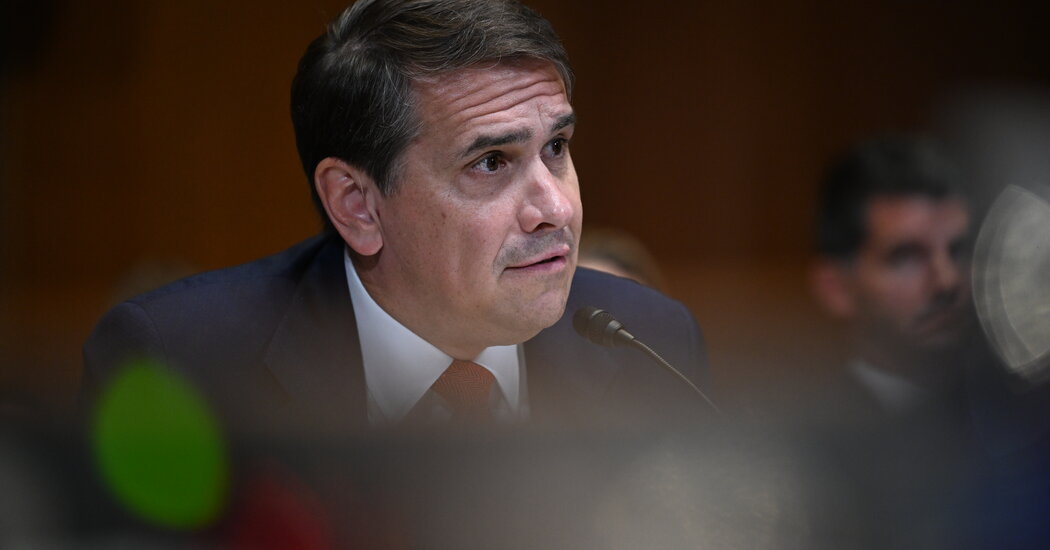
This ongoing saga has ultimately transformed the acting attorney general into a deeply isolated figure, caught in the crossfire between an insatiable president demanding total fealty and a panicked Republican establishment fighting for its political survival. Unlike his predecessor, Pam Bondi, or other firebrands within the administration, Blanche continues to project a polished, soft-spoken courtroom demeanor, eschewing public insults and aggressive shout-downs in favor of a calm, measured defense of his actions. Yet, this polite facade has begun to crack under the weight of his impossible position, as demonstrated during a dramatic exchange with Democratic Senator Chris Van Hollen during a Senate subcommittee hearing. When Van Hollen sharply questioned whether he was acting as a servant of the public interest or merely as a hired gun for his former client, Blanche became visibly agitated, raising his voice to insist that his past role as Trump’s defense lawyer was irrelevant to his current duties as acting attorney general. But Van Hollen’s swift, cutting retort—that Blanche was continuing to act precisely like the president’s personal attorney—captured the central tragedy of Blanche’s career. By trying to bridge the gap between his personal loyalty and his public oath, Todd Blanche has found himself trapped in a political wilderness, having traded his professional reputation as a respected lawyer to become the highly visible shield for a presidency that demands nothing less than the complete subordination of the law.