



Trump’s Beijing Odyssey: Touring Icons of Power and Tradition
In the intricate ballet of international diplomacy, few stages are as potent as Beijing’s historic landmarks, where symbolism intertwines with strategy. President Donald Trump’s meticulously planned visit to China this week has unfolded against this backdrop, as he engages with President Xi Jinping in a series of engagements that echo centuries of China’s imperial and ideological heritage. From sprawling squares to ancient temples, Trump’s itinerary is a curated narrative, designed not just for meetings but for messages of unity and tenacity. As the American delegation liaises with Chinese officials amid global uncertainties, these sites—imbued with layers of history and national identity—serve as silent arbiters in the delicate dance of Sino-American relations. It’s a reminder that in geopolitics, as in architecture, every stone tells a story.
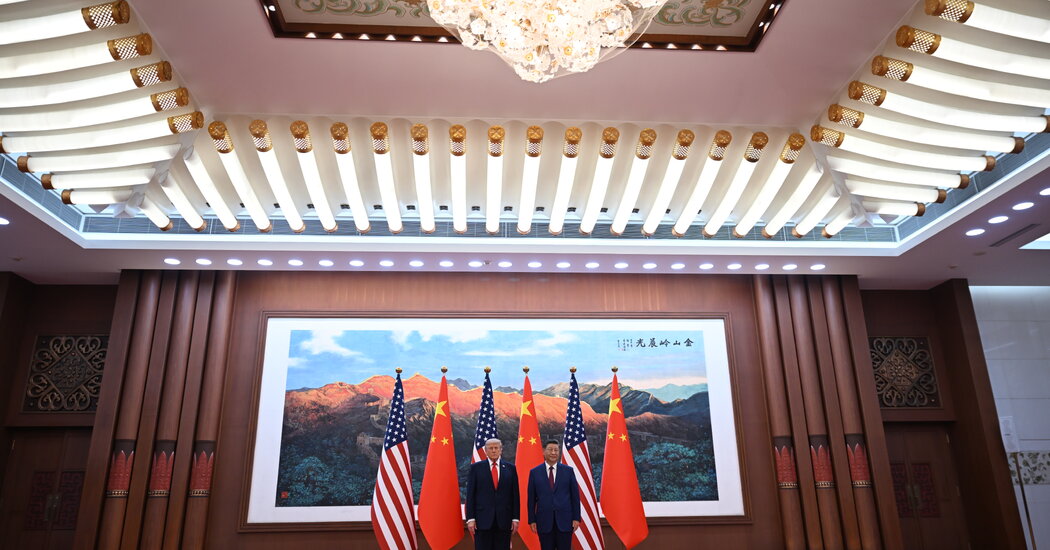
The visit kicked off with a flourish at the Great Hall of the People, Beijing’s grandiose signature on Tiananmen Square, where a welcome ceremony Thursday morning set the tone for high-stakes exchanges. Photogenic and purposeful, the event featured the requisite red carpets and anthems, a ritualistic nod to the pomp that characterizes state diplomacy. Trump, ever the showman, navigated the formalities with charisma, while Xi, the master strategist, steered conversations toward shared economic interests and bilateral ties. This wasn’t mere protocol; it was a calculated display, amplifying themes of cooperation in an era fraught with trade wars and technological rivalries. Security was omnipresent, with barricades fending off curious onlookers, underscoring the event’s weighty implications for global markets and diplomatic balances.
By afternoon, the focus shifted eastward to the Temple of Heaven, a serene oasis amidst Beijing’s urban sprawl. It’s a short drive from the bustling square, yet worlds apart in ambiance—a verdant compound where emperors once beseeched the heavens for prosperity. Trump’s tour here felt almost meditative, a contrast to the morning’s vigor, as guides recounted tales of imperial rites that shaped China’s dynastic legacy. The president, who has a penchant for grand gestures, was photographed basking in the temple’s tranquil gardens, a moment that humanized the high-stakes summitry. Observers noted how these sites, chosen with precision by Chinese hosts, allow Xi to subtly juxtapose China’s long-game planning against the short electoral cycles of Western democracy, framing Beijing as a beacon of stability in turbulent times.
Diving deeper into the narrative, the Great Hall of the People stands as a monument to China’s revolutionary triumph, erected in 1959 mere years after the Communist Party seized power in 1949. Commissioned as a testament to the masses’ sovereignty, it was Premier Zhou Enlai’s vision to embody the ethos that “the people are the masters of the country.” Sprawling across the equivalent of 24 soccer fields and boasting over 300 meeting rooms, the hall’s auditorium seats 10,000 under a ceiling crowned by a radiant red star encircled in galaxy-like lights—a vivid allegory for communist unity. Today, it hosts the National People’s Congress sessions, diplomatic summits, and party rallies, evolving from a symbol of upheaval into the nerve center of governance. For Trump and Xi, meeting here wasn’t accidental; it highlighted Beijing’s modernization drive, where ancient ideologies fuse with economic dynamism.
The Temple of Heaven, meanwhile, transports visitors back to the Ming dynasty’s reign in the early 1400s, when it was constructed alongside the Forbidden City, that labyrinthine palace complex Trump toured with Xi and their spouses during a 2017 rendezvous. Emperors performed elaborate ceremonies here, invoking divine favor for bountiful harvests and serene weather, rituals that underscored the Mandate of Heaven doctrine—an invisible yet ironclad authority that legitimized rule. This temple isn’t just a relic; it’s a living chronicle of China’s enduring ethos, a narrative Xi emphasized to Trump five years ago, drawing parallels between past glories and current ambitions. Unlike its sister site, the Forbidden City, the Temple of Heaven has seldom graced presidential itineraries—Gerald Ford’s 1975 visit being a rarity—making Trump’s stop noteworthy. As Mr. Han Lin of the Asia Group points out, Beijing’s curation of such stops aims to accentuate continuity and openness, offering Washington a mirror to its own political volatility.
Amid all this, analysts like Lin perceive a deeper strategic undercurrent. China’s leadership, he argues, leverages these landmarks to project an image of unwavering resolve, contrasting with the ebb and flow of American politics driven by elections. Themes of economic interconnectedness and global harmony resonate here, rooted in a civilization steeped in millennia of history. For Trump, whose “America First” mantra has redefined trade pacts, the sojourn through Beijing’s iconic venues becomes a forum for subtle negotiations on tariffs, tech transfers, and military posturing. Yet, it’s also a cultural exchange, inviting reflection on why these places endure. The Great Hall bridges the chasm between revolution and reform, while the Temple of Heaven evokes a spiritual legacy that outlives dynasties. In an unpredictable world, where alliances shift like tectonic plates, Trump’s Chinese pilgrimage offers a fleeting glimpse of potential harmony—provided the symbols yield to substantive dialogue. As the sun sets on Beijing’s ancient vistas, one can’t help but wonder if this visit will etch a new chapter into the annals of U.S.-China relations, or fade like the incense at the Temple.