

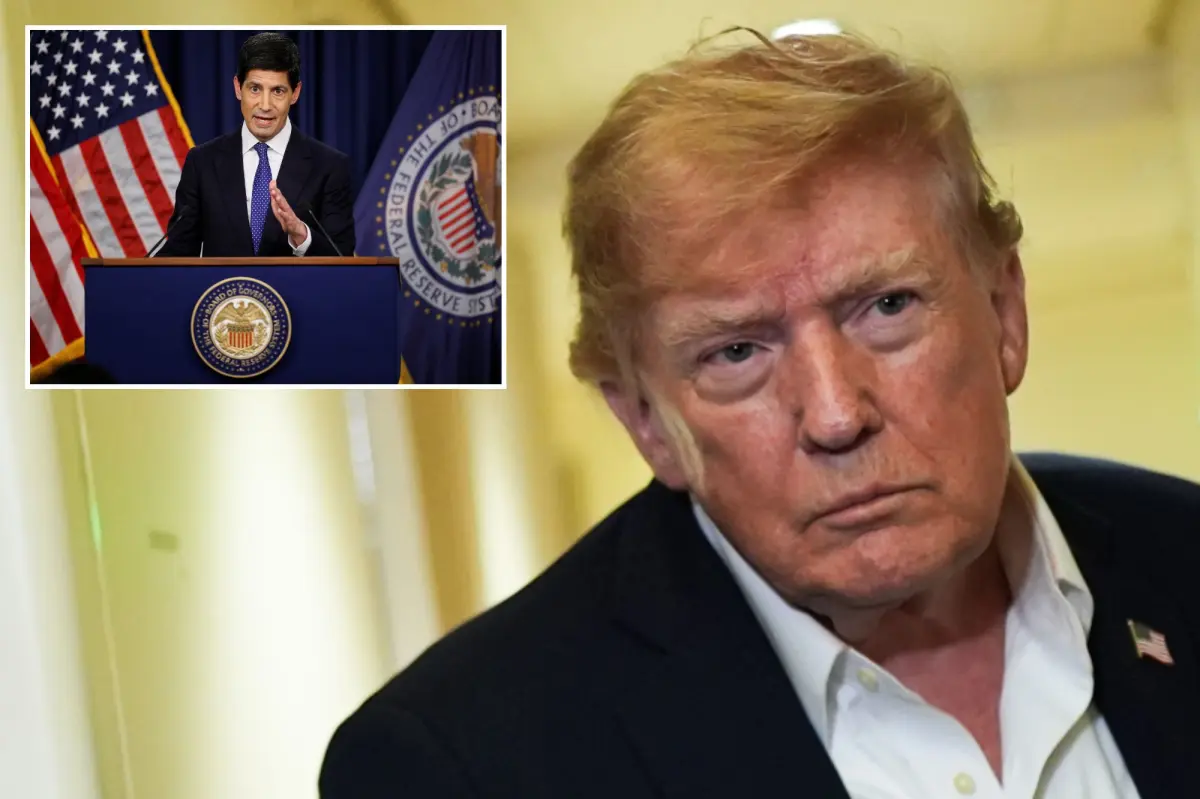
It may have started like any ordinary Wednesday in Washington, with the usual hum of bureaucracy and the quiet calm of a city that never sleeps. But within hours, the calm was shattered. The Federal Reserve, the powerful institution that controls the cost of borrowing across the entire country, decided to do something it had not done in three years: it raised interest rates. In a unanimous vote, the Fed lifted its benchmark rate by a quarter percentage point, pushing it to a range of 3.75% to 4%. For most Americans, that number might sound like a dry financial statistic, but it means real things. It means that borrowing money is getting more expensive, that credit card debt will be pricier, that businesses will have to think twice before expanding. It is the kind of move that makes no one happy in the short term, unless you happen to be a saver who loves watching your bank account earn a little extra interest. President Trump, however, was not in the mood for nuance. He had barely finished reading the news before he took to his favorite online platform, Truth Social, and let the world know exactly what he thought. “Interest Rates in the United States should be 1%, or less, because we are the Best Credit in the World — BY FAR,” he wrote. The message was classic Trump: confident, blunt, and utterly convinced. He went on to describe a country “BOOMING with new Investment!” and demanded that the Fed lower rates immediately. It wasn’t a suggestion. It was a command. And it was aimed, at least indirectly, at the man he had personally chosen to lead the central bank, Kevin Warsh.
To understand why Trump is so determined to see lower rates, you have to imagine the world the way he sees it. In that world, the United States is the strongest economy on the planet, the safest place to put your money, and the engine that keeps the entire global market running. The government can borrow money more cheaply than almost anyone else because investors all over the world trust it to pay them back. So why, Trump asks, should American businesses and consumers have to pay high interest rates? Why shouldn’t the best credit in the world get the best deal in the world? His answer is simple: it should. Rates should be 1%, or even lower, so that money flows freely, businesses invest enthusiastically, and the stock market keeps climbing. There is a certain homespun logic to this. If you walked into a bank with a perfect credit score, you wouldn’t expect to be charged the same interest rate as someone who has defaulted on loans for years. You would expect a reward. Trump is applying that logic to an entire country, and he is doing it with the urgency of someone who truly believes the window of prosperity is closing. But there’s more to it than economics. There is pride. He wants the Fed to acknowledge that America is exceptional. Every time the Fed raises rates, it sends a quiet message that the economy needs cooling off, that things might be getting out of hand. That message drives him crazy, because it undercuts everything he likes to say about the White House’s economic record. Lowering rates, in his mind, would be an acknowledgment of victory. It would mean that the central bank is on his side, improving things, not fighting against him. And it would give Americans a sense of relief. That’s maybe the most human part of his argument. He feels that when the cost of money goes up, ordinary people lose. Their monthly payments go up, their dreams of buying a house or growing a business get pushed further away. He sees the Fed as a gatekeeper that keeps those dreams just out of reach. To him, 1% isn’t just policy. It’s a promise that America is still the place where anything is possible. It’s a number that says: we’re doing well, we deserve a break, and now is not the time to slam on the brakes. This emotional pull is powerful, and it resonates with anyone who has ever looked at a loan payment and wished it were smaller. But, of course, it is not the whole story.
Then there is the trade deficit, which is Trump’s favorite obsession and the centerpiece of his economic worldview. In his Truth Social post, he insisted that if the United States simply stopped trading with every country that it runs a trade deficit with—which is most of them—the country would make at least $1.5 trillion a year. He offered no detailed plans, no complex formulas, just a simple and forceful belief that the word “deficit” is nothing more than “a fancy word for LOSS.” This is the kind of language that sounds like common sense. After all, nobody lies awake at night dreaming of losing money. Nobody wants to hear that their family is spending more than it earns. The idea that America is on the losing end of trade deals with dozens of countries feels wrong, like being the only one in a group project who ends up doing all the work. And Trump leaned into that feeling when he said the United States is “carrying” almost every country in the world and “that cannot go on any longer.” He speaks to a sense of exhaustion and unfairness, a belief that hardworking Americans are being taken advantage of by allies who still act like rivals. It is a powerful narrative, and it works on an emotional level. But it also ignores the complex reality of how trade actually functions. A trade deficit is not simply a loss. It can mean that Americans have enough money to buy goods from overseas, that companies benefit from cheaper parts and materials, and that the dollar is strong enough to be used around the world. Sometimes a deficit is just a sign of abundance, not weakness. But to the average person who is trying to make ends meet, hearing that the country is “losing” billions of dollars sounds like a crime. Trump knows this. He uses it to channel anger into action, or at least into a demand for a different approach. It doesn’t matter that economists take a different view. What matters is the feeling. And the feeling is that the United States is too generous, too trusting, and too willing to be the world’s bank. In that sense, his demand for lower interest rates is also a demand for a country that puts its own citizens first. He wants to stop subsidizing the world. He wants to give the money back to America. It’s a fantasy of national independence, and it’s exactly why so many people believe him when he says that the Fed is getting in the way.
But over at the Federal Reserve, a different story was playing out. Kevin Warsh, the chairman whom Trump had picked to replace Jerome Powell back in January, stood before his colleagues and made the case that inflation is too high and has been too high for too long. His words were not a warning shot. They were the deliberate, measured language of a central banker who believes that the biggest danger to the economy is not slower growth, but runaway prices. The unanimous vote to raise rates to the 3.75% to 4% range was a signal that the Fed is willing to make unpopular choices in order to keep the economy healthy over the long haul. It might be tempting to think of the Fed as a distant tower of unelected officials who enjoy making everyone’s life miserable. But their job is actually quite personal. When inflation runs high, the money in your wallet doesn’t go as far. The groceries cost more. The gas pump hurts more. Rent rises, and the raises you hoped for never seem to catch up. The Fed’s biggest fear is that once people start expecting prices to climb forever, they will start changing their behavior. They’ll demand higher wages. Businesses will pass those costs on to customers. And then the spiral becomes impossible to stop. That is why Warsh and his colleagues are willing to raise rates even when the president of the United States is publicly screaming at them. They know that lower rates can feel great in the moment, like finding a sale on something you need. But they also know that if they let inflation run wild, those lower rates will eventually eat everyone alive. The human reality is that there is no free lunch. When the Fed cuts rates, it can inflate bubbles. When it raises rates, it can hurt borrowing. Warsh is choosing the pain of higher rates today in order to avoid the greater pain of an uncontrolled price surge tomorrow. It is not an easy choice, and it is not a glamorous one. But it is the job. And it means that even though Trump is his patron, Warsh is not going to simply follow orders. He may be friendly with the president. He may owe his position to the president. But when he casts a vote, he says he does it for the country, not the White House.
Trump, for his part, stopped just shy of calling out Warsh by name. He didn’t need to. When he wrote, “LOWER THE INTEREST RATES FOR THE UNITED STATES OF AMERICA, AND FAST!” everyone in Washington understood exactly who was being asked to act. It was a direct challenge, wrapped in the kind of blunt simplicity that may be Trump’s greatest political gift. He knows how to make complicated issues feel like a fight between good and bad, and in his telling, the Federal Reserve is the bad guy standing in the way of a booming economy. The problem is that central bank independence exists for a reason. If presidents could push interest rates up or down based on their own political schedules, the economy would swing wildly with every election cycle. Low rates might be great right before a vote, but terrible afterward. The Fed’s credibility depends on its willingness to ignore political pressure. That is why Warsh’s unanimous vote matters. It demonstrates that even a hand-picked Fed chair can resist the person who gave him the job. But the conflict between the White House and the central bank is not just a philosophical debate. It has real consequences for the stock market, for business investment, and for anyone who has ever signed a mortgage or taken out a car loan. When the markets hear the president attacking the Fed, they worry that political pressure might someday win. When they hear the Fed standing its ground, they worry about higher borrowing costs. Either way, uncertainty follows. And uncertainty, as any business owner will tell you, is usually the enemy of growth. Trump seems to think that by shouting loud enough, he can will the economy into submission. Warsh seems to think that by holding firm, he can protect the country from itself. In the meantime, the rest of us are forced to live with the swirling mix of tweets and technical decisions, trying to figure out whether we should save more, spend less, or just hold on tight and hope the people in charge figure out a way to balance the books. It is a drama that plays out in every newspaper, but its real theater is on a kitchen table where a family is deciding whether to buy a home, start a business, or simply pay off a debt. That is the human cost of the standoff.
So what are ordinary Americans supposed to do with all of this? On one side, they have a president who tells them the economy is booming and that interest rates should be 1% or less, pure and simple. On the other side, they have a Fed chairman who tells them inflation is too high and that the only responsible thing to do is raise rates. Both are speaking to the same people, but they are describing completely different worlds. Trump’s world is one of boundless opportunity, where cheap money is a river that lifts all boats. Warsh’s world is one of discipline and caution, where you have to swallow some tough medicine now to keep the patient healthy later. The truth is that both have a point, and that is the cruelest part of the whole debate. Low rates really do make borrowing easier, and they can help businesses grow. But high rates are often necessary to stop prices from running away. There is no perfect number that satisfies everyone. A young couple hoping to buy their first home might be crushed by rising mortgage rates. A retired grandparent living on a fixed income might be relieved to see the government finally take inflation seriously. A family with credit card debt might feel betrayed by the Fed. A small business owner might be terrified by the idea of rapid inflation. The economy is not a uniform thing. It is a collection of millions of individual lives, all with different needs, different fears, and different dreams. And when the president and the central bank fight in public, it becomes easy to feel powerless. But there is a human realization underneath all the jargon: money is not just about numbers. It is about security, hope, and the ability to plan for a future. It is about whether you can afford to send your child to college, whether you can fix your car, whether you can take a vacation without going into debt. The fight over interest rates is really a fight about which risks we are willing to take. Trump is willing to risk inflation for growth. Warsh is willing to risk a slowdown to preserve the value of money. And until those two visions can find a common ground, every decision we make with our own dollars will carry a little more weight. That is why this story matters, not because it is about politicians and bankers, but because it is about us. It is about how we hold on to hope in an uncertain economy, how we make old choices and new dreams fit into a budget that sometimes seems too small, and how we keep going even when the people who are supposed to be in charge cannot seem to agree on the simplest question: what is a dollar really worth? In the end, that is what all of these numbers really mean. They are not cold and abstract. They are as human as the hands that hold them.