



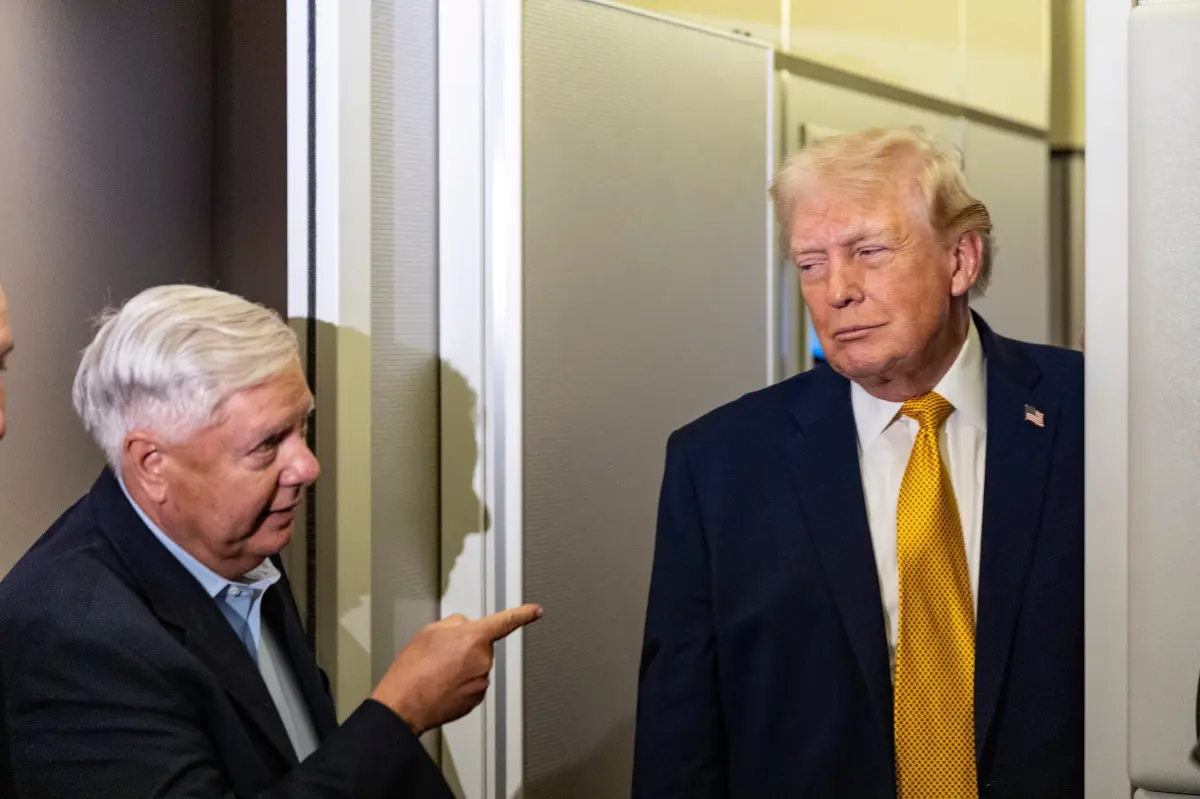
The political landscape shifted quietly this weekend as news broke of the passing of Senator Lindsey Graham at the age of 71. The longtime South Carolina lawmaker, known for his sharp wit and mercurial political alliances, died on Saturday following a brief and sudden illness. His office shared the heartbreaking news with the public, marking the end of a decades-long career in Washington that left an indelible mark on the nation’s capital. In the wake of his sudden departure, tribute poured in from across the political spectrum, none more prominent than that of President Donald Trump. Taking to Truth Social, Trump lauded the late senator as a “true American Patriot” and “one of the greatest people and Senators I have ever known,” promising that details of his funeral arrangements would be shared in the coming days as the nation prepares to bid him a final farewell.
Graham’s political journey was a masterclass in survival and adaptation. Before he became a giant in the Senate, where he served diligently from 2003 until his death, he cut his teeth in the House of Representatives representing South Carolina from 1995 to 2003. He was a creature of Capitol Hill, a man who seemed to breathe the air of committee rooms and legislative debates. For those who watched him over the years, Graham was a consummate insider, a politician who understood the levers of power and was never afraid to pull them. His career was defined not just by the bills he sponsored, but by his sheer longevity and his ability to remain at the absolute center of national gravity for nearly thirty years.
Perhaps nothing illustrated Graham’s political instincts better than his evolution from one of Trump’s fiercest detractors to one of his most loyal confidants. During the bitter 2016 Republican primary, when Graham briefly ran for the presidency himself, he didn’t hold back his disdain for the real estate mogul. He famously warned his party, “If we nominate Trump, we will get destroyed… and we will deserve it.” Yet, politics makes strange bedfellows, and the years that followed saw an extraordinary transformation. Graham transitioned seamlessly into the president’s inner circle, eventually serving as the chairman of the Senate Judiciary Committee from 2019 to 2021—a critical period where he helped shape the conservative makeup of the federal judiciary, securing a legacy that will outlive him by decades.
As their relationship deepened, Graham became a human shield for Trump in the Senate, defending him fiercely through the darkest hours of his presidency. During both of Trump’s impeachment trials, the South Carolina senator stood firmly in the breach, voting to acquit him both times and fiercely denouncing the proceedings as partisan theater. He echoed the president’s own raw rhetoric, arguing that the inquiries were not about safeguarding the nation but were designed solely to destroy a sitting president. When the chaotic aftermath of the 2020 election unfolded, Graham initially backed Trump’s legal battles in key swing states, though he ultimately chose to accept Joe Biden’s victory once the Electoral College votes were officially certified, walking a tightrope between loyalty and constitutional order.
In his final years, Graham remained a powerhouse on national security and foreign policy, bridging the gap between his own hawkish instincts and Trump’s more populist “America First” agenda. While they occasionally clashed over the extent of American military intervention abroad, they found common ground on a robust defense budget, unwavering support for Israel, and a confrontational stance toward global adversaries like Russia, China, and Iran. Graham was particularly vocal in his final months, championing Trump’s recent military strikes against Iranian targets, arguing with characteristic conviction that decisive action was the only way to halt Tehran’s nuclear ambitions.
Looking back on his own tumultuous path, Graham seemed at peace with the choices he made and the alliances he forged. In one of his final interviews, he reflected on his relationship with the president with a sense of pragmatism and self-awareness, noting that history would ultimately be the judge of his actions. “I have a lot of respect for President Trump,” Graham remarked, adding that while presidents must carry the heavy burden of their decisions, “as to me, history will be very clear as to where I stood, for better or worse.” With his passing, the Senate loses one of its most colorful and consequential characters, leaving behind a legacy of a man who loved the arena, thrived in the spotlight, and never shied away from the fight.