

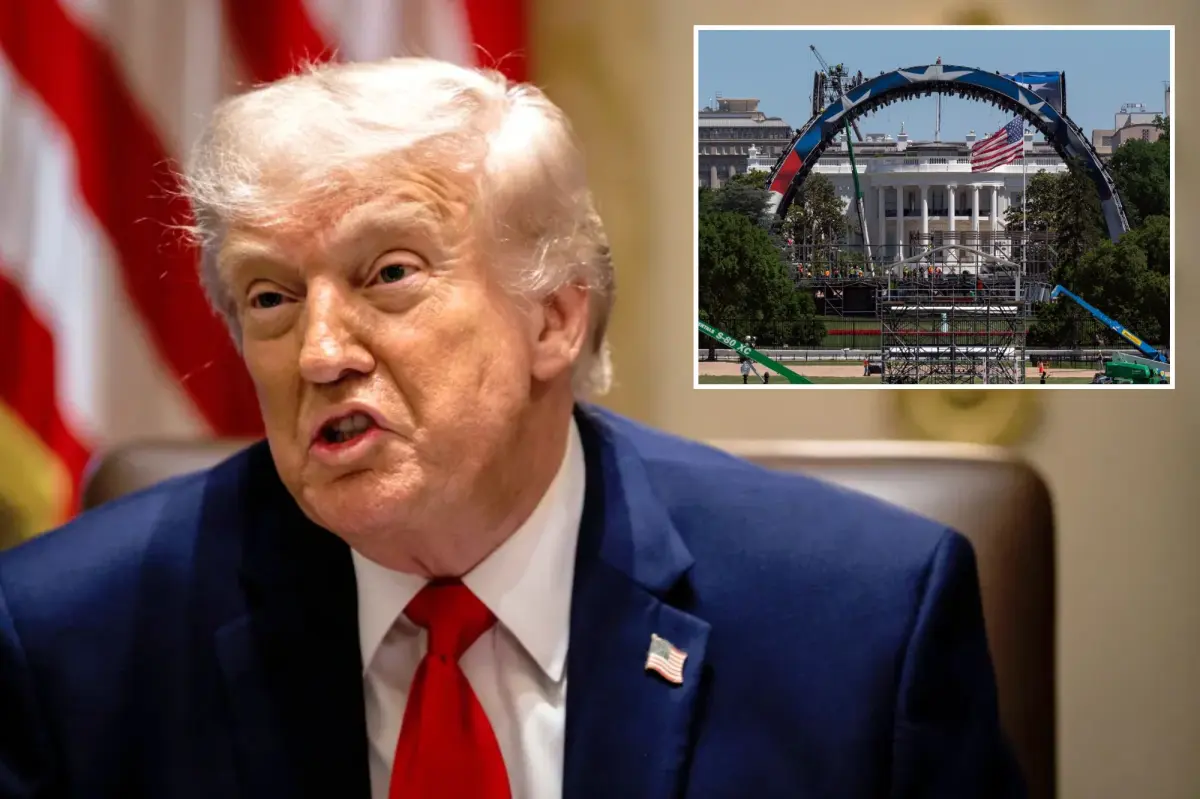
As the United States rapidly approaches its milestone 250th anniversary in the summer of 2026, the ambitious plans to commemorate this historic milestone on the National Mall in Washington, D.C., have unexpectedly transformed into a dramatic battleground of culture, politics, and celebrity influence. Originally envisioned as the “Great American State Fair,” a grand multi-week festival scheduled to run from June 25 through July 10, 2026, the event was designed to stretch majestically from the steps of the U.S. Capitol all the way to the shadow of the Washington Monument. It was meant to be a grand celebration of unity, heritage, and spectacles designed to bring citizens together from all walks of life. However, the delicate harmony of this national birthday party was severely disrupted when a sudden exodus of mainstream musical acts threw the scheduled “Freedom 250” concert series into total disarray. Rather than quietly managing the damage behind the scenes, Donald Trump chose to catapult the controversy into the national spotlight, suggesting that the entire musical lineup should be abandoned in favor of a massive, politically charged Make America Great Again (MAGA) rally that would redefine the tone of the country’s landmark celebration.
The sudden friction began when several prominent artists, who had originally been announced as part of the star-studded musical lineup, abruptly pulled out of the festivities shortly after the schedule was made public. High-profile performers representing various musical generations and genres—including country music icon Martina McBride, rock frontman Bret Michaels, hip-hop pioneer Young MC, the legendary funk group Morris Day and The Time, and dance-pop ensemble C+C Music Factory—all chose to withdraw their participation from the summer stage. Their sudden departures triggered a swift and characteristically fiery response from Trump on his social media platform, Truth Social. In a series of lengthy, unfiltered statements, the former president made no effort to hide his disdain for the departing musicians, publicly dismissing them as overpriced, ungrateful, and boring showmen whom the public did not genuinely want to hear anyway. Rather than mourning the loss of these established acts, Trump aggressively argued that the entire concert format should be canceled immediately, asserting that the country should instead focus its energy on hosting a monumental public gathering built around his own personal brand of patriotism.
This high-profile dispute on the National Mall unfolded against the backdrop of another deeply personal grievance for Trump, who was simultaneously reeling from a recent legal setback involving his legacy in the nation’s capital. Just a day prior to his social media outbursts, a federal judge had issued an order demanding the removal of Trump’s name from the prestigious Kennedy Center for the Performing Arts, a move that clearly struck a sensitive nerve. Trump quickly connected these two cultural battles in his online rants, framing the legal decision not as a personal defeat, but as a mutual and voluntary parting of ways from an institution he claimed was already in steep decline. He passionately defended his decision to distance himself from the Kennedy Center, describing it as an “unsafe” and “failing” space, and alleged that a highly biased and conflicted judiciary had unfairly prevented him from spending his own resources to revitalize the center. By linking the Kennedy Center dispute with the unraveling of the Freedom 250 concert lineup, Trump successfully turned a double dose of public rejection into a rallying cry against what he characterizes as an elitist establishment determined to suppress his contributions to American culture.
Faced with a shrinking roster of musical talent, Trump did what he has done throughout his entire career: he pitched himself as the ultimate headliner, declaring that his own unmatched star power was more than enough to carry the nation’s 250th anniversary celebrations. With his signature theatrical flair, he mockingly suggested that the departing artists had developed “the yips” due to the immense pressure of the historic occasion, offering his own presence as the ultimate remedy for the failing event. He boldly compared his drawing power to that of Elvis Presley in his absolute prime, arguing that he can command far larger and more passionate audiences without even needing to hold a guitar. By positioning himself as both “THE GOAT” (Greatest of All Time) and the standard-bearer of genuine patriotism, Trump proposed a dramatic shift in programming for June 24, suggesting that a major keynote address of his own design replace the highly-paid, “Third-Rate” performers who chose to step away. He asserted that he only wishes to surround himself with happy, smart, and competitive people, transforming the celebration from a standard entertainment showcase into a highly focused demonstration of national strength and political victory.
This intense cultural divide has cast a glaring spotlight on the deep polarization that currently characterizes American public life, where even a landmark national anniversary cannot escape the gravity of political alignment. While many of the mainstream and legacy acts chose to distance themselves from the event to avoid the inevitable political firestorms that accompany any project associated with Trump, others have stood their ground with enthusiasm. Iconic ’90s rapper Vanilla Ice, for instance, publicly bucked the trend of withdrawals by declaring that he felt deeply “honored” to participate in the milestone celebration, illustrating that the entertainment industry remains deeply fragmented over how to navigate the modern political landscape. This stark division highlights a broader reality in contemporary America, where ancestral traditions, historic milestones, and public spaces are increasingly viewed through a partisan lens, making a genuinely unified national celebration almost impossible to coordinate without triggering intense debate over who represents the true spirit of the nation.
Ultimately, the organizers of the Freedom 250 event chose to lean fully into the controversy rather than trying to salvage the original, non-partisan musical format, officially confirming that Trump will indeed take center stage to launch the historic celebration. Freedom 250 spokeswoman Danielle Alvarez officially announced via social media that Trump, whom she praised as the true visionary behind the concept of the Great American State Fair, will personally deliver the opening ceremony’s keynote speech on Wednesday, June 2026. This pivotal decision guarantees that the nation’s 250th birthday will kick off not with a neutral display of pop culture, but with an epic and politically charged spectacle on the historic National Mall. As the country prepares to mark two and a half centuries of independence, the upcoming summer festivities will serve as a vivid, real-time reflection of America itself: a nation characterized by intense passion, deep-seated cultural debates, and an ongoing, high-stakes struggle to define the true meaning of its modern identity.