


The Cost of a “Detour”: Trump Downplays U.S.-Iran Conflict Amid Rising Domestic and Geopolitical Tolls
The President’s Oval Office Appraisal: Trivializing a Costly Geopolitical Conflict
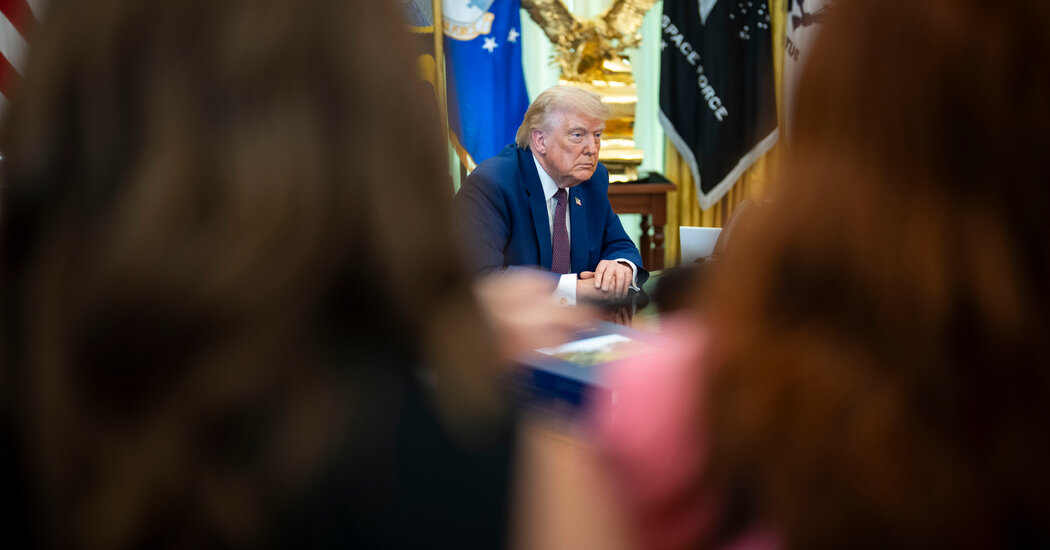
In the high-stakes arena of modern American foreign policy, words spoken behind the Resolute Desk carry the weight of global stability; yet on Wednesday, President Donald J. Trump offered a remarkably casual assessment of the ongoing military campaign in Iran, describing the highly volatile conflict as “not a big thing” for the United States. Speaking to a pool of White House reporters gathered in the Oval Office, the commander-in-chief engaged in what has become a familiar strategy of rhetorical downplaying, holding up indicators of domestic economic strength—most notably a record-setting stock market—to buffer his administration against the mounting human and material costs of the war.
This controversial framing arrives at a highly sensitive moment, as the Pentagon grapples with the loss of at least 13 American service members, while human rights organizations estimate that the aerial bombardment and ground hostilities have claimed the lives of approximately 1,700 Iranian civilians. Beyond the devastating loss of human life, the conflict has severely drained American tactical stockpiles and placed an immense logistical burden on the nation’s armed forces, sparking intense debate among military strategists over the sustainability of this unexpected Middle Eastern theater. Rather than addressing these grim statistics or the strain on the defense establishment, President Trump chose to reframe the military campaign as minor, asserting he was “very proud” of what he characterized as a temporary “detour” in the region.
This rhetorical effort to diminish the gravity of an active theater of war exposes a profound gap between the administration’s confident public posturing and the agonizing reality on the ground, where military families and global observers continue to watch a localized strategy transform into a protracted conflict with regional and global repercussions.
   [U.S. & Allied Forces] ---> Coordinated Air Strikes (Feb 28)
                                |
                                v
   [Avenue of Conflict] ----> Prolonged War of Attrition (3+ Months)
                                |
        +-----------------------+-----------------------+
        |                                               |
        v                                               v
[Human & Material Toll] [Diplomatic Uncertainty]
- 13 U.S. Service Members Lost – Confusing nuclear demands
- ~1,700 Civilian Casualties – Erratic negotiating stances
- Depleted Pentagon Stockpiles – “Boring” diplomatic channels
The Prosperity Metaphor: Disconnecting Market Gains from Main Street Realities
President Trump’s defense of the campaign relied heavily on the performance of Wall Street, as he explicitly linked the resilience of the financial markets to his administration’s handling of the geopolitical crisis. He argued that the ongoing conflict—which he alternatively labeled a “military” engagement and a “war”—had failed to disrupt the American economic engine, suggesting that a booming stock market somehow nullifies the domestic hardships caused by the foreign intervention. In making this connection, the president asserted that consumer costs were actively decreasing across the country, a claim that starkly contradicts the everyday experiences of working-class Americans who are currently bearing the brunt of the war’s economic fallout at the gas pump and the grocery store.
This disconnect was further highlighted when he cited unnamed “great financial people” who allegedly assured him that because 401(k) portfolios were climbing, “everybody’s making a lot of money,” showcasing a worldview that equates elite financial metrics with the economic well-being of the broader public. Rather than demonstrating empathy for families struggling with war-induced inflation and supply chain disruptions, the president has shown an increasing irritation with the public’s concerns, previously stating that he did not consider the financial plight of ordinary Americans when making strategic decisions about the war’s timeline. This political stance was further emphasized in a late-night social media post in which he sharply criticized political opponents and analysts who were “chirping” about the conflict, insouciantly advising the American public to “just sit back and relax” because “it will all work out well in the end.”
| Key Economic Indicators & Public Perception | Administration Rhetoric | Main Street Reality |
|---|---|---|
| Domestic Stock Market | Record highs prove the war is “not a big thing.” | Benefits portfolios, but fails to offset daily living costs. |
| Consumer Price Index (CPI) | Claims that consumer costs are actively coming down. | High energy prices driving up grocery and gasoline bills. |
| Middle-Class Financial Health | Reassurances that 401(k) increases mean “everyone makes money.” | Working-class families bear the brunt of war-induced inflation. |
| Strategic Accountability | Urges the public to “sit back and relax” via social media. | Broad public anxiety over an ambiguous, endless deployment. |
The Broken Promise of Decisive Victory: From Weeks to Months of Attrition
The present state of the conflict stands in stark opposition to the rapid, decisive operation that President Trump and his national security advisors originally described to the American public. When the United States joined forces with Israel to launch a coordinated and aggressive bombing campaign on February 28, the action was framed as a swift, targeted intervention designed to neutralize immediate threats and bring the regime in Tehran to its knees in short order. Instead, the military campaign has dragged on for over three months with no clear resolution in sight, rapidly evolving into a grueling war of attrition that has tested both American strategic patience and the limits of allied cooperation.
As the conflict’s initial objectives—ranging from regime destabilization to an immediate halt of regional proxy activities—have proved increasingly elusive, the administration has steadily shifted its public messaging to cope with the reality of a prolonged deployment. He has consistently dismissed the widespread unpopularity of the war, attempting to craft a narrative of unfolding success out of a military stalemate that has cost billions of dollars and yielded few tangible strategic breakthroughs. By downplaying the drag on defense infrastructure and refusing to acknowledge the shifting goalposts of the deployment, the administration reflects a concerning pattern of entering foreign conflicts with optimistic assumptions, only to struggle to find a viable exit ramp when those assumptions clash with reality.
Behind the Closed Doors of Diplomacy: Chaotic Negotiations and Fragmented Frameworks
While military operations continue to stall on the ground, the administration’s diplomatic efforts have been characterized by rapid shifts between public optimism and apparent personal disinterest. Over the past several weeks, President Trump has repeatedly signaled that the United States and Iran were on the cusp of signing a major peace framework, creating a sense of imminent breakthrough that has yet to gain real diplomatic traction. This narrative peaked last week when the president dramatically announced that he was convening a high-level meeting in the Situation Room to make a “final determination” regarding a historic peace deal, an announcement that ultimately yielded no observable strategic shift or diplomatic breakthrough.
Just days after this ostensible push for peace, the president’s public attitude shifted from urgent engagement to open dismissiveness, as he acknowledged on Monday that he found the actual process of negotiating with Iranian leaders to be “very boring.” This erratic approach to high-stakes diplomacy has been further complicated by the president’s habit of imposing numerous deadlines on Tehran while simultaneously sending mixed signals about where negotiations actually stand. The administration’s demand that any valid peace agreement must permanently prevent Iran from developing nuclear weapons remains a central pillar of its policy, yet the lack of a cohesive diplomatic strategy and the open disdain for the slow work of international negotiation have left both allies and adversaries unsure of Washington’s true goals.
The Strategic Muddle of Non-Proliferation: Conflicting Demands and Overrated Milestones
Nowhere is the administration’s rhetorical inconsistency more apparent than in its handling of the crucial issue of Iran’s nuclear capabilities and enriched uranium stockpiles. When questioned about his previous claim that a peace deal would involve the physical removal of Iran’s enriched uranium—a vital step in preventing the acquisition of a nuclear weapon—President Trump offered a confusing defense, asserting that while Iran had agreed to the condition, the entire operation was ultimately “very overrated.” In a self-effacing yet perplexing admission, the president stated that he was the one who had inflated the importance of the uranium removal, noting that while it mattered to him, it was deemed unimportant by others, thereby undermining the strategic significance of a key non-proliferation benchmark.
                            [Nuclear Negotiations]
                                      |
            +-------------------------+-------------------------+
            |                                                   |
            v                                                   v
[Strategic Contradictions]                            [Verified Security Standards]
 - Demands enrichment halts                            - Uncertain verification terms
 - Minimizes uranium removals                          - Vague bans on "buying" vs "making"
 - Labeled operations "overrated"                      - Lack of standard treaty oversight
This muddling of core policy objectives continued as the president delivered back-to-back statements that simultaneously claimed a breakthrough and walked it back in the same breath. After confidently stating that the U.S. had successfully stopped Iran from obtaining a nuclear weapon because they had already agreed to it, he quickly corrected himself to clarify that they would agree to it only “if they sign the agreement.” He went on to describe complex and confusing distinctions between whether current diplomatic talks centered on preventing Iran from developing a bomb versus purchasing one, ultimately claiming victory on the issue of purchasing—provided, of course, that “they sign the paper.” This dizzying back-and-forth highlights the fluid, often chaotic nature of the administration’s strategic communications, where critical national security objectives are treated as negotiable rhetorical points rather than fixed pillars of international arms control.
An Uncertain Path Forward: Navigating Between Annihilation and Paper Peace
As the United States looks toward the future of this unresolved conflict, the administration’s strategy remains a volatile mix of severe military threats and open-ended patience. President Trump has continued to swing between threatening total destruction of the Iranian state and expressing a willingness to wait out the diplomatic process, leaving military commanders, foreign allies, and the American public in a state of constant uncertainty. This strategic ambiguity was on full display when the president casually noted that the military possessed the capability to “wipe everybody out” within a matter of weeks, asserting that commanders on the ground were eager and ready to execute such an extreme option.
While he stated a preference for avoiding such a devastating escalation in favor of securing a written peace agreement, his casual framing of absolute destruction as an “easy” alternative highlights the high-stakes brinkmanship that defines his administration’s foreign policy. This volatile approach, combining devastating military capabilities with unpredictable diplomatic overtures, leaves the ultimate outcome of the conflict deeply uncertain. With military forces prepared for a long halt and the president preferring a simplified, transactional approach to complex international relations, the American public is left to wonder how long this “detour” will last, and what the ultimate cost of this unconventional geopolitical strategy will be.