





The Lingering Shadows of Political Rivalry
In the swirling tempest of American politics, where every word can ignite a wildfire, President Donald Trump unleashed a barrage of accusations that cut deep into the heart of partisan divide. Over a year into his second term, amidst swirling scandals and economic ups and downs, Trump’s feud with House Minority Leader Hakeem Jeffries had simmered like a pot ready to boil over. Jeffries, the sharp-tongued Democrat from New York, had been a vocal critic of Trump’s policies, championing progressive causes with the fervor of someone who grew up in the corridors of Brooklyn’s ambitious dreamers. But on this fateful Thursday, things escalated in a way that blurred the lines between heated rhetoric and real danger. Trump, ever the showman with his 12.6 million Truth Social followers as his audience, pointed fingers at Jeffries for what he deemed an unforgivable sin: inciting an assassination attempt. It wasn’t just politics anymore; it felt personal, like a family spat turning lethal. As word spread, people across the country paused their dinners to check their feeds, wondering if this was the point where words could truly spill blood. The incident traced back to April, during the high-society glamour of the White House Correspondents’ Association Dinner, where an intruder named Cole Allen breached a Secret Service checkpoint at the Washington Hilton. Guns were drawn, chaos ensued, and Trump was whisked to safety, his security detail springing into action like guardians from a thriller novel. But Trump didn’t see coincidence; he saw causation, a direct line from Jeffries’ fiery words to this near-tragedy. It heightened tensions in a nation already polarized, where trust in leaders feltered like autumn leaves. Jeffries, a man who climbed the ranks from community advocacy to congressional powerhouse, must have felt the weight of history on his shoulders—echoing times when politicians’ language led to unspeakable acts. Yet, Trump’s fury wasn’t isolated; it reflected the raw underbelly of democracy, where words are weapons and leaders are both targets and accusers. As families gathered around tables, heads buzzing with debates, this clash reminded everyone that in the game of power, words could be as deadly as bullets, and every accusation carried the potential to rewrite narratives and lives.
Trump’s Scathing Post and the Visual Crusade
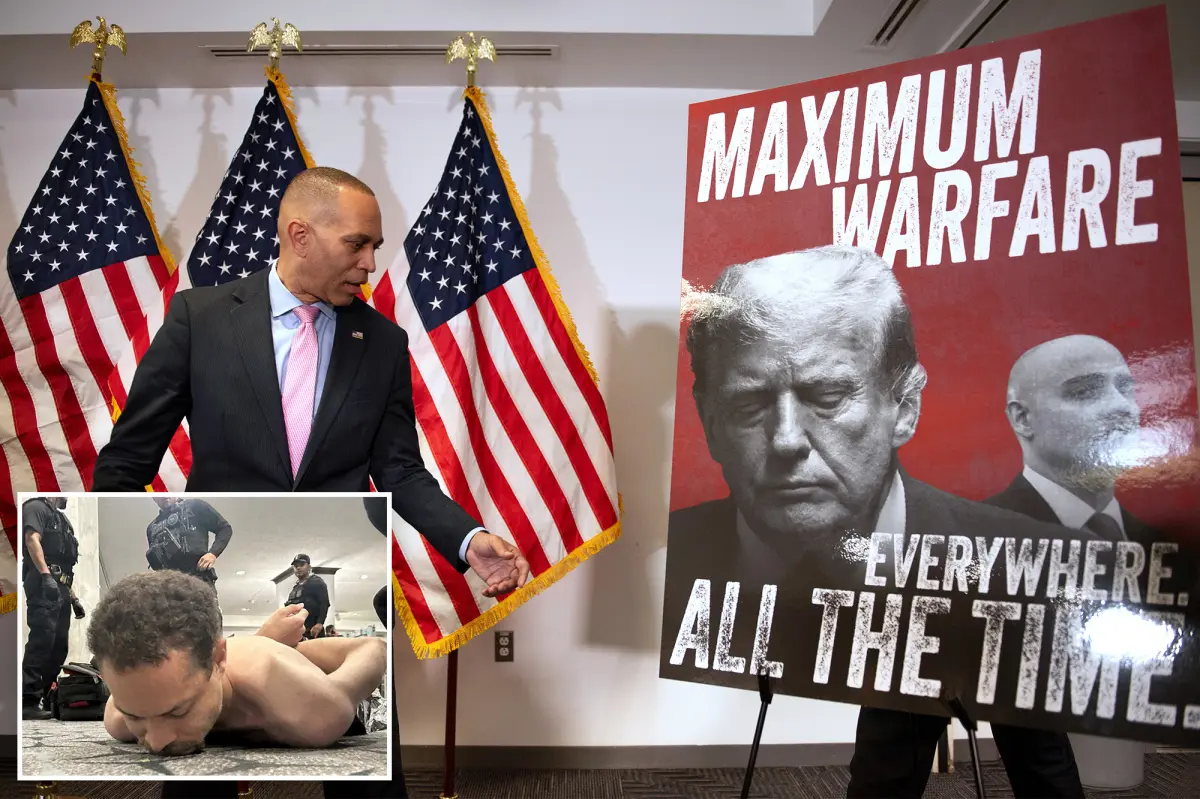
Trump’s fingers danced across his phone screen that evening, crafting a post that would reverberate through the digital halls of Truth Social. He didn’t hold back, labeling Jeffries a “lunatic” and a “Low IQ” figure, terms that stung like venom from an old grudge. With unbridled passion, he demanded Jeffries’ arrest for inciting violence, painting a picture so vivid it felt like a courtroom drama unfolding in real time. Attached were images that told a story, or at least Trump’s version of it: Jeffries standing proud with a sign proclaiming “maximum warfare,” his face juxtaposed against the likenesses of Trump and his aide, James Blair. Just three days later, the screen showed alleged assassin Cole Allen, gun in hand, charging through the scene at the Hilton like a character bursting from a suspense novel. “This lunatic, Hakeem ‘Low IQ’ Jeffries, should be charged with INCITING VIOLENCE!” the post blared, challenging his followers with the weighty question: “Should Hakeem Jeffries be charged with inciting violence?” For Trump’s supporters, it was manna from heaven, a rallying cry that reinforced their loyalty and fueled the narrative that Democrats were not just opponents but threats. Trump, the billionaire-turned-president with a knack for spectacle, had mastered the art of the incendiary tweet, but this felt different—edgier, more accusatory. In the quiet moments of his day, perhaps while gazing out at the Washington skyline from the Oval Office, Trump reflected on the personal toll: the bodyguard’s vigilance, the sleepless nights worrying about his family. He wasn’t just pointing fingers; he was defending his legacy, his very life. To detractors, it seemed like deflection from pressing issues like soaring gas prices and economic woes, but to him, it was justice served cold. As the post gained traction, it sparked debates in coffee shops and online forums, where ordinary Americans weighed in. Was this truth or theater? Conspiracy theorists scribbled notes, while moderates sighed, longing for a politics of unity. Trump’s world, always theatrical, now felt like a powder keg, with each like and share adding to the fuse.
Jeffries Strikes Back with Indignation
Across town in the bustling hub of Democratic strategists, House Minority Leader Hakeem Jeffries read Trump’s words with a mix of frustration and resolve. A man shaped by his roots in New York’s diverse communities, Jeffries had always seen himself as a unifier, bridging divides in a party desperate for strong voices. But Trump’s accusation hit him like a punch to the gut, accusing him of fueling an assassination attempt. He wasn’t about to let that stand, so his spokesperson directed media to a swift rejoinder on X, where Jeffries called Trump’s rant “another deranged rant.” It was a calculated move, deflecting the heat by steering the conversation back to what mattered to everyday folks: the economy. “Gas prices are sky high, grocery bills are surging, and families can’t catch a break,” he wrote, his words resonating with parents budgeting for groceries, truckers filling up tanks, and small business owners drowning in costs. This wasn’t just politics; it was empathy, a reminder that leaders were human, too, feeling the same squeeze as the people they represented. Jeffries, with his charismatic delivery and policy acumen, had long advocated for affordable living, championing initiatives that could ease the burden. Trump’s attacks, he implied, were distractions from real progress, as Democrats geared up for potential House wins. In private, Jeffries might have paced his office, thinking of his own family—his wife and kids—and how close calls like the Hilton incident affected everyone. But publicly, he stood firm, not backing down from the fight. This exchange encapsulated the broader drama: two leaders, each battling for the soul of the nation, their feud a microcosm of a divided electorate. As the digital dust settled, followers pondered the true cost of such rhetoric, wondering if leaders like Jeffries and Trump could ever rise above the fray and foster genuine dialogue.
Defending the Flames of Partisan Battle
The saga didn’t end with that single post; it delved deeper into the history of words and warfare in American discourse. Just days after the initial backlash in late April, Jeffries had already defended his controversial “maximum warfare” declaration, brushing off GOP criticism with defiant flair. “I don’t give a damn about your criticism,” he shot back at Republicans, his voice carrying the unyielding spirit of a boxer who refuses to yield. Standing at a press conference, surrounded by cameras and eager journalists, Jeffries explained the phrase’s origins in the gritty arena of nationwide redistricting battles. It was a term, he claimed, first wielded by an anonymous White House staffer during a New York Times interview last summer— not his invention, but a reflection he adopted. “That phrase ‘maximum warfare everywhere, all the time’ came from the White House in the summer of 2023, when they started this redistricting battle,” he asserted, redirecting the blame like a skilled politician. This, he argued, was the GOP’s hypocritical outrage; they ignited the fire, and now Democrats were finishing the fight. His words evoked the passionate struggles of generations past, where communities rallied for fair representation, drawing lines on maps that could dictate futures. Jeffries, inspired by civil rights icons, saw this as a continuation of that legacy, a way to combat gerrymandering that favored Republicans with twisted districts. Yet, in his defense, there was a humanity—a man who had watched friends lose elections due to rigged lines, feeling the sting of unfair play. To him, “maximum warfare” wasn’t about violence; it was about relentless advocacy, pushing back against power imbalances. As audiences listened, they glimpsed the emotion behind the rhetoric: the frustration of playing on an uneven field, the hope of leveling it. It humanized Jeffries, turning him from a distant figure into someone fighting for justice, much like everyday activists who knock on doors and make calls. In this narrative, the feud wasn’t just elitist bickering; it was a battle for the heart of democracy, where words shaped not just policies but the very fabric of fairness.
Tracing the “Maximum Warfare” Roots
Digging deeper, the phrase “maximum warfare” revealed a tale of whispers and escalation in the halls of power. According to Jeffries, it all stemmed from that fateful 2023 New York Times interview, where a shadowy White House insider—likely someone close to Trump’s inner circle—warned Democrats of impending gerrymander onslaughts. ‘”Maximum warfare everywhere, all the time'” echoed through the article, a metaphor for the all-out assault on election maps that Republicans were preparing. Jeffries recalled those words vividly, feeling them like a gauntlet thrown down. The context was redistricting, a decennial process where states redraw congressional lines, often twisting them to favor one party. Republicans, with their data-driven strategists and legal battles, had mastered this art, aiming to lock in advantages post-2020 census. Democrats, including Jeffries, vowed not to concede, turning the phrase back on its originators. “And now they’re big mad because Democrats have decided to finish it. Get lost,” Jeffries declared at that news conference, his Brooklyn grit shining through. It painted a picture of political combat zones, where maps became battlefields and votes the spoils. For those unfamiliar, redistricting wasn’t abstract; it affected neighbors, deciding who represented them and influencing everything from healthcare funding to environmental protections. Families across America could relate—perhaps recalling local elections where lines seemed drawn unjustly, splitting communities or silencing voices. Jeffries’ adoption of the term wasn’t born of malice but necessity, a rallying cry for reformers tired of losing. In reflecting on this, one could imagine the long nights Jeffries spent absorbing policy briefs, strategizing with aides, dreaming of a fairer system. Yet, it also underscored the irony: a phrase meant to intimidate had inadvertently fueled Trump’s narrative, blurring lines between metaphor and menace. This backstory added layers, transforming a simple accusation into a saga of origin, where even anonymous words carried the weight of accountability.
A Pledge Against Violence Amid Rhetoric
Despite the heat of his language, Hakeem Jeffries drew a firm line in the sand against political violence, refusing to backtrack while emphasizing the need for measured discourse. Appearing on “Fox News Sunday” last month, he spoke earnestly about lawmakers setting “the most appropriate example” in their words, a call to action in an era rife with rising threats. “Whatever your ideological perspective is, we all love America, and we all want to make sure that this country is the best that it can possibly be,” he said, his voice laced with patriotism and hope. It was a moment of vulnerability, revealing a leader who grappled with his role in a volatile landscape. Jeffries had consistently opposed all forms of violence, advocating for unity even as he wielded sharp rhetoric against opponents. In his eyes, fiery words like “maximum warfare” amplified debates without crossing into harm; they were tools of democracy, igniting passion without endorsing peril. Yet, the assassination scare at the Hilton loomed large, a reminder that rhetoric’s edge could inspire dangerous actions. Jeffries must have reflected on this personally—perhaps thinking of his own security, the impact on his constituents, and the families scarred by political unrest. This stance humanized him further: not a firebrand for mayhem, but a dedicated public servant navigating peril to uphold values. As the nation watched, it underscored a broader truth—that in polarized times, leaders must balance conviction with caution, fostering dialogue over division. Ordinary people, tuning in from living rooms across the spectrum, appreciated this nuance, seeing Jeffries as someone striving for a better America despite the chaos. The feud with Trump, while incendiary, highlighted the human stakes: forgiveness, accountability, and the pursuit of a more perfect union. In the quiet aftermath, as debates raged on, Jeffries’ words offered a path forward, urging all to cherish the nation they shared and work tirelessly to elevate it.