



# Trump’s War on the Media Escalates: A Deep Dive into the Endorsement Battle
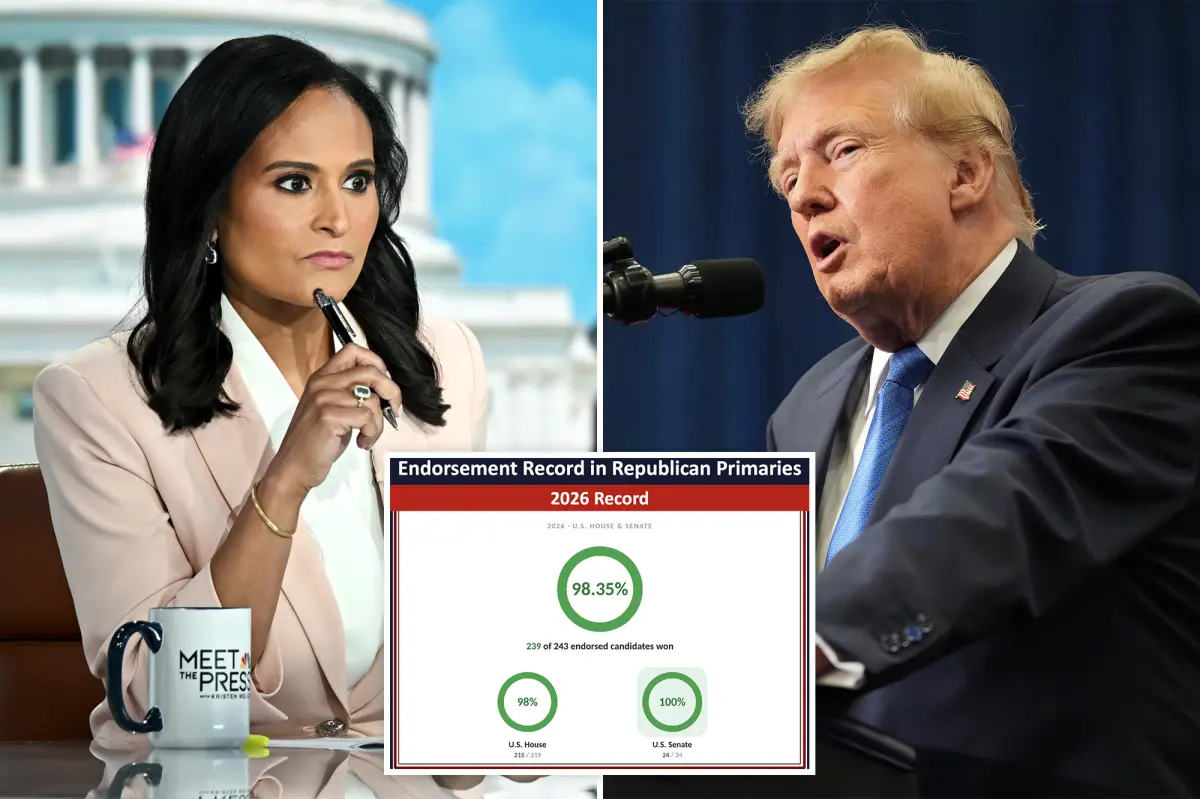
In a fiery weekend outburst that has sent shockwaves through the political media landscape, former President Donald Trump launched yet another blistering attack on NBC’s “Meet the Press” anchor Kristen Welker, demanding that FCC Commissioner Brendan Carr take punitive action against the network. The former president’s rage was ignited by Welker’s characterization of his endorsement record as having “mixed results” in recent Republican primary elections — a characterization that Trump vehemently disputes, claiming instead that his endorsement track record represents nothing less than “the strongest Endorsement in the History of Politics.” This latest confrontation represents just another chapter in Trump’s increasingly contentious relationship with mainstream media outlets, which he has consistently accused of unfair coverage and biased reporting since his emergence on the national political scene in 2015.
The specific objection raised by Trump centers on Welker’s on-air assessment during the Sunday morning political talk show, where she suggested that his endorsement record has been inconsistent in the current election cycle. Trump, never one to accept criticism without a fight, immediately took to his Truth Social platform to demand that the federal government intervene, arguing that NBC’s use of publicly owned airwaves should come with strings attached regarding their journalistic content. The former president’s demand for government intervention against a news organization raises significant First Amendment concerns, yet it follows a pattern of behavior that has become increasingly common from Trump — using the levers of government power to intimidate and punish media outlets that displease him. This strategy has been particularly evident in his repeated calls for the revocation of broadcast licenses, a threat that hangs over the heads of network executives who must balance their journalistic responsibilities against the very real possibility of government retaliation.
Welker’s initial reporting was based on a comprehensive analysis conducted by Ballotpedia, a nonpartisan political tracking organization, which examined Trump’s endorsement pattern throughout the current election cycle. According to this data, Trump had made approximately 313 endorsements across various races, with a success rate hovering around 96 percent — a number that on its surface appears overwhelmingly positive. However, the “mixed results” characterization came from a closer examination of the nature of these endorsements, as many of Trump’s picks were in races where he had backed incumbents or candidates who were already heavily favored to win their primaries. When the analysis focused specifically on contested races where Trump’s endorsement could genuinely tip the scales, the results told a more nuanced story — one that suggested his kingmaker status within the Republican Party, while still significant, was not quite as infallible as both Trump and his supporters would like to believe.
Trump’s response to this more complex picture has been characteristically defiant, pointing to his victories in contested Senate races in Texas, Louisiana, and South Carolina as evidence of his continued dominance over Republican primary voters. Yet even this selective reading of his record omits the notable setbacks that have occurred alongside these successes — instances where Republican voters chose to buck Trump’s wishes and select other candidates despite his public support for their opponents. These defeats, while representing a small percentage of his overall endorsement portfolio, have become meaningful data points for political analysts attempting to gauge Trump’s actual influence in the post-presidency era. The narrative becomes even more complicated when examining specific cases, such as his backing of Representative Cory Mills in Florida, who managed to survive his primary despite questions about his conduct in office, or the senator from South Carolina who benefited from Trump’s endorsement in ways that seemed to contradict the former president’s stated commitment to challenging the Republican establishment.
The broader context of Trump’s attack on Welker and NBC must be understood within his long-running feud with the network’s parent company, which he has repeatedly accused of harboring anti-Trump bias in its news coverage. This particular escalation, however, marks a significant departure from mere rhetorical attacks, as Trump is now explicitly calling for regulatory action against a specific journalist by name, demanding that her reporting be investigated and that she face consequences for her coverage. The demand that FCC Commissioner Carr take action against NBC represents a dangerous crossing of the line that separates legitimate criticism from government intimidation of the press, yet it follows a pattern that became familiar during Trump’s presidency. His administration’s FCC did not ultimately revoke any broadcast licenses, but the threat alone served its purpose of creating an atmosphere of fear and uncertainty among media organizations, potentially influencing their editorial decisions through the implicit threat of regulatory retaliation.
Trump’s characterization of his endorsement power as unprecedented in American political history requires examination of the actual mechanics of how his endorsements function in modern Republican primaries. The former president’s base remains extraordinarily loyal, and his endorsement can provide candidates with instant name recognition, fundraising capabilities, and a built-in army of supporters who will campaign on their behalf. However, the value of a Trump endorsement has fluctuated based on the specific circumstances of individual races, including the quality of the candidate he backs, the political dynamics of the district or state in question, and the strength of any opposition that might emerge. In races where Trump endorses an incumbent who faces a well-funded challenge from the right, his endorsement can be the difference between victory and defeat. In other situations, particularly where local issues or candidate quality dominate the conversation, Trump’s endorsement has proven less decisive than he would like to claim, creating the “mixed results” that Welker described in her reporting.
The attack on Welker also needs to be understood in light of her professional background, which includes extensive experience covering the White House and a reputation for asking tough but fair questions of politicians from both parties. Her approach to the endorsement story was consistent with standard journalistic practice — presenting data that showed both successes and failures while contextualizing that information to provide viewers with a complete picture of Trump’s actual influence. By attacking her personally and demanding government action against her employer, Trump is attempting to delegitimize unfavorable coverage through intimidation rather than engaging with the substance of the reporting. This strategy has become increasingly common across right-wing media, where journalists who report inconvenient facts about Trump or other conservative figures are frequently characterized as enemies of the people who deserve punishment rather than professionals doing their jobs.
The demand for FCC intervention against NBC must also be viewed within the context of Chair Carr’s political positioning and his own statements about media regulation. Carr, who was appointed by Trump and has been floated as a potential future candidate for office, has previously expressed sympathy with conservative complaints about media bias and has signaled openness to using the commission’s regulatory power to address these concerns. This alignment between Trump’s demands and Carr’s apparent predispositions creates a concerning dynamic where the government’s regulatory apparatus could potentially be weaponized against journalists whose reporting does not conform to the preferred narrative of those in power. The First Amendment’s protections for press freedom are designed precisely to prevent this kind of government interference, but those protections only work if regulators and politicians are willing to respect them, even when doing so means tolerating coverage they find objectionable or unfair.
Beyond the immediate controversy over Welker’s reporting, this incident reveals deeper tensions within American media and politics that show no signs of abating in the foreseeable future. Trump has consistently refused to acknowledge any legitimacy in media coverage that does not align with his self-perception, and he has built a political identity that depends on positioning himself as the victim of a supposedly corrupt and hostile press establishment. This narrative has proven extraordinarily effective with his political base, who have adopted his framing of mainstream media as an enemy of the American people. The danger in this approach, however, lies in its cumulative effect on democratic institutions and the public discourse upon which democracy depends. When a political leader consistently attacks the media’s credibility and calls for government action against specific journalists, it inevitably undermines public confidence in the free press as an institution, even if those attacks do not result in direct government action against any individual outlet.
The specific statistics that Trump cited in his defense — a 96 percent success rate across 313 endorsements, with a claimed 100 percent record in Senate primaries and 98 percent in House primaries — demonstrate his determination to frame his record in the most favorable possible light. But these numbers obscure significant caveats, including the number of races where his endorsement went to candidates who faced no serious opposition or who were running in such safely Republican districts that the outcome was never genuinely in doubt. When examining competitive races where Trump’s endorsement might have made a meaningful difference, the picture becomes considerably more mixed. The defeats Trump has suffered in races like Georgia’s governor primary and various House contests across the country suggest that his endorsement power, while substantial, is not absolute, and that Republican voters are increasingly willing to make their own choices in certain circumstances, particularly when local issues or candidate quality trump national considerations.
The substitution and marginalization of some candidates that led to these losses also highlights a tension within the Trump political coalition that has become more pronounced in recent cycles. Trump’s endorsement tends to favor candidates who demonstrate absolute loyalty to him personally, even when those candidates may be weaker general election contenders or may struggle to appeal beyond the most committed Trump supporters. This dynamic has created friction with more traditional Republican Party leaders who worried about the party’s ability to win general elections with candidates who are closely identified with Trump’s more controversial positions and rhetorical style. The tension between satisfying Trump’s base and winning the broader coalition needed for general election success represents an ongoing challenge for the party as it attempts to navigate the post-Trump era while maintaining his support.
The immediate practical impact of Trump’s latest attack on Welker remains to be seen, though the pattern suggests that NBC will likely issue some form of statement defending her reporting while perhaps offering some limited response to Trump’s specific criticisms. The former president’s calls for her punishment are unlikely to result in actual government action, as even a Trump-appointed FCC would face significant legal and practical barriers to revoking a network’s license over the content of its news coverage. However, the attack itself serves multiple purposes for Trump: it reinforces his narrative of victimization for his base, it creates a chilling effect on other journalists who may now think twice before reporting unflattering information about him, and it keeps him in the news cycle and at the center of political attention. For Welker and other journalists who cover Trump, the challenge is to continue doing their jobs professionally while navigating an environment where their reporting can trigger personal attacks and demands for government intervention.
This latest incident ultimately reflects the broader crisis of trust in American media and the increasingly adversarial relationship between political power and the press that has developed over the past several years. While Trump’s specific demands for FCC action against NBC may not be immediately successful, they contribute to a larger climate in which attacks on journalism from all sides of the political spectrum have become normalized. The long-term consequences of this dynamic for American democracy remain uncertain, but the pattern raises troubling questions about the sustainability of a political system in which a major party’s most prominent figure routinely characterizes professional journalism as an enemy to be suppressed rather than a legitimate check on power. As the nation moves into the next election cycle, these tensions promise only to intensify, and the ability of journalists to continue reporting accurately on powerful figures without fear of retaliation will remain a defining test of American democratic institutions.
The request from Trump that Carr “rebuke or punish” Welker represents an unprecedented demand, one that even his own administration did not attempt to execute during his presidency, despite repeated threats and posturing. While the FCC does have regulatory authority over broadcast licenses, the Supreme Court has consistently upheld the principle that government cannot dictate the content of news coverage, and any attempt to punish a broadcaster for its editorial decisions would almost certainly face successful legal challenge. The fact that Trump continues to make these demands despite their likely illegality suggests that they are primarily rhetorical in nature — designed to energize his base and intimidate his critics rather than to achieve actual regulatory outcomes. But even if Trump never succeeds in persuading the government to take action against the media outlets that criticize him, the cumulative effect of his attacks has already altered the landscape in subtle ways, making news organizations more defensive in their coverage and more cautious in their editorial decisions when it comes to stories about Trump that might trigger another round of attacks.
As the political world digests Trump’s latest eruption, the debate over his endorsement record continues among political analysts who seek to understand the actual extent of his influence over Republican voters. The data from Ballotpedia paints a picture of a political figure who remains extraordinarily influential within his party, but whose power has limits that he is unwilling to acknowledge. The “mixed results” characterization that triggered Trump’s attack represents an accurate assessment of an endorsement record that includes both impressive victories and notable defeats. By demanding that the federal government punish a journalist for accurately reporting this reality, Trump is attempting to rewrite the facts to match his preferred narrative. Whether he will succeed in this effort depends on whether journalists remain willing to report the truth in the face of unprecedented pressure and intimidation, and whether the institutions responsible for protecting press freedom remain strong enough to withstand the assault from the nation’s most powerful political figure.
The controversy surrounding Trump’s attack on Welker ultimately reveals as much about the state of American media as it does about the former president’s grievance politics. The lines between news reporting, commentary, and political advocacy have become increasingly blurred in recent years, creating an environment where every media outlet is viewed through a partisan lens and where accusations of bias have become standard weapons in political combat. Trump’s willingness to use the full power of his platform to attack individual journalists represents a level of personal confrontation that pushes the boundaries of acceptable political discourse, even by contemporary standards. Whether this approach ultimately serves his political interests or whether it generates a backlash that undermines his influence remains an open question, but the immediate consequences are clear: another round of sharp polarization, another occasion for partisan warfare, and yet another journalistic professional caught in the crossfire of Trump’s ongoing war against the media.