





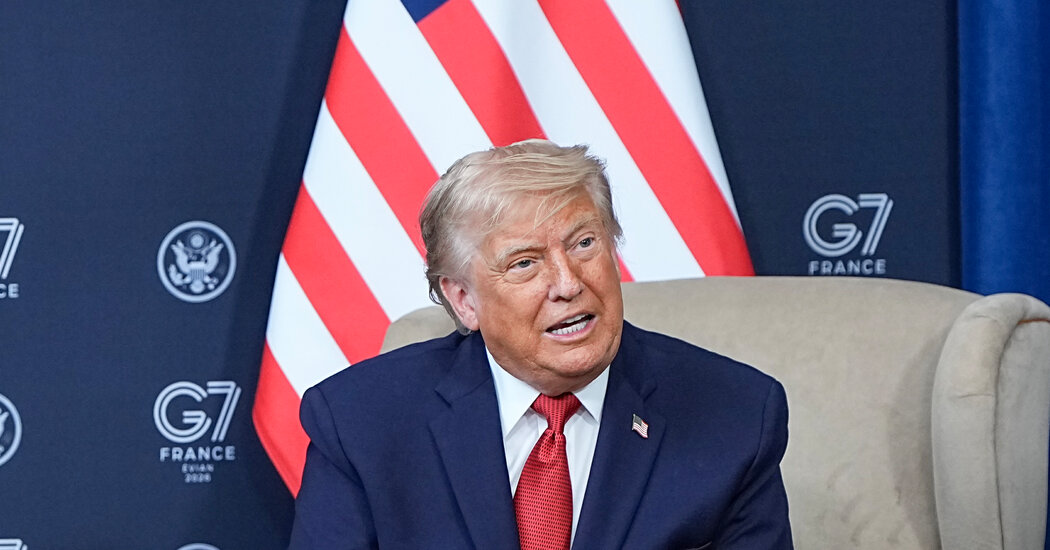
Against the picturesque and highly civilized backdrop of Biarritz, France, where the leaders of the world’s most powerful democracies gathered for the final day of the Group of Seven summit, a deeply personal and geopolitical drama unfolded as President Donald Trump fiercely defended his administration’s emerging peace agreement with Iran. Far from the quiet, calculating whispers typical of high-stakes international diplomacy, Trump’s defense was marked by a raw, unfiltered intensity that laid bare his long-standing, obsessive rivalry with his predecessor, Barack Obama. For Trump, this new memorandum of understanding was not merely a diplomatic triumph; it was a personal vindication, a chance to definitively rewrite the narrative of American foreign policy in the Middle East. He passionately insisted to a packed room of journalists that, unlike the landmark nuclear pact negotiated in 2015, his deal did not involve the United States paying off Tehran or offering premature, unearned concessions. The atmosphere in the briefing room crackled with a palpable tension as Trump sought to convince both the press corps and a skeptical global public that he had succeeded where others had failed. By painting himself as the ultimate, uncompromising negotiator who could tame one of America’s most enduring adversaries without sacrificing American capital, Trump exposed a deeply human aspect of high-office politics. This press conference was not just an announcement of statecraft; it was a manifestation of the intense, personal drive for legacy and validation that often shapes global affairs. Through his animated gestures and sharp retorts, the President made it clear that the upcoming agreement was a direct reflection of his personal strength, setting up a stark psychological contrast between his own self-styled pragmatism and the perceived weakness of the previous administration’s diplomatic efforts. He wanted the world to understand that this was a new era of American dominance, where deals were struck on Washington’s terms alone, free from the conciliatory tones of the past.
The credibility of this new diplomatic breakthrough, however, was immediately clouded by a wave of conflicting messages bubbling up from within the Trump administration itself, highlighting the chaotic internal dynamics of modern governance. Only days prior, Vice President JD Vance had publicly suggested to national broadcasters that Iran might indeed gain access to a staggering $300 billion reconstruction fund as part of the broader package, a revelation that sparked widespread confusion and concern among foreign policy observers. When confronted with these contradictory statements by the press in France, Trump flatly dismissed the notion of a U.S.-funded reconstruction effort, calling the reports entirely false and reiterating that America would not be investing even a single dime of taxpayer money. Yet, in a characteristically pragmatic twist of logic, Trump did not entirely rule out the flow of massive capital into Iran; instead, he shifted the financial responsibility onto third-party international actors, particularly the wealthy oil nations of the Persian Gulf. He argued that if foreign allies or regional neighbors wished to pour their own resources into Iranian infrastructure, the United States had no ethical or legal obligation to stop them, effectively farming out the financial burden of stabilizing the region while claiming clean hands for his own treasury. This rhetorical pivot revealed a president grappling with the complex realities of global economics: understanding that peace requires financial incentives, yet politically constrained by his promise to always put America’s financial interests first. The resulting policy ambiguity left foreign allies and domestic citizens alike trying to parse the true cost of peace, demonstrating how the human messiness of administrative infighting and executive backtracking can obscure even the most monumental diplomatic initiatives. In trying to navigate this delicate balance, Trump sought to project absolute clarity while simultaneously introducing a layer of strategic ambiguity that has come to define his approach to international relations. By asserting that other countries were free to invest if they chose to do so, he essentially decoupled the concept of regional stabilization from American taxpayer funding, a move designed to appease his domestic political base while keeping the door open for international partners to rebuild a devastated Iranian economy. This created a fascinating paradox where the administration seemed to speak with multiple voices at once, leaving diplomats worldwide scrambling to figure out whether Vance’s detailed projections or Trump’s vehement denials represented the actual roadmap for the future. The sheer disconnect between the President and his second-in-command highlighted the human challenges of coordinating a coherent foreign policy in an environment where personal branding and political messaging often collide with the intricate gears of statecraft. Ultimately, this friction served as a reminder that behind the grand announcements of global treaties lies a volatile human landscape where leaders must constantly negotiate not just with foreign adversaries, but with the competing factions and voices within their own government walls.
At the heart of the current agreement lies a critical, real-world compromise that carries immense consequences for global commerce, maritime security, and the everyday lives of thousands of merchant sailors navigating the treacherous waters of the Middle East. The immediate, tangible centerpiece of the upcoming memorandum of understanding, scheduled for its official signing on Friday, is the reopening of the Strait of Hormuz—the vital maritime artery through which a massive portion of the world’s petroleum supplies must pass daily. For months, escalating tensions and hostile actions in these narrow waters had sent shockwaves through global energy markets, threatening the livelihoods of working-class families worldwide who rely on stable fuel prices. By prioritizing the pacification of this volatile shipping corridor, Trump targeted a highly visible, economically vital objective that could yield instant benefits for the international community. However, this immediate success is tempered by a profound sense of long-term uncertainty, as the most complex and dangerous aspects of the bilateral relationship—namely, the future of Iran’s nuclear development program—have been pointedly left out of the initial framework. Instead, these existential threats have been kicked down the road, relegated to an intense, high-stakes sixty-day negotiating window that will commence immediately after the signing ceremony. This two-phase approach creates a fragile peace, offering immediate commercial relief while forcing the global public to live under the shadow of a ticking clock. It illustrates the human compromise of diplomacy, where negotiators must often settle for temporary, practical victories, such as securing trade routes and lowering oil prices, while leaving the terrifying threat of catastrophic conflict to be resolved by future, highly uncertain deliberations. This precarious arrangement highlights the delicate tightrope walk of international diplomacy, where long-term security is frequently traded for immediate regional stability. For the sailors and shipping crews who risk their lives traversing the Strait of Hormuz, the reopening of the waterway represents a profound personal relief, transforming a zone of constant military dread back into a functional channel of commerce. Yet, for global security analysts and the citizens of neighboring nations, the sixty-day countdown serves as a source of intense anxiety, a reminder that the underlying causes of the conflict remain completely unresolved. This structural division of the agreement showcases how modern treaties are often built on a foundation of delayed confrontation, allowing leaders to claim historic breakthroughs today while leaving the truly agonizing work of nuclear disarmament for tomorrow. It exposes the deeply human tendency to prioritize immediate relief over permanent resolution, setting up a dramatic, time-bound countdown where the ultimate survival of the peace agreement will depend entirely on the ability of both nations to find common ground in a matter of weeks.
To fully comprehend the depth of Trump’s intense emotional investment in this deal, one must look back at the enduring, bitter grievances surrounding the Obama-era joint agreement, which has long served as a central focal point for Trump’s political identity. Few foreign policy decisions have animated the President and his supporters as intensely as the 2015 nuclear deal, particularly the highly controversial transfer of $1.7 billion in physical cash to Tehran shortly after the agreement was finalized. During his remarks in France, Trump’s long-simmering resentment erupted into an expletive-laden tirade, during which he vividly recounted how Iranian officials had supposedly mocked his predecessor, calling Obama a “stupid son of a bitch” for agreeing to such generous terms. This vulgar, raw outburst offered a rare, unvarnished window into the psychological forces driving Trump’s foreign policy agenda, where international relations are viewed not as dry legal agreements, but as direct tests of personal respect, masculinity, and national pride. While historians and former administration officials have long pointed out that the $1.7 billion cash payment was actually the settlement of a decades-old legal debt regarding undelivered military equipment, and that it was dwarfed by the unfreezing of over $50 billion in Iranian foreign assets, Trump’s focus remained squarely on the visceral, humiliating imagery of pallets of physical currency being delivered to a hostile regime. By framing the past agreement as a national embarrassment where America was openly laughed at by foreign adversaries, Trump positioned his own, highly secretive negotiation style as a necessary act of national restoration. This personal crusade to erase the perceived humiliation of the past reveals how deeply human emotions like pride, shame, and the desire for respect can dictate the course of global history, often overshadowing dry financial calculations and complex legal precedents.
Even as Trump passionately defended the merits and strength of his newly forged agreement, he laid bare the terrifyingly thin line that separates modern diplomacy from catastrophic military violence, utilizing language that was as shocking as it was revealing. In one of the most remarkable moments of his press conference, the President openly acknowledged that this agreement was far from a permanent peaceful resolution, explaining with chilling candor that if he became dissatisfied with how the terms were being executed, or if Iran failed to meet his high expectations, he would not hesitate to resume active hostilities. With the direct, menacing promise that “we’ll go right back to dropping bombs right smack in the middle of their head,” Trump illustrated a doctrine of peace through sheer intimidation, using the threat of complete physical devastation as his primary diplomatic leverage. This raw, brutal language stripped away the polite, sanitized euphemisms of professional statecraft, exposing the grim reality of military power that always looms behind the negotiating table. For the millions of ordinary citizens living in the Middle East, as well as the families of American service members stationed in the region, such casual threats of catastrophic violence are not mere rhetorical posturing; they represent a terrifying, existential reality where their safety and survival hang on the volatile temperament of a single world leader. By framing the choice for Iran as either absolute obedience or immediate, devastating aerial bombardment, Trump highlighted the immense, frightening responsibility of executive decision-making, where a failure of diplomacy does not just mean a return to the drawing board, but the potential loss of countless human lives in an instant. This terrifyingly direct approach to diplomatic negotiations serves as a stark reminder of the human cost of modern geopolitical standoffs. It creates a high-pressure dynamic where foreign leaders must negotiate with a virtual gun to their heads, leaving very little room for the traditional, face-saving compromises that typically facilitate long-term international harmony. By keeping the threat of devastating military action at the absolute forefront of his diplomatic strategy, Trump sought to project an image of absolute strength and unpredictability, calculated to keep his adversaries off balance. Yet, this strategy also carries immense risks of accidental escalation, where a minor misunderstanding or a perceived slight could easily trigger a catastrophic conflict. The human anxiety generated by such aggressive rhetoric extends far beyond the diplomatic corridors of Washington and Tehran, echoing through the lives of everyday citizens who must live with the constant, unsettling knowledge that the fragile peace maintaining their daily lives could be instantly shattered by a single, impulsive presidential command.
Despite the looming threats of military devastation and the cloud of unresolved nuclear disputes, the immediate reaction of the international community was characterized by a collective, albeit cautious, sigh of relief, most clearly reflected in the ecstatic performance of the global financial sector. Trump himself gleefully noted this phenomenon during his closing remarks, proudly pointing to the dramatic surge in the stock market as definitive proof of his deal’s genius and success. In a moment of striking, self-aware irony, the President admitted that “nobody knows what it is, but it’s very strong,” acknowledging that the public and the markets were celebrating an agreement whose actual details and mechanisms remained completely wrapped in secrecy. This bizarre spectacle of widespread joy over an unknown, unreleased treaty highlights a fascinating, deeply human aspect of our modern, interconnected world: the desperate, almost blind hunger for stability and positive news in an era of constant global crises. Investors and everyday citizens alike are so eager to escape the grinding anxiety of trade wars, shipping disruptions, and the threat of global military conflict that they are willing to enthusiastically embrace a mystery deal based purely on the promise of peace. As the global stage prepares for the formal signing ceremony on Friday and the subsequent, grueling sixty-day security negotiations, the world remains suspended in a state of hopeful suspense, demonstrating how humanity’s collective hopes and economic fortunes are inevitably tied to the unpredictable, deeply personal maneuvers of those who hold the levers of global power. This collective leap of faith underscores the profound psychological impact of geopolitical tension on the global consciousness. When the stock market rallies on the mere rumor of a deal, it reflects a deep-seated human desire for predictability and financial security, showing how closely tied our personal well-being is to the decisions of a few powerful individuals. Ultimately, the true test of Trump’s diplomatic gamble will not be found in the temporary green numbers of Wall Street trading screens, nor in the self-congratulatory atmosphere of G7 press conferences, but in whether this fragile, unwritten pact can actually survive the grueling reality testing of the coming months. As the curtain falls on the summit in France, the world is left to ponder a fundamental question about the nature of modern peace: can a stable, enduring international order truly be constructed out of personal rivalries, financial ambiguity, and the constant threat of total destruction, or are we simply enjoying a temporary, fragile respite before the inevitable storm? Only time, and the upcoming weeks of intense, closed-door negotiations, will tell if this historic gamble will lead to a genuine, lasting peace or an even more perilous era of global instability.