


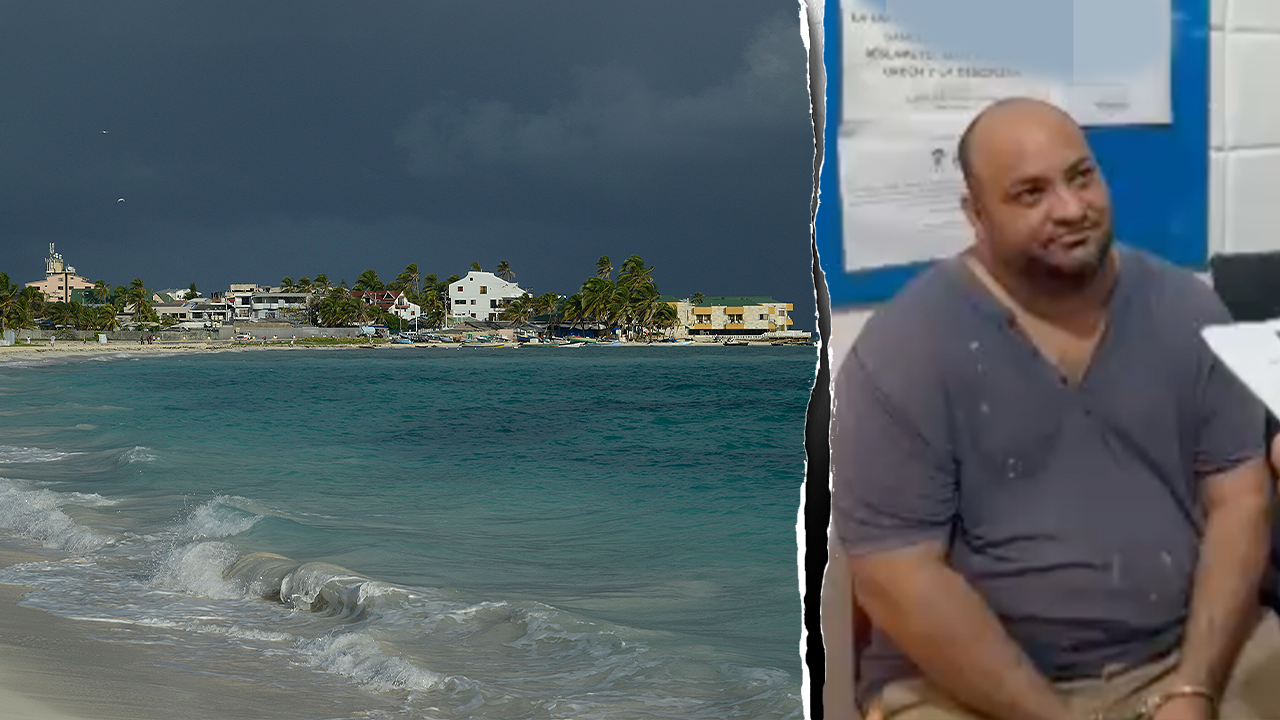
In a federal courtroom in El Paso, Texas, a man’s quiet admission of guilt has pulled back the curtain on one of the most haunting tragedies along the migrant trail—a journey that ended not with a new beginning, but with silence. Luis Enrique Linero Pinto, a 41-year-old Colombian smuggler known on the streets as “El Calvo,” pleaded guilty to conspiracy to commit alien smuggling and placing lives in jeopardy, becoming the first legal crack in a case that still haunts federal prosecutors. The plea stems from a voyage that set out from Colombia’s San Andrés Island on October 21, 2023, carrying roughly 40 migrants and two boat captains, bound for Nicaragua. That boat never arrived. No distress call was ever heard. No bodies were ever recovered. And after more than a year, no one aboard has been seen or heard from again. Assistant Attorney General Tysen Duva, who leads the Justice Department’s Criminal Division, described the case as “a particularly sad and disturbing situation.” In an interview with Fox News Digital, Duva laid bare the grim reality: “These 40 individuals and the two boat captains, once they set out from San Andrés Island to Nicaragua, were never heard from again. These individuals are, of course, missing and presumed dead, and it appears that there were no survivors.” For the families left behind, there is no grave to visit, no body to bury, no final goodbye—just the unbearable weight of unanswered questions on a route designed to be invisible.
The disappearance did not happen in a vacuum, and Linero Pinto’s guilty plea has revealed just how calculated and cold-blooded the operation truly was. According to the Justice Department, Linero Pinto was a key cog in a smuggling conspiracy that stretched from the Caribbean to the U.S. border, a network that relied on bribery, deception, and the willingness to treat human beings as disposable cargo. His role, prosecutors said, was multifaceted: he advised migrants on how to reach San Andrés Island, personally received them when they arrived, arranged their accommodations, and then transported them to waiting boats bound for Nicaragua. From there, the migrants planned to travel by land through Central America and Mexico before slipping illegally into the United States. But the danger started far before any border crossing. In fact, Linero Pinto also bribed members of the Colombian navy to get real-time intelligence about the positions of patrol vessels between San Andrés Island and Nicaragua. This allowed the smuggling boats to slip through gaps in enforcement, evading authorities while carrying scores of people in overloaded, barely seaworthy vessels. In the case of the vanished boat, Linero Pinto admitted he helped put those migrants aboard, knowing the risks and apparently not caring. Duva noted with a sense of sorrow that the victims didn’t even make it through the first leg of their journey. “That’s the first leg,” he said. “They didn’t even finish the first leg here and get to Nicaragua and then try to come north by land. It’s a really long journey, and it’s full of really bad things that can happen.”
And those “really bad things,” Duva warned, are not confined to open water. The ocean is only the beginning of a gauntlet that migrants are forced to run—one that stretches through treacherous jungles, across unforgiving mountains, and into the hands of smugglers who view them not as people, but as profit margins. Duva painted a chilling picture of what awaits those who manage to survive the sea: migrants can face brutal terrain while traveling through South and Central America, and even if they reach the U.S.-Mexico border, the nightmare often changes shape rather than ending. “You pay money to come to the United States, and then when you get here, the co-conspirators or those involved in the criminal enterprise will say, ‘But now you owe more, and you’re going to work this off in the sex trade,’” Duva said. This, he explained, is the dark alchemy of cross-border crime: what starts as smuggling often transforms into human trafficking once the debt becomes a weapon. “Cross-border smuggling cases often times just morph right into human trafficking cases,” Duva continued. “The crime sort of changes along the way. The travelers are the ones victimized, and this comes at a significant cost in terms of public safety.” In other words, the migrants who board those boats are not just risking drowning; they are gambling with their entire futures, often unknowingly, on criminal networks that are perfectly willing to sell them into sexual exploitation, forced labor, or worse. The vanished boat, with its 42 souls, is not an anomaly. It is a tragic symbol of a system that preys on human desperation, converting hope into hard cash and leaving only heartbreak in its wake.
For Linero Pinto, the legal consequences are now beginning to catch up, though no sentence can bring back the missing or heal the families who wait in vain. He was charged in October 2024 and arrested in Colombia that December at the request of the U.S. government, later extradited to stand trial in America. He made his first appearance in federal court in El Paso in December 2025, and his guilty plea to conspiracy to commit alien smuggling and placing lives in jeopardy carries a maximum sentence of 20 years in federal prison. A sentencing date has not yet been set, but the case against him is far from over. Duva noted that a case against alleged co-conspirator Hernando Manuel de la Cruz Rivera Orjuela remains pending, indicating that prosecutors are not satisfied with just one conviction. They are digging deeper, following the money and the connections that allowed such a deadly operation to exist. Linero Pinto’s plea is part of a much broader, more aggressive federal crackdown known as Operation Take Back America, coordinated by Joint Task Force Alpha—a Justice Department-led initiative targeting cartels and transnational criminal organizations involved in human smuggling and trafficking. Duva praised President Donald Trump and his administration for putting a “tremendous focus” on the initiative and for providing the Justice Department with the resources needed to pursue these cases across the globe. “We’re super thankful to President Trump,” Duva said. “We’re deeply thankful to the White House for that. We’re thankful to Congress for that, and we’re going to keep doing what we’re doing.”
That gratitude, Duva explained, is not just political rhetoric—it has translated directly into manpower and muscle. The funding approved through Trump’s signature “One Big Beautiful Bill” allowed the Criminal Division to hire additional prosecutors and place experienced attorneys in the sections handling the administration’s top priorities. “People think, ‘Well, what is that? What did it do?’” Duva said. “We’re feeling the effects of that. We’re able to put skilled prosecutors in these different sections to attack these administration priorities.” The task force is now hunting criminal networks along the southern border, maritime routes near Florida, and the northern border with Canada, with Duva insisting, “We are focusing on these cases at any border that we have.” His warning to smugglers operating beyond America’s shores was blunt and unyielding: “Our reach is substantial. We are going to chase these cases no matter where they originate from or where we find them.” This global pursuit is built on expanded international partnerships, which Duva described as critical because the criminals behind these operations often believe that distance will insulate them from justice. “They just think, ‘Well, they catch other people, but they’re not going to get me,’” he said. “You really try to combat that one case at a time.” And the numbers suggest that strategy is working. Joint Task Force Alpha has already produced more than 483 domestic and international arrests, over 436 U.S. convictions, and more than 371 significant prison sentences, according to the Justice Department—each one representing a dismantled network, a disrupted route, and potentially lives saved.
Yet for all the statistics and legal victories, Duva remains grounded in the human cost that drives the mission. He insisted that the fight against smuggling cartels should never be a partisan issue, because the networks threatening migrants also threaten American communities. “It shouldn’t be partisan,” he said. “It should be obvious that anybody who’s in the White House, anybody who is in Congress, should be lauding these cases and the work that’s being done by Criminal Division entities like Joint Task Force Alpha.” The ultimate goal, Duva said, is the “total elimination” of cartels and the criminal organizations profiting from human suffering, a goal he acknowledged can only be achieved incrementally. “You do it one case at a time,” he said. “We are focused on doing the very best cases that we can for the American people. That’s what we get up every day and think about.” But even as he spoke of institutional victories, the vanished boat remained a powerful, haunting reminder of why this work matters so deeply. “I don’t know that I’ve ever heard of anybody who survives that one after several months and a year,” Duva said of the missing vessel. “It’s super tragic, and hopefully people realize when they hear about this case just how dangerous it is and how important it is that you target these smuggling groups.” In the end, Linero Pinto’s guilty plea is more than a legal formality—it is a small measure of accountability in a case defined by absence. But for the families of the 42 people who vanished into the Caribbean, no conviction will ever be enough. Their loved ones did not simply die; they disappeared into a criminal enterprise that traded their dreams for dollars, and their fate now stands as a grim warning to anyone willing to board a smuggler’s boat in search of a better life. The ocean took them, but the system that put them there is the one now on trial.