


Tragedy in LaSalle: How a Community Celebration Ended in Inflatable Castle Disaster
A Sunday Devotion Shattered by a Sudden Gale
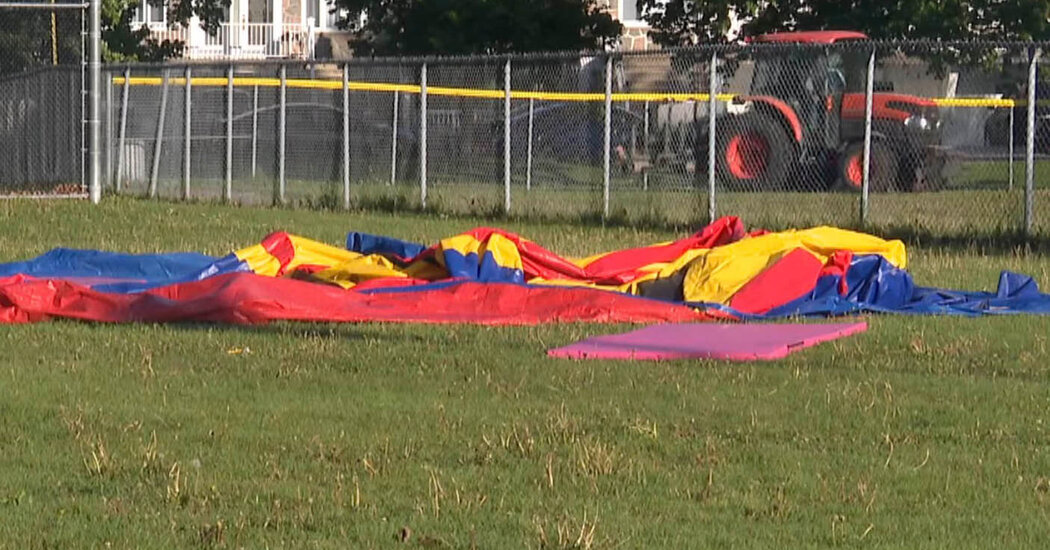
What was supposed to be a warm, joyful afternoon of community fellowship and spiritual reflection in southwest Montreal transformed in a matter of seconds into an unimaginable scene of panic, confusion, and profound tragedy. On a Sunday afternoon in the tight-knit borough of LaSalle, families had gathered in a local park near the Madre Dei Cristiani church to celebrate the Feast of the Visitation of the Blessed Virgin Mary—commonly cherished by the local congregation as the Feast of the Madonna. Under a shifting sky of heavy grey clouds and light, scattered rain, children laughed and played inside a large, colorful bouncy castle, their parents chatting nearby in the warmth of community solidarity. But at approximately 4:29 p.m., the atmospheric peace was violently shattered when sudden, severe wind gusts tore through the park, immediately over-toppling heavy event tents and lifting the massive inflatable play structure high into the air with children still trapped inside. Panicked onlookers and desperate parents watched in horror as the structure was lofted and violently tossed across the grass, prompting a flurry of frantic 911 calls to the local emergency services, Urgences-santé. Within six minutes, paramedics and emergency rescue crews arrived at the chaotic scene to find debris scattered across the park, eleven people injured—including seven adults and four children—and a community instantly paralyzed by shock. Ultimately, six victims required immediate transport to nearby hospitals, where medical staff desperately worked to treat their injuries; tragically, a three-year-old girl who had been inside the airborne structure sustained fatal trauma and later succumbed to her injuries, leaving an entire city to grapple with a devastating loss.
+————————————————————-+
| LASALLE TRAGEDY: KEY DATA POINTS |
+————————————————————-+
| Date of Incident | Sunday Afternoon |
| Exact Time of Call | 4:29 p.m. |
| Emergency Response | Paramedics arrived at 4:35 p.m. |
| Wind Speed Peak | Approx. 42 mph (68 km/h) |
| Total Casualties | 11 individuals injured |
| Adult Injuries | 7 adults |
| Child Injuries | 4 children |
| Hospitalizations | 6 individuals (including 2 children)|
| Fatalities | 1 child (3-year-old girl) |
+————————————————————-+
The Anatomy of a Storm: Meteorology and the Critical Warning Window
The suddenness of the gale that struck LaSalle highlights the volatile nature of summer weather systems in Quebec, where tranquil afternoons can rapidly evolve into dangerous meteorological events. According to Simon Legault, a government meteorologist with Environment Canada, the localized wind gusts responsible for the disaster reached packing speeds of roughly 42 miles per hour (approximately 68 kilometers per hour)—a velocity more than capable of transforming lightweight, high-surface-area structures like tents and inflatables into dangerous, wind-driven hazards. Earlier that Sunday, Environment Canada had raised concerns about shifting atmospheric conditions, officially transmitting a severe thunderstorm watch for the greater Montreal region at noon. This watch alert indicated that conditions were favorable for the development of dangerous storms characterized by damaging wind gusts, torrential downpours, and frequent lightning. As the storm cell converged directly over the southwest of Montreal, the meteorological agency upgraded its alert to a formal severe weather warning for the LaSalle area, dispatching the notification roughly thirty minutes before the destructive winds actually made landfall in the park. Despite these warnings, the rapid onset of the localized wind shear left event organizers with very little time to evacuate the towering inflatable castle, demonstrating how quickly environmental conditions can outpace emergency preparedness during highly localized weather events.
A Fractured Community Mourns its Most Vulnerable
In the aftermath of the disaster, a heavy blanket of grief settled over the LaSalle borough, an area known for its strong community ties, rich cultural heritage, and multi-generational families. The tragedy has cast a long, somber shadow over the Madre Dei Cristiani parish, converting what should have been an annual milestone of spiritual joy into a historical marker of collective mourning. Steve Mac Duff, an operations chief with Urgences-santé, recounted the frantic atmosphere confronting first responders as they triaged injured children and adults amidst a scene of scattered personal belongings, collapsed structures, and emotional trauma. LaSalle Borough Mayor Nancy Blanchet gave voice to this widespread, shared pain in a heartfelt public statement posted to social media, noting that in LaSalle, residents are bound together by an intimate, neighborly closeness where everyone knows each other, either directly or through shared community life. Mayor Blanchet extended her deepest condolences to the grieving family, asserting that during such staggering trials, the entire community stands united to share in their monumental grief and support one another through the long recovery ahead. This profound sense of loss has also prompted spontaneous memorials near the park, as neighbors lay flowers, candles, and stuffed animals to honor the young life cut short and to offer a silent prayer of comfort to the recovering survivors.
   [Atmospheric Storm Watch Issued (12:00 PM)]
                        |
                        v
 [Severe Weather Warning Broadcasted (approx. 4:00 PM)]
                        |
                        v
   [Sudden 42 mph Wind Gusts Impact Park (4:29 PM)]
                        |
                        v
[Inflatable Castle Lofted; Emergency Calls Placed (4:29 PM)]
|
v
[First Responders Arrive On Scene (4:35 PM)]
Under the Microscope: The Quebec Coroner’s Quest for Answers
As LaSalle begins the agonizingly slow process of emotional healing, provincial authorities have officially initiated a rigorous investigation to determine the exact circumstances and systemic failures that contributed to this tragic loss of life. Jake Lamotta Granato, a spokesperson for the Quebec coroner’s office, confirmed on Tuesday that a formal investigation has been launched under the direction of provincial coroner Martine Lachance. Unlike standard criminal proceedings, the primary objective of a Quebec coroner’s investigation is not to assign legal blame or civil liability, but rather to reconstruct the timeline of events, isolate the physical and systemic causes of the incident, and formulate binding recommendations to shield the public from future tragedies. Lachance’s investigation is expected to meticulously analyze several key elements: the securement and anchoring methods utilized for the inflatable structure, whether the manufacturer’s maximum safe wind tolerances were exceeded, the presence of operational supervision during the storm warnings, and the clarity and accessibility of the municipal permits granted for the church gathering. This comprehensive review aims to address growing concerns regarding whether current municipal bylaws and provincial safety standards are robust enough to govern the use of commercial party rentals in public spaces under volatile weather forecast conditions.
A Persistent Global Hazard: The Dangerous Physics of Airborne Inflatables
The tragic incident in LaSalle is far from an isolated anomaly; instead, it represents a recurring, internationally documented threat that highlights the volatile physics inherent to inflatable play structures. Inflatables possess a unique combination of exceptional surface area, massive interior volume, and comparatively lightweight construction, which essentially causes them to behave like giant sails during sudden high-wind events. When wind gusts sweep underneath a bounce house, they generate quick aerodynamic lift that can easily overcome standard anchor pegs, lifting structures weighing several hundred pounds into the air with terrifying ease. In the United States alone, the year 2024 has witnessed similar tragedies, including a heartbreaking incident in Maryland where strong wind gusts lofted a bounce house 15 to 20 feet into the air, claiming the life of a five-year-old boy. Only months before, a two-year-old child in Arizona lost their life under nearly identical circumstances when a sudden dust storm tore an inflatable clean off its anchorings. These recurring tragedies, alongside past international disasters such as the 2021 Hillcrest Primary School tragedy in Australia, underscore a global regulatory blind spot, demonstrating that despite the ubiquitous presence of these toys at backyard parties and church bazaars, their operation remains dangerously vulnerable to unpredictable weather shifts.
+————————————————————————-+
| NOTABLE AIRBORNE INFLATABLE TRAGEDIES |
+———————+———————–+—————————+
| Location | Year of Incident | Victim Demographics |
+———————+———————–+—————————+
| Montreal, Canada | Current Year | 3-year-old girl deceased |
| Maryland, USA | 2024 | 5-year-old boy deceased |
| Arizona, USA | 2024 | 2-year-old child deceased |
| Devonport, Australia| 2021 | 6 school children deceased|
+———————+———————–+—————————+
Beyond the Grief: Implementing Strict Safeguards for a Safer Tomorrow
Moving forward, the primary challenge facing lawmakers, municipal authorities, and community leaders is translating the profound grief of the LaSalle tragedy into concrete, actionable public safety reforms. Safety advocates are increasingly demanding that municipalities implement mandatory weather-monitoring protocols for any public or commercial event featuring inflatable play equipment, including the compulsory use of handheld anemometers to measure wind speeds in real-time. Furthermore, many suggest that rental companies should be legally required to provide certified, professional installation and safety-trained operators who possess the authority to shut down and deflate structures the moment wind speeds approach a predefined safe limit, usually capped around 15 to 20 miles per hour depending on manufacturer specifications. Public education campaigns must also be expanded so that parents and community organizers fully appreciate that these inflatables are sensitive, engineered structures requiring rigorous mechanical anchoring, rather than mere backyard toys. By establishing clear standards for structural ballast weight, enforcing strict weather-related eviction limits, and requiring professional inspections for public events, communities can hope to preserve the innocent joy of childhood play while ensuring that no family ever has to endure the heartbreaking loss of a child to a preventable gust of wind.