






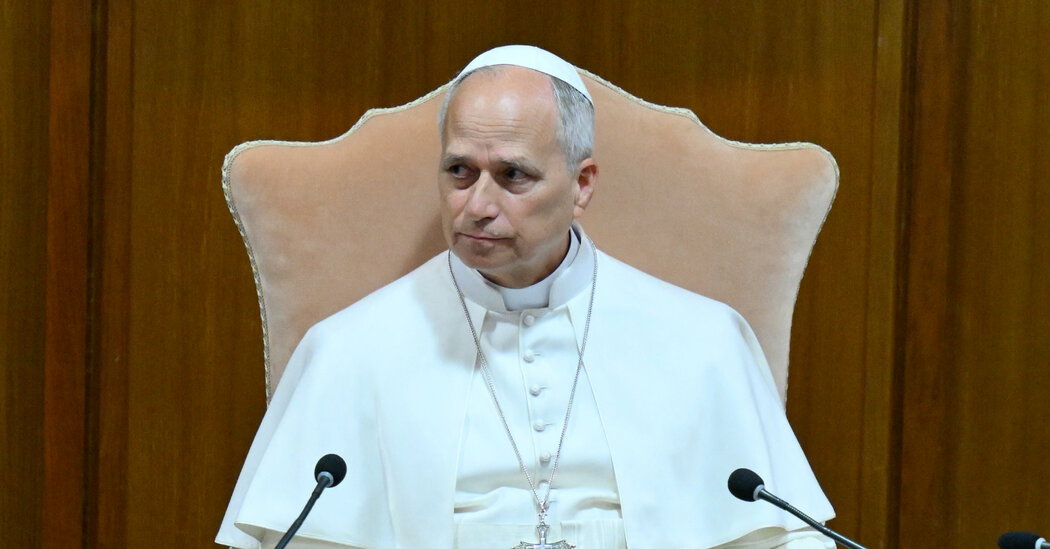
Although popes historically governed from the gilded distance of the Vatican, Pope Leo XIV—the first pontiff from the United States—consistently steps onto the active battlegrounds of contemporary global struggle. As a vocal, empathetic critic of immigration crackdowns and escalating military conflicts, Leo has frequently clashed with the political establishments of his homeland. Now, he has expanded this ambitious moral agenda to confront a different breed of power broker: the extraordinarily wealthy leaders of Silicon Valley. With the publication of his highly anticipated new encyclical, “Magnifica Humanitas,” or “Magnificent Humanity,” Leo has produced the defining theological statement of his young papacy and what is undeniably the most significant, deep-reaching moral critique of artificial intelligence ever articulated by a major global religious leader. This historic document is far more than a standard pastoral letter; it represents a deliberate, highly strategic effort to inject deeply rooted, human-centered Catholic ethical frameworks into a notoriously secular, heavily American-dominated technological landscape that is currently reinventing the daily structures of human life at an unprecedented, dizzying speed. At its heart, the document addresses our existential anxieties, challenging us to look past the seductive simplicity of automation and confront the urgent questions of our collective path forward. Pope Leo passionately argues that we can no longer afford to ignore where these massive systems are taking us or who is operating the steering wheel of this transformation. In a striking speech delivered at the Vatican, he called on the global community to “disarm” artificial intelligence, drawing an explicit, dramatic parallel to the Catholic Church’s long-standing advocacy for global nuclear non-proliferation. By demanding that artificial intelligence be freed from the cold, purely commercial logics of dominance, social isolation, and automated violence, Leo brilliantly frames this rapid technological frontier not merely as a matter of software optimization, but as an ultimate battleground for the survival of human dignity and soul.
The physical setting of this message’s debut was just as telling as the words themselves, unfolding in the Vatican’s synod hall with the sleek packaging of a major corporate product launch. Beneath bright yellow banners and a high-energy video co-produced with EWTN, the Vatican proved it could match ancient liturgy with the marketing language of modern-day California. Yet, the most remarkable, boundary-pushing visual dynamic of the afternoon lay in the seating arrangements on the main stage, where seated just steps away from the Pope himself was Christopher Olah, a high-powered, pioneering figure in the artificial intelligence sector and a co-founder of Anthropic. Introducing a high-level technological executive into a solemn Vatican announcement was an extraordinary departure from protocol, signaling Leo’s commitment to radical dialogue. Rather than launching a distant condemnation of the technology industry, the Pope chose to invite one of its chief architects into the sacred space, modeling an approach coupling ethical demands with a hospitable, collaborative posture. According to Cardinal Blase Cupich of Chicago, who attended the presentation close to the stage, this open, generous stance is the essential diagnostic bridge required to translate the Church’s two-thousand-year-old moral repository and rich philosophical tradition into practical, lived boundaries for modern software development. This deliberate encounter emphasized a crucial reality of the modern era that the Pope is quick to recognize: today, user data and the true arbiters of human destiny are often not traditional sovereign nation-states or democratically elected leaders, but a small handful of private economic and technological actors. By addressing Mr. Olah directly with a level of profound diplomatic reverence typically reserved exclusively for visiting heads of state, Pope Leo initiated a mutual, high-stakes commitment to walk together through this digital landscape, treating high-tech corporate leaders not as cold, cartoonish adversaries operating in isolation, but as vital partners and moral beings who must remain held consistently accountable to the collective security of the global human family.
This bold, historic venture is informed by the Church’s long memory, which stretches back centuries to witness how radical technological leaps rupture the existing global order. Vatican historians know the fifteenth-century printing press did not merely accelerate literacy; it fundamentally destabilized religious authority, fueled the Protestant Reformation, sparked destructive sociopolitical conflicts, and paved the way for modern nation-states, forever altering Rome’s singular political dominance. Recognizing that artificial intelligence represents an epochal shift of even greater magnitude, the Vatican has spent the better part of the last decade quietly laying the groundwork for this moral intervention. Under Pope Francis, this institutional effort manifested in the regularly convened “Minerva Dialogues,” which originally brought tech executives and theologians to the same table, and eventually culminated in Francis’s historic address to the G7 summit in 2024, where he passionately pleaded for international regulations and a comprehensive ban on terrifying, lethal autonomous weapons systems. Pope Leo’s “Magnifica Humanitas” represents the absolute culmination of this sustained diplomatic and theological effort, transforming fragmented conversations into a cohesive, universal moral encyclical. Leo asserts that in these historic moments of profound cultural disruption, the Church is uniquely mandated to decipher these “new things” through the lens of human dignity and the timeless wisdom of the Gospels. The urgency of this moral appraisal has skyrocketed in recent years as artificial intelligence is increasingly militarized in bloody global conflicts and deployed in ways that directly impact the cognitive and psychological development of innocent children. With companies like Anthropic on the verge of becoming trillion-dollar monoliths, Pope Leo explicitly warns of a dangerous, dystopian reality where unimaginable power becomes concentrated in the hands of an elite, unaccountable few, operating in opaque corporate boardrooms completely isolated from public oversight, ultimately giving rise to severe digital dependencies, systemic exclusion, and devastating new forms of global inequality across the landscape of our interconnected world.
This concentration of massive corporate and technological power has nurtured a pervasive, quiet, and deeply troubling cultural narrative in Silicon Valley—an elitist worldview that Pope Leo’s encyclical seeks to directly confront and dismantle in the public square. In the sleek corridors of northern California’s Silicon Valley, developers frequently operate under the assumption that the future of human civilization rests in the hands of a microscopic minority: a few hundred elite engineers building frontier models and a tiny circle of powerful politicians regulating them. Meghan Sullivan, the distinguished director of the Institute for Ethics and the Common Good at Notre Dame, notes that the tech elite often treat the vast majority of the global population as passive, secondary consumers of their grand experiments. “Magnifica Humanitas” stands as a monumental and uncompromising philosophical rebuttal to this dismissive, technocratic philosophy, reasserting the foundational Christian doctrine that every single human life possesses equal, infinite worth. By raising his voice on this global stage, the Pope is insisting that the millions of everyday citizens living in places like Wichita, Kansas; South Bend, Indiana; Nairobi, Kenya; and Manila, Philippines are not some distant, unimportant bit players, data points, or collateral damage in someone else’s profitable technological revolution. Instead, they are the main protagonists and essential moral centers of human history, whose livelihoods, family structures, psychological safety, and spiritual well-being must be actively protected from the highly disruptive, unpredictable whims of algorithmic automation. For vulnerable communities that often feel entirely powerless and marginalized in the face of runaway technological advancement, the Roman Catholic Church offers a formidable, highly organized global institution with the structural weight, historical authority, and moral platform necessary to stand up to the unchecked ambitions of trillion-dollar tech corporations, demanding that humanity’s collective future be designed to serve the common good of all. By shifting the theological spotlight onto these ordinary everyday struggles, the Pope is re-anchoring the technological conversation in the lived reality of human suffering and hope.
To effectively carry out this moral mission, the encyclical adopts a remarkably American tone and cultural vocabulary, reflecting Pope Leo’s deep personal roots and highlighting the crucial role that American institutions must play in this global ethical awakening. In an unprecedented move for a papal document, Leo explicitly calls out the United States Conference of Catholic Bishops—the only national bishops’ conference mentioned by name—specifically urging them to address the rising tides of job insecurity, anxiety, and socioeconomic displacement currently confronting young workers in an increasingly automated economy. Furthermore, in a creative gesture that resonates strongly with contemporary popular culture, the Pope quotes from J.R.R. Tolkien’s beloved fantasy epic, The Return of the King—a novel deeply cherished by many in America, particularly young men—drawing on literary themes of ancestral duty, moral courage, and the stubborn resistance against overwhelming, centralizing power to capture the imagination of a younger generation of tech-literate believers who are searching for meaning in a fragmented world. This strategic cultural integration is matched by a groundswell of intellectual mobilization within the vibrant ecosystem of American Catholic higher education. Respected academic institutions such as Georgetown University and Santa Clara University have already stepped into the breach, hosting critical public symposiums, interdisciplinary studies, and community-driven initiatives designed to study the intersection of artificial intelligence, social justice, and religious ethics. This academic crusade received a monumental boost when the University of Notre Dame was awarded a sweeping fifty-million-dollar grant from the Lilly Endowment, specifically designated to fund the development of faith-based ethical frameworks for artificial intelligence through its specialized research institutes. By nurturing these robust academic ecosystems, the Church is attempting to translate Pope Leo’s lofty theological declarations into highly practical, field-tested guidelines that can actually influence the behaviors of computer scientists, corporate policy directors, and government regulators who are currently writing the algorithms of tomorrow.
While the release of “Magnifica Humanitas” has undoubtedly sent ripples through religious and technological circles, the true measure of its success lies in its ability to break through the widespread public apathy and sense of resignation that characterizes our contemporary day-to-day relationship with modern technology. Too often, the prevailing narrative pushed by tech conglomerates is one of absolute inevitability—the disempowering idea that human beings have no choice but to passively accept and incorporate pervasive, demanding artificial intelligence into every layer of our personal and professional lives. Ron Ivey, writer and research fellow with Harvard’s human flourishing program, warns that we have largely abandoned the democratic traditions of public consultation, noting that societies like the United States once held monumental constitutional conventions to navigate major historical disruptions. He argues that rather than quietly surrendering to a pre-packaged digital future, we must aggressively reclaim our shared agency, revitalizing our local libraries, civic centers, and community organizations to engage in deep, democratic debates about the ultimate purpose of these technological tools. We must have the courage to ask why we are building this thing, who it is truly for, and how we can successfully steer these platforms to support authentic, multi-dimensional human flourishing rather than systemic alienation. Ultimately, Pope Leo XIV’s intervention is not merely a critique of technological tools, but a profound defense of the human spirit, reminding a distracted world that we are not helpless observers of our own creations. By bridging the ancient moral authority of the Church with the urgent questions of the Silicon Valley elite, “Magnifica Humanitas” challenges all of us to stand up and demand a future where technological progress is forever bound to the preservation of our shared humanity.