


The summer heat of Washington, D.C., has always possessed a heavy, almost physical weight, but this season, the air surrounding the National Mall carries a distinct tang of chemicals, damp earth, and frustration. Stretching majestically between the towering obelisk of the Washington Monument and the grand, neoclassical temple of the Lincoln Memorial, the historic Reflecting Pool has long served as a quiet sanctuary for national contemplation. Yet, those who gather at its edge today are not greeted by the serene, mirrored surface that has graced millions of family albums, historic broadcasts, and cinematic memories. Instead, they are witnessing a bizarre, highly public struggle between nature and a rushed, politically charged cosmetic makeover. The pool’s century-old concrete basin, recently subjected to an aggressive paint and seal job, seems to be actively rejecting its new coating. What was promised as a brilliant, patriotic transformation has rapidly deteriorated into a patchy, chaotic canvas; large sheets of synthetic “American flag blue” paint are peeling away from the floor, floating like discarded plastic wraps atop a murky, thick soup of “acid green” algae. The resulting landscape is a visual disaster of pea-green waters and bright blue debris, leaving both tourists and locals to wonder how a symbol of national pride could become so thoroughly entangled in bureaucratic haste and ecological rebellion.
This current crisis is the direct result of a highly publicized, top-down initiative driven by President Donald Trump’s administration, which demanded a rapid aesthetic overhaul of the basin to coincide with celebrations marking the nation’s 250th anniversary. Eager to present a picture-perfect image of national renewal, the administration circumvented traditional, highly regulated federal bidding processes designed to ensure structural competence and financial transparency. Instead, the Department of the Interior awarded a lucrative, no-bid contract to a firm closely connected to a longtime supporter of the President—a company whose primary qualifications, as proudly noted by Trump himself, included maintaining swimming pools at one of his private golf clubs. This shortcut avoided the meticulous, long-term engineering analyses typically required for preserving century-old monument infrastructure. As the rushed paint job dried under the intense mid-Atlantic humidity, the superficial nature of the fix quickly became apparent. In a desperate attempt to control the public narrative, federal officials took to social media to showcase heavily edited, pristine images of the monument reflected in seemingly deep blue, crystal-clear water, claiming the algae had been successfully eradicated. However, these digital triumphs stood in stark contrast to the physical reality on the ground, where the underlying, unaddressed plumbing failures of the basin continued to fuel a rapidly worsening ecological and structural breakdown.
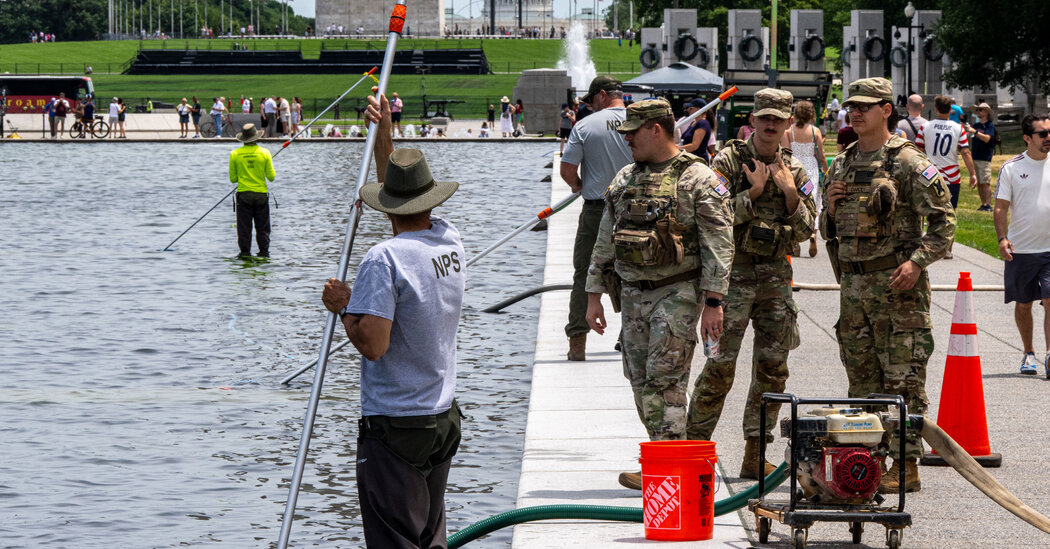
The human cost of this administrative failure is felt most acutely by those forced to occupy the front lines of the cleanup effort. On any given afternoon, a small, weary contingent of National Park Service employees can be seen wading knee-deep into the tepid, chemical-scented green water, armed only with manual scrubbers and plastic nets. Among the onlookers watching this Sisyphean task was Alex Hobe, a fifty-two-year-old local food delivery courier who had paused his daily route to witness the aftermath of the widely discussed renovations. Standing at the water’s edge, Hobe bent down to retrieve a floating fragment of the pool’s new floor—a rough, semi-transparent chip of blue coating that felt brittle and inorganic between his fingers. Holding the fragment up to the light, Hobe characterized the entire renovation project as an absolute, systemic failure, yet his criticism was immediately tempered by a deep sense of empathy for the laborers working under the blistering sun. He noted that these workers had been out in the water for days on end, engaged in a punishing, seemingly hopeless battle to scrape away the relentless green blooms. This stark disparity between the luxury of executive decision-making and the grueling, manual reality of working-class labor highlights the human friction at the heart of this national embarrassment.
Faced with mounting public criticism and visual evidence of a botched job, President Trump took to social media to offer his own explanation, deflecting blame from the questionable contractor and the rushed timeline toward a familiar target. In a late-night post, he asserted that the unsightly damage to the newly painted basin was not a failure of craftsmanship or materials, but rather a deliberate act of “vandalism” perpetrated by political adversaries seeking to demean and destroy his administration’s beautiful work. He assured his followers that the green algae was seventy-five percent gone, promising that the situation would soon be entirely resolved and that the allegedly vandalized portions of the basin would be repaired within days. Meanwhile, engineers and park management specialists pointed to a far more mundane and systemic explanation: the ancient pipes running beneath the pool are extensively damaged, frequently leaking and permanently disconnected from any functional, modern filtration system. Rather than investing the time and capital required to repair this subterranean infrastructure, the administration opted for temporary, cosmetic treatments. This week, that meant dumping massive quantities of liquid hydrogen peroxide directly into the historic basin—a crude chemical intervention intended to instantly bleach the organic matter, but one that has done little to stop the peeling paint or cure the stagnant water.
The physical atmosphere around the Lincoln Memorial has consequently transformed from a solemn place of reflection into something resembling a noisy, disorganized industrial shipyard. Visitors walking along the gravel pathways find themselves stepping over heavy, black rubber hoses that snake across the walkways, pumping warm, bright-green water out of the pool and discharging it into nearby storm drains. The historic silence of the Mall has been replaced by the deafening, continuous hum of diesel generators and fuel-guzzling water pumps working around the clock to circulate the dying water. For many of the tourists visiting Washington from across the country, this chaotic scene has become a primary point of interest, overshadowing the very monuments they traveled to see. Instead of gazing upward at the statue of Abraham Lincoln or contemplating the spot where Martin Luther King Jr. delivered his most famous address, crowds of onlookers gather at the stone parapets, pointing and whispering at the floating blue sheets of paint and the strange, chemically altered froth. Some find the spectacle confusing, while others find it symbolic of a larger, systemic dysfunction within the modern American political apparatus, where image-making is consistently prioritized over functional, honest public service.
Among those observing the chaotic scene was Trey Quealy, a twenty-nine-year-old supply chain logistics professional from West Virginia, who had come to the capital to attend a performance at the nearby Kennedy Center. Walking down to the water with a friend, Quealy admitted that curiosity had drawn him to the site after hearing widespread reports of the pool’s bizarre appearance. Given his professional background, he expressed a degree of understanding regarding the immense complexity of sourcing materials and finding qualified contractors for historical preservation projects of this scale, yet he remained deeply skeptical of the decision to grant a no-bid contract to a golf course swimming pool builder. Reflecting on his previous visits, Quealy recalled that the old, unpainted concrete basin had possessed its own quiet, historic dignity, invoking a sense of nostalgia that connected visitors to iconic moments in American cultural history, such as the famous, water-wading reunion scene in the film Forrest Gump. To him, the old pool felt authentic and perfectly integrated into the landscape, rendering the entire, highly partisan renovation project entirely unnecessary. Ultimately, the crumbling state of the Reflecting Pool serves as a vivid, poignant metaphor for the dangers of superficial governance—a stark reminder that when we prioritize quick, flashy aesthetic fixes over the invisible, foundational work of rebuilding our shared institutions, the paint will eventually peel away, exposing the decay beneath.