



Profiles in Avian Hope: How Two ‘Super Breeder’ Parakeets Saved Their Species From the Brink of Extinction
Amidst the tranquil, pristine expanses of New Zealand’s South Island, an extraordinary biological miracle has quietly unfolded, offering a powerful beacon of hope for global wildlife conservation. At the Isaac Conservation and Wildlife Trust in Christchurch, a single pair of critically endangered orange-fronted parakeets—scientifically classified as kākāriki karaka—has astonished international conservationists by producing an unprecedented 55 chicks over a mere two-year period, single-handedly expanding the entire global population of their species by more than ten percent. This remarkable reproductive triumph is centered around a parakeet couple affectionately named Trixie and Nacho, whose prolific partnership has rewritten the rules of captive breeding and provided an invaluable lifeline to New Zealand’s rarest parakeet. During the most recent breeding season, which spans the warm southern hemisphere months from December to April, the pair reached the peak of their productivity by successfully hatching an astonishing 33 chicks, a feat that far eclipses the output of other couples within the recovery program who typically rear between 10 and 15 offspring. To witness such a monumental surge in birth rates from a single pair is nothing short of revolutionary for wildlife managers, who have painstakingly monitored every fragile egg in a desperate bid to rescue these vibrant, emerald-feathered birds from slipping forever into the silent abyss of extinction.
Resurrected from the Shadows: The Turbulent History of New Zealand’s Rarest Parakeet
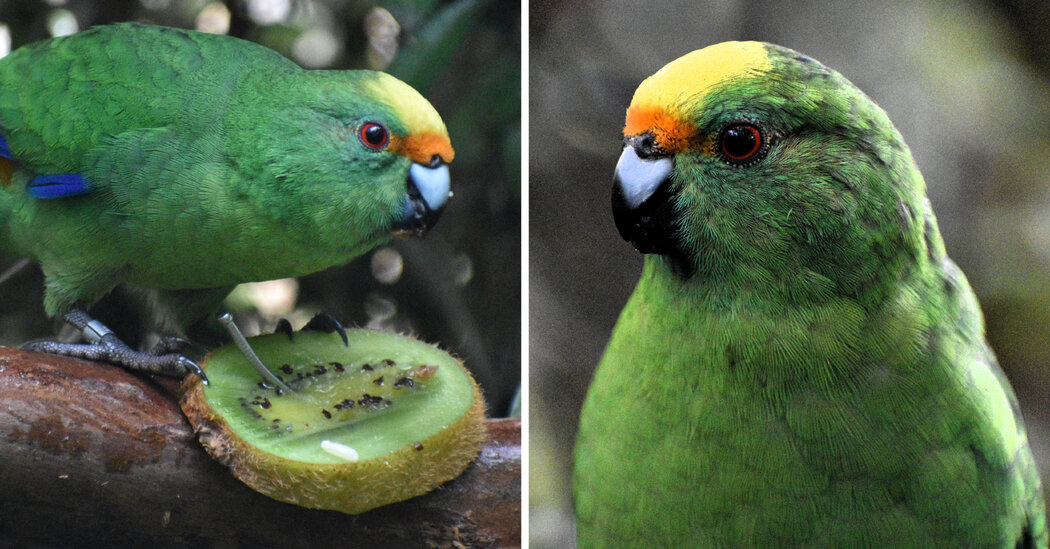
To understand the profound significance of Trixie and Nacho’s contribution, one must explore the turbulent history of the kākāriki karaka, a species that has repeatedly danced on the very edge of oblivion. Throughout the twentieth century, the orange-fronted parakeet was twice declared officially extinct—first in 1919 and again in 1965—only to defy the odds both times by transitioning from a biological phantom back into a living reality after tiny, remnant populations were extraordinarily rediscovered hiding deep within the remote, beech-forested mountain valleys of the South Island. Today, this beautiful parakeet, characterized by its striking bright orange forehead band and dazzling turquoise wing accents, remains the country’s most critically endangered parakeet, with fewer than 450 individuals estimated to exist across both managed captive breeding facilities and highly vulnerable wild habitats. Historically, these birds carpeted the forested regions of New Zealand, but the rapid onset of human colonization, coupled with the catastrophic introduction of aggressive mammalian predators, decimated their numbers, forcing them into a few isolated, high-altitude alpine valleys. By producing a massive influx of healthy genetic stock in such a concentrated timeframe, the historic breeding success of Trixie and Nacho has effectively insulated the species against immediate demographic collapse, offering conservationists a crucial window of opportunity to fortify the bird’s fragile wild populations before the window of survival closes permanently.
A Match Made in Christchurch: Why Natural Partner Selection is Revolutionizing Captive Breeding
The secret behind this unprecedented reproductive boom lies not in sterile laboratory intervention, but in the timeless, instinctive chemistry of natural selection and mutual attraction. Rather than arbitrarily forcing birds together based solely on genetic compatibility charts, the expert husbandry team at the Isaac Conservation and Wildlife Trust implemented a progressive pairing strategy where they placed several eligible, healthy birds together in a communal setting, allowing them to organically select their own mates. According to Leigh Percasky, the wildlife manager at the trust, this patient, hands-off approach fosters far stronger emotional bonds between the birds, ultimately translating into highly cooperative parenting dynamics, reduced stress levels, and vastly superior breeding success rates compared to traditional forced pairings. The resulting union between Trixie and Nacho revealed a highly synchronized, remarkably laid-back couple whose individual eccentricities complement one another perfectly: Nacho is famously characterized by the staff as an exceptionally curious, bold, and inquisitive bird with a keen interest in human keepers, while Trixie is noticeably larger and more robust than typical females of the species, a physical trait that has enabled the duo to consistently hatch and raise chicks that are significantly larger, stronger, and more resilient than average. This powerful synergy has enabled them to effortlessly manage the exhausting demands of incubating and rearing multiple successive clutches of eggs without showing signs of physical strain, proving that when animals are given the autonomy to choose their partners, nature find a way to optimize its own recovery.
A Shared Legacy: Indigenous Guardianship and the Fight for Forest Sanctuaries
The survival of the kākāriki karaka is not a isolated laboratory endeavor, but rather the beating heart of a deeply collaborative, nationwide conservation framework championed by New Zealand’s Department of Conservation (DOC) and Te Rūnanga o Ngāi Tahu, the principal Indigenous Māori tribe of the South Island. Rooted in the sacred indigenous principle of kaitiakitanga—the traditional practice of environmental guardianship and intergenerational stewardship—this vital partnership focuses on managing a comprehensive recovery program that monitors existing wild habitats, actively suppresses invasive predator numbers, and systematically identifies secure, predator-free islands and mainland sanctuaries to introduce new wild populations. Wayne Beggs, the dedicated lead of the Department of Conservation’s kākāriki karaka recovery program, has expressed profound gratitude for the immense biological boost provided by the birds bred at the Isaac Conservation and Wildlife Trust, highlighting that the ultimate reward of this arduous, round-the-clock labor is seeing captive-born chicks successfully taking flight in their ancestral forests. Currently, there are five established, carefully managed populations of the orange-fronted parakeet across the South Island, with conservation officials harboring ambitious plans to expand this ecological footprint to ten thriving wild colonies over the next two decades, using the robust, forest-ready offspring of Trixie and Nacho to seed these new wilderness frontiers.
The Vulnerable Eden: Navigating Predators, Habitat Loss, and the Climate Crisis in the South Island
To appreciate why the preservation of these parakeets requires such intensive human intervention, one must examine the unique, evolutionary isolation of New Zealand’s native bird species, which evolved over millions of years in a unique geographical ecosystem completely devoid of predatory land mammals. Today, New Zealand is home to approximately 206 breeding bird species, an astonishing 94 of which are endemic and found nowhere else on Earth, including iconic species like the flightless kiwi and the heavy, ground-dwelling kakapo—the world’s heaviest parrot. Because these birds evolved in an avian-dominated paradise where the only predators were birds of prey, many native species discarded the energy-intensive ability to fly, making them heartbreakingly defenseless when European settlers and early explorers introduced destructive mammals such as ferrets, stoats, weasels, and ship rats. For the arboreal yet ground-foraging kākāriki karaka, these invasive predators, alongside rapid habitat degradation from forestry, introduced avian diseases, and the intensifying unpredictability of climate-induced weather patterns, created a perfect ecological storm. In response, conservationists initiated the modern captive breeding program in 2003 by carefully harvesting wild eggs from threatened nests and placing them under foster birds to hatch, eventually developing the advanced, highly specialized aviary protocols that today allow super-breeders like Nacho and Trixie to replenish their species in a safe, predator-free environment.
Beyond the Aviary: The Ultimate Quest for Self-Sustaining Wild Populations
While the astounding reproductive contribution of Nacho and Trixie has injected a vital burst of genetic vitality and optimism into the recovery initiative, the ultimate, long-term success of New Zealand’s conservationists will not be measured by the number of birds kept in cages, but by the ability of these birds to reclaim their rightful place in the wild. The ultimate goal of the recovery program is to establish self-sustaining, naturally reproducing wild populations of the orange-fronted parakeet that no longer require the artificial support of captive breeding centers, intensive predator trapping networks, or human-mediated foster programs. Until that day comes, the dedicated animal care experts at the Isaac Conservation and Wildlife Trust are focused on the delicate, vital task of safeguarding the ongoing physical health and well-being of Nacho and Trixie, closely monitoring their nutritional intake, stress levels, and physical stamina to ensure that their intense parenting duties do not compromise their long-term health. As their strong, resilient offspring are gradually prepared for release into the ancient, silent beech forests of the South Island, Nacho and Trixie remain at the center of this historic wildlife campaign, their remarkable story serving as an inspiring testament to the power of natural partnership, indigenous collaboration, and the resilient, enduring spirit of the natural world.